
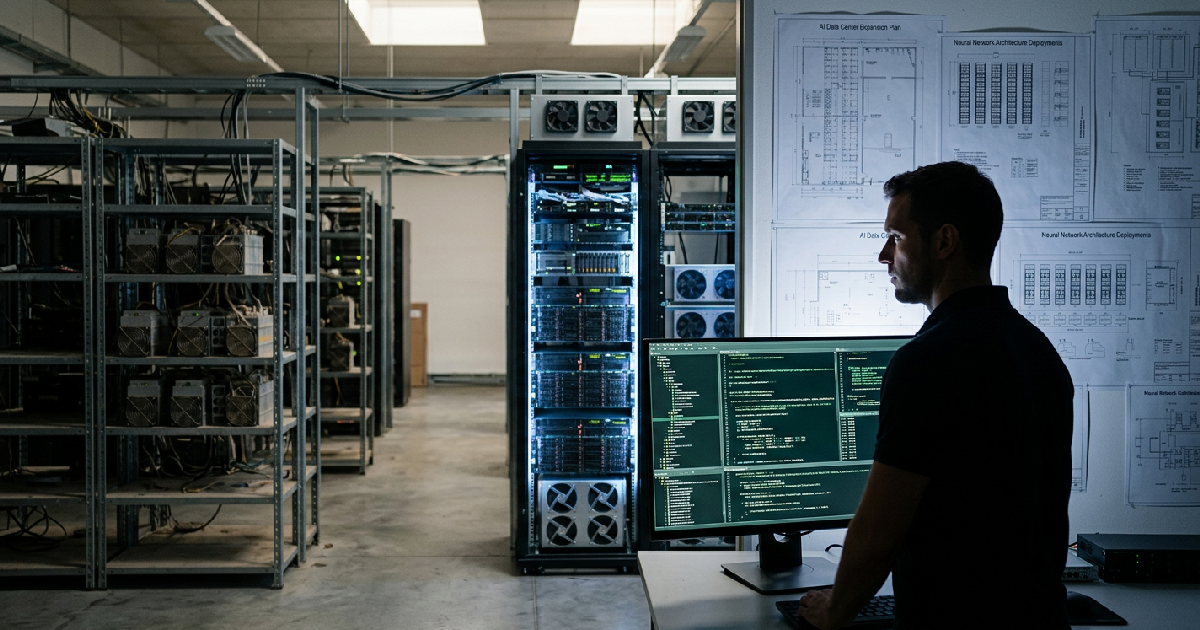

Bitcoin miners are grappling with a historic collapse in profitability following a 21% price crash that saw the digital asset plummet from $76,000 to $60,000 in a single day. The volatility, triggered in part by the January 31, 2026, release of the second batch of Epstein files, has pushed the Bitcoin hashprice to a record low of $28.90 per petahash per day (PH/day). This revenue compression is forcing major publicly traded firms like Core Scientific, Riot, and IREN to pivot their operations away from the network and toward the artificial intelligence (AI) sector.
The downturn has reached levels of economic stress not seen in over a decade. Data from the mining platform Hashrate Index confirms that current daily earnings for one petahash of computing power—roughly the output of five modern ASIC machines—amounts to less than $29. This measly payout has triggered six negative difficulty adjustments over a three-month period ending February 7, 2026. Such a sustained downward trend in mining difficulty has not occurred since 2011, when the network was in its infancy.
Mining difficulty serves as a self-correcting mechanism for the network: as participants leave, the remaining machines find it easier to secure blocks. However, the current exodus of hardware is being driven by more than just temporary market swings. The crypto market liquidation analysis suggests that broader macro headwinds are forcing companies to reconsider their long-term infrastructure investments as energy costs rise and block subsidies dwindle.
Public miners shift focus to AI and high-performance computing
In a major shift for the industry, the largest US-based public miners are decommissioning their ASIC fleets to make room for Graphics Processing Units (GPUs). This transition targets the booming Large Language Model (LLM) market, catering to platforms like ChatGPT and Claude. Companies including Cipher, CleanSpark, Hut 8, and TeraWulf are leading this charge, prioritizing the higher margins offered by data center services over the diminishing returns of proof-of-work mining.
Collectively, these publicly traded entities represent approximately 40% of the total network hashrate. For years, these firms utilized their access to equity markets to expand aggressively, often diluting shareholders to maintain operations even when mining independently was not profitable. By pivoting to AI, these “megaminers” are effectively withdrawing from the competitive hashing landscape, which could fundamentally change the network’s security profile.
Industry analysts view this as a necessary evolution rather than a terminal decline. As these massive corporations exit, they remove the artificial pressure on hashrate growth. This shift may offer a reprieve for smaller operators who have struggled to keep pace with the capital-heavy expansion of public firms. High-level Bitcoin price analysis indicates that while price volatility hurts current margins, the removal of “zombie” miners who rely on equity sales could eventually stabilize the mining ecosystem.
The vanishing block subsidy and the race for transaction fees
The long-term roadmap for Bitcoin presents a mathematical challenge for those who remain committed to the hardware. By the year 2036, the block subsidy is scheduled to drop to just 0.78125 BTC. To maintain the same nominal revenue that miners earned under the 3.125 BTC subsidy at current prices, the market value of the coin would need to reach at least $272,000. Without such a price appreciation, the industry must rely almost entirely on transaction fees to survive.
Currently, the “fee market” remains quiet. Despite high adoption rates, technical upgrades like SegWit and Taproot have made transactions significantly more data-efficient. Most users are now moving toward “Bitcoin banks”—exchanges, ETFs, and custodial services—which settle many trades off-chain. This efficiency, while good for users, leaves the primary mempool relatively empty, with many transactions confirming for less than 1 satoshi per virtual byte (sat/vbyte).
Temporary spikes in fee revenue, such as the 2024 craze for Ordinals and Inscriptions, have largely faded. While these “NFT-style” assets provided a temporary cushion for mining revenue, no permanent Layer 2 or secondary use case has yet filled the volume gap. Smaller miners must now find a unique operational edge, such as using stranded energy or heat recycling, to remain competitive as the subsidy trends toward zero.
A more decentralized mining future in 2036
The departure of public megaminers is being described by some insiders as a “whitepill” for the network’s decentralization. The exit of the largest US-based firms could mirror the “Great Hashrate Migration” of 2021 when China banned the industry. While that event caused a temporary drop in hashrate, it ultimately moved power away from a single geographic region. The current pivot to AI could similarly move power away from few large corporate boardrooms.
By 2036, the mining landscape is expected to be dominated by scrappy, nimble, and private operations. These miners will likely operate on the geographical and economic margins where they can access the cheapest possible power. This transition marks the end of the era of “mining for the sake of mining” and the beginning of a period where only the most energy-efficient and inventive operators can survive.
Even as traditional mining models face obsolescence, the underlying network continues to show resilience. While the bitcoin exchange supply remains at multi-year lows, suggesting long-term conviction from holders, the infrastructure supporting that supply is undergoing its most radical transformation since the first ASIC machines were introduced. The miners of 2036 will look very different from the industrial giants of today.