
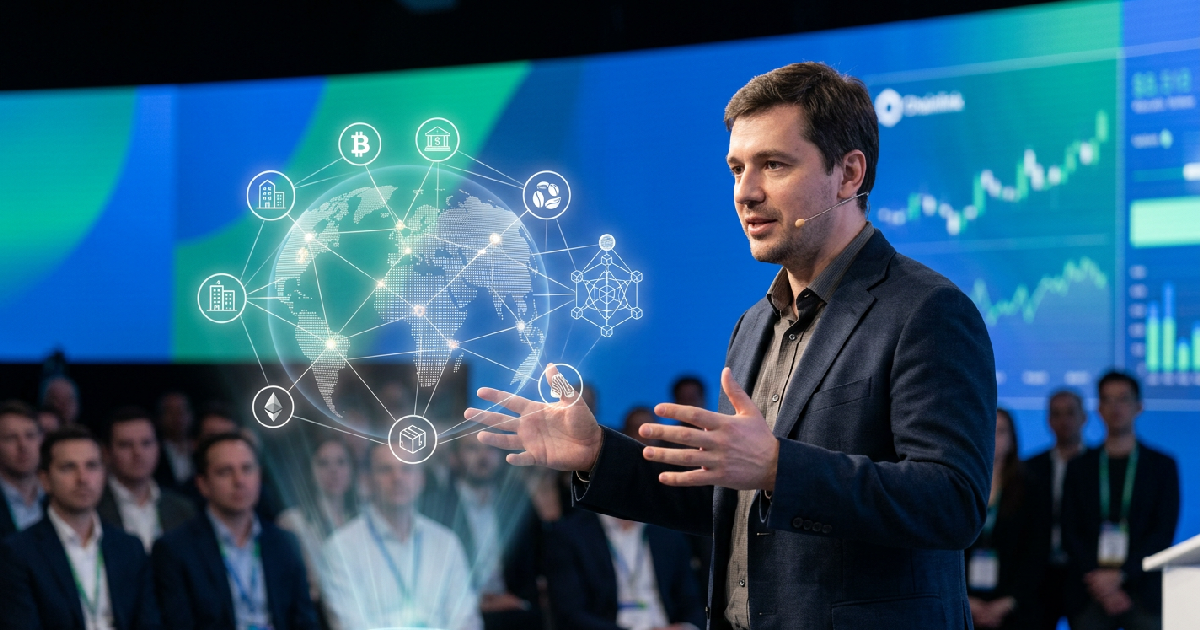

Chainlink Co-Founder Sergey Nazarov detailed three pivotal shifts defining the digital asset market on February 9, 2026, arguing that the industry has moved toward structural resilience and real-world utility. In a post on X, Sergey Nazarov highlighted market robustness, the steady adoption of real-world assets (RWAs), and the transition of infrastructure into a primary value driver as the pillars for the next era of crypto. His assessment suggests that the most meaningful developments are now occurring beneath the surface of daily trading swings.
The perspective offered by Sergey Nazarov marks a departure from the “boom and bust” narratives associated with previous cycles. He noted that recent periods have matured significantly, showing an absence of the large risk management failures or widespread systemic risks that characterized the 2022 FTX collapse. Instead, he sees a structural strengthening where blockchains act as foundational financial rails for the global economy. This shift is critical for long-term institutional participation.
This maturation coincides with a shifting appetite among global market participants. While Bitcoin price analysis often centers on resistance levels, Sergey Nazarov maintains that the true story is the industry’s newfound durability. This stability serves as a necessary prerequisite for the heavy capital influx expected as capital markets and central banks increasingly engage with on-chain systems.
Institutional resilience signals a maturing market structure
One of the most striking observations from Sergey Nazarov is the newfound robustness of the crypto ecosystem. He pointed out that cycles are a normal part of the industry, but what matters is what they reveal about progress. Unlike previous downturns, current market cycles have not triggered the cascading institutional failures that once threatened the entire sector. This indicates a higher standard of risk management within major firms and among protocols.
According to Sergey Nazarov, these cycles act as filters that reveal how far adoption has truly progressed. By avoiding systemic contagion, the market proves its readiness for more complex financial operations. This resilience is directly tied to the use of secure on-chain protocols that offer transparent collateral management, providing a level of clarity that traditional centralized systems often lack.
The industry’s ability to withstand pressure has also influenced how new market entrants are evaluated. For instance, the ApeMars presale gains momentum as investors look for projects with clear utility within this more resilient framework. This shift reflects a broader trend where participants prioritize infrastructure and long-term viability over purely speculative overnight gains.
Real-world assets migrate on-chain regardless of price
The second trend identified by Sergey Nazarov is the unstoppable migration of real-world assets (RWAs) to blockchain environments. This involves tokenizing traditional instruments like commodities, real estate, and treasury bills. Sergey Nazarov noted that “the adoption of RWAs is continuing independent of crypto market cycles” because features like 24/7 trading and global access offer efficiencies beyond speculative use cases.
Data from RWA.xyz supports this view, showing that the value of tokenized assets on-chain grew by 300% over the last 12 months. Sergey Nazarov previously predicted that RWAs could eventually surpass the total value of all native cryptocurrencies within one to three years. We are already seeing this growth through on-chain issuance and perpetual markets tied to traditional assets like silver.
Blockchains are evolving into the definitive record for global value. When assets live on-chain, they benefit from automated compliance and instant settlement. This evolution is particularly relevant as international regulations evolve. For example, as Russia lawmakers push to legalize various digital asset trades, it signals that even cautious jurisdictions recognize the utility of tokenization for cross-border transactions and asset management.
Growth of perpetual markets and commodity tokenization
Sergey Nazarov specifically highlighted the growth of perpetual markets for RWAs as a key indicator of successful adoption. By bringing traditional commodities into a decentralized environment, institutions can eliminate intermediaries while increasing liquidity. This was a central theme during his discussions at the White House Digital Asset Summit, where the role of blockchain in financial systems was a primary focus.
Infrastructure becomes the central value proposition
As the scale of on-chain activity grows, Sergey Nazarov believes infrastructure itself has become the primary product. He argues that the need for reliable data, cross-chain connectivity, and secure identity systems is now more critical than the specific tokens being traded. Without these components, the migration of trillions in capital remains impossible.
Chainlink has positioned itself at the center of this movement, providing data and orchestration for over 70% of the DeFi market. While the technical infrastructure enabled over $15 trillion in transaction value throughout its history, that figure was reported to have surpassed $18 trillion by January 2025. This massive volume is supported by collaborations with traditional financial giants like S&P and ICE.
The future lies in “orchestration” between existing systems and emerging blockchains. As the Cross-Chain Interoperability Protocol (CCIP) sees wider use for secure messaging and token transfers, the focus shifts toward foundational security. Sergey Nazarov suggests that as blockchains become the backbone of the global financial system, the platforms providing these secure connections will capture the most significant long-term value.