
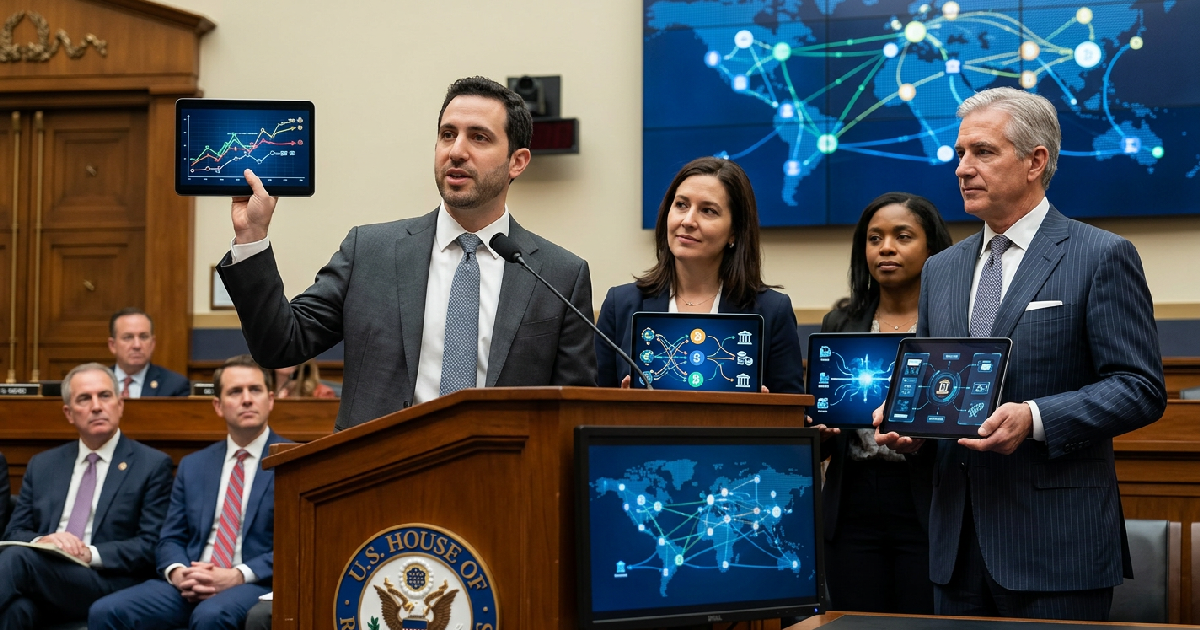

Crypto executives, banking leaders, and policy researchers called on the U.S. Congress on May 21, 2026, to modernize the Bank Secrecy Act (BSA) to combat AI-driven financial crime. Testifying before the House Financial Services Subcommittee on National Security, Illicit Finance, and International Financial Institutions, experts warned that the 1970-era law is structurally incapable of handling the speed of digital assets. Ari Redbord, Global Head of Policy at TRM Labs, told lawmakers that illicit funds now move across wallets within 24 to 48 hours, rendering retrospective reporting frameworks obsolete.
The hearing, titled “Modernizing the BSA for Financial Crime in the 21st Century,” highlighted a growing rift over how to reform the 56-year-old anti-money laundering (AML) regime. While industry groups seek tech-driven updates, the legislative environment is tightening. Just two days prior on May 20, 2026, President Donald Trump signed an executive order expanding BSA customer due diligence rules to flag accounts tied to undocumented immigrants. This move has intensified the debate over whether the BSA should be scaled back to protect privacy or expanded to bolster national security.
The scale of the threat remains a primary concern for the panel. Ari Redbord noted that North Korea stole over $2 billion in digital assets in 2025 and another $600 million in early 2026. Furthermore, he testified that “pig butchering” networks stripped more than $35 billion from Americans last year. These figures add urgency to discussions around legislative progress for digital asset bills as the industry seeks to replace a system many describe as outdated and ineffective.
Addressing the high cost of manual compliance
Witnesses argued that the current framework creates significant regulatory burdens on financial institutions, including banks, credit unions, and crypto exchanges. John Court, General Counsel at the Bank Policy Institute (BPI), emphasized that the regime was poorly designed for the modern era. He suggested that the focus must shift from high-volume, low-value reporting toward identifying genuinely suspicious and high-risk illicit activity. This sentiment was echoed by others who feel the current system prioritizes quantity over actionable intelligence.
Nicholas Anthony, a Research Fellow at the Cato Institute, warned that the BSA has enabled extensive financial surveillance. He advocated for reforms that would restore financial privacy, arguing that the existing reporting mandates are both costly and ineffective for law enforcement. As market sentiment shifts under macro pressures, the expense of maintaining these legacy compliance systems has become a point of contention for both small community banks and large digital asset firms.
The push for modernization is supported by broad industry advocacy. Groups like the Independent Community Bankers of America (ICBA) and the American Bankers Association (ABA) have previously expressed concerns regarding BSA regulation for digital assets. Experts believe that without a pivot to “machine speed” tools, the gap between criminal capabilities and regulatory responses will continue to widen as AI-enabled scam activity—which surged 500% over the last year—becomes more prevalent.
Proposed legislation and the fight for financial privacy
Congress is currently evaluating several pieces of legislation aimed at updating the AML/CFT framework. Senator Pete Ricketts is co-sponsoring the STREAMLINE Act to improve information sharing, while Senators Mike Lee and Rick Scott have introduced the Saving Privacy Act. These proposals represent a push Toward localized control and privacy, contrasting with the Digital Asset Anti-Money Laundering Act of 2022 introduced by Senators Elizabeth Warren and Roger Marshall, which seeks to bring more of the ecosystem under the 1970 law’s umbrella.
In addition to these bills, the Senate Banking Committee advanced the Digital Asset Market Clarity Act on May 14, 2026. This legislative activity follows a characterization by Treasury Secretary Scott Bessent in April that modernization is a top priority for the department. While lawmakers in other regions explore their own whitelisting and P2P trade legalizations, the U.S. remains focused on reconciling the 56-year-old BSA with 21st-century technology.
Industry leaders such as Ms. Caroline Hill of Circle and Mr. Grant Rabenn of Coinbase also provided input on the practicalities of compliance. Mr. Rabenn suggested that the current framework floods the Financial Crimes Enforcement Network (FinCEN) with data that is rarely useful. He joined Carole Noelle House of the Atlantic Council in stressing that the domestic framework must evolve or risk failure against sophisticated global adversaries who use AI to launder funds almost instantly.
Future of anti-money laundering and digital assets
The Subcommittee must now decide whether to pursue a full repeal of certain BSA provisions or focus on targeted technological modernization. Representative Bill Foster and other lawmakers are weighing how to maintain the constitutional right to privacy while giving agencies like FinCEN and OFAC the tools they need. FinCEN Acting Director Himamauli Das and OFAC Director Andrea Gacki remain at the forefront of implementing these rules as the Trump administration expands their reach.
Looking forward, the debate will likely center on finding a middle ground that reduces the burden on legitimate businesses while increasing the detection of illicit actors. The committee is expected to continue reviewing input from national security experts and financial organizations in the coming months. With the 1970 Bank Secrecy Act now entering its 57th year, the pressure to deliver a updated, AI-ready policy has never been higher.