
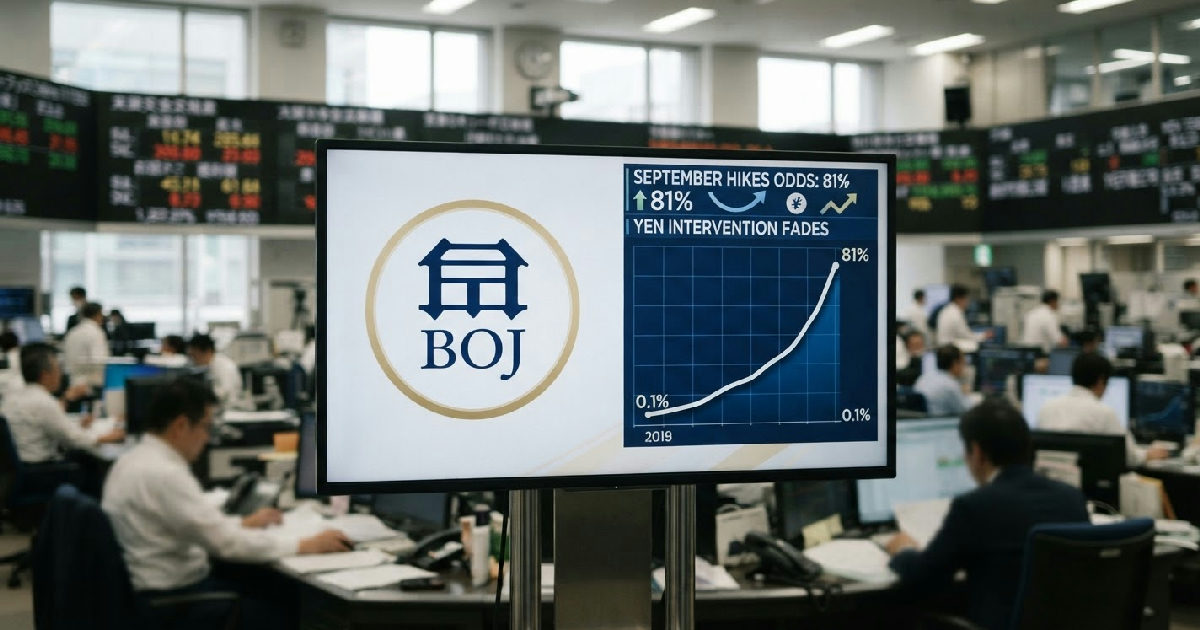

Bettors on the prediction market Polymarket now place an 81% chance on a Bank of Japan (BOJ) interest rate hike in September, a dramatic increase from just 22% two weeks prior. This sharp pivot in market sentiment reflects growing recognition that currency intervention alone isn’t enough to support the struggling yen.
The shift comes as Japan’s currency intervention loses its grip, with the yen unwinding much of its recent rebound. Analysts are increasingly pointing to a genuine rate hike as the only sustainable solution to the currency’s persistent weakness.
Yen intervention loses steam, currency slides
The yen has faced significant downward pressure this week, falling approximately 1% to 159.43 per dollar. This performance puts it on track for its biggest weekly loss in three months, effectively erasing about half the gains made after late July and early August interventions.
Before the coordinated interventions by the U.S. and Japan, the yen traded near 164 per dollar. But a joint action on July 31 saw an estimated $34 billion spent to bolster the currency, with a reported $53 billion spent the day prior, marking potentially the largest single-day intervention on record.
While the yen initially bounced to around 155.20 against the dollar following the intervention, that boost proved temporary. It quickly weakened back above the 159 level, much like Japan’s April intervention which also saw the currency drift back toward 40-year lows in subsequent months.
Mitsuhiro Furusawa, Tokyo’s former top currency diplomat, has indicated Japan could again tap its “yen war chest” at any moment. He also suggested officials might signal faster rate hikes to defend the currency, linking intervention directly to future monetary policy.
Polymarket reflects growing conviction for BOJ action
The surge in Polymarket odds for a September Bank of Japan rate hike underscores the market’s conviction. Traders are now largely pricing in a quarter-point increase, seeing it as an inevitable step.
OCBC strategist Sim Moh Siong recently observed that intervention alone can’t fundamentally alter the yen’s trajectory. He argued the currency requires a “genuinely hawkish Bank of Japan behind it” to establish a lasting trend change.
This sentiment aligns with internal discussions at the Bank of Japan, where sources reportedly told journalists that policymakers might consider another rate hike in September. These reports followed what was described as a “relatively hawkish write-up” of the July meeting.
The market also saw a 76% chance of a September hike as of August 13, 2026, according to Tokyo Tanshi data. This was a significant jump from 24% just two weeks earlier, on July 30, further highlighting the rapid shift in expectations.
Underlying economic and political pressures build
Several factors are converging to pressure the Bank of Japan into tightening its monetary policy. Stubbornly wide interest-rate differentials with the U.S. continue to weigh heavily on the yen, making carry trades—borrowing in yen to invest in higher-yielding currencies—highly attractive.
The U.S. Federal Reserve has maintained its rates between 3.50% and 3.75% this year, a stark contrast to Japan’s ultra-low rates. This disparity funnels capital away from Japan and exacerbates the yen’s depreciation.
Inflation in Japan also remains a concern, with Tokyo’s core Consumer Price Index (CPI) at 3.1% and headline inflation at 3% as of December 15, 2025. These figures hover near the Bank of Japan’s target, providing a fundamental justification for a rate adjustment.
Political signals add another layer of pressure. U.S. Treasury Secretary Scott Bessent reportedly urged Japan to follow up its joint intervention with “policy and fundamentals,” an implicit call for the BOJ to raise rates. Takahide Kiuchi, executive economist at Nomura Research Institute, noted that “With political pressure weakening, there is a possibility that the Bank of Japan could accelerate the pace of its rate hikes.”
The path ahead for Japanese monetary policy
The market’s focus has squarely shifted from the efficacy of currency intervention to the necessity of Bank of Japan policy action. Traders are betting on the BOJ to “hold the line” for the yen, rather than anticipating further direct market intervention.
Goldman Sachs Group strategists, including Kamakshya Trivedi, expect “depreciation pressures to reemerge over time absent a shift in global conditions or a policy surprise.” This outlook reinforces the view that a rate hike is crucial for any sustained yen recovery.
However, the bet isn’t without risk. A decision by the BOJ to hold rates steady instead of hiking could quickly disappoint traders, potentially sending the yen sliding further. Previous surprises of this nature have seen the yen weaken rapidly, sometimes falling back toward the 160 per dollar mark.
While the precise timing remains subject to the BOJ’s discretion, the overwhelming sentiment on Polymarket and among analysts suggests September is now the most anticipated window for a policy adjustment. The Bank of Japan is also scheduled to announce a rate decision on December 19, which will be closely watched for any further tightening signals.