
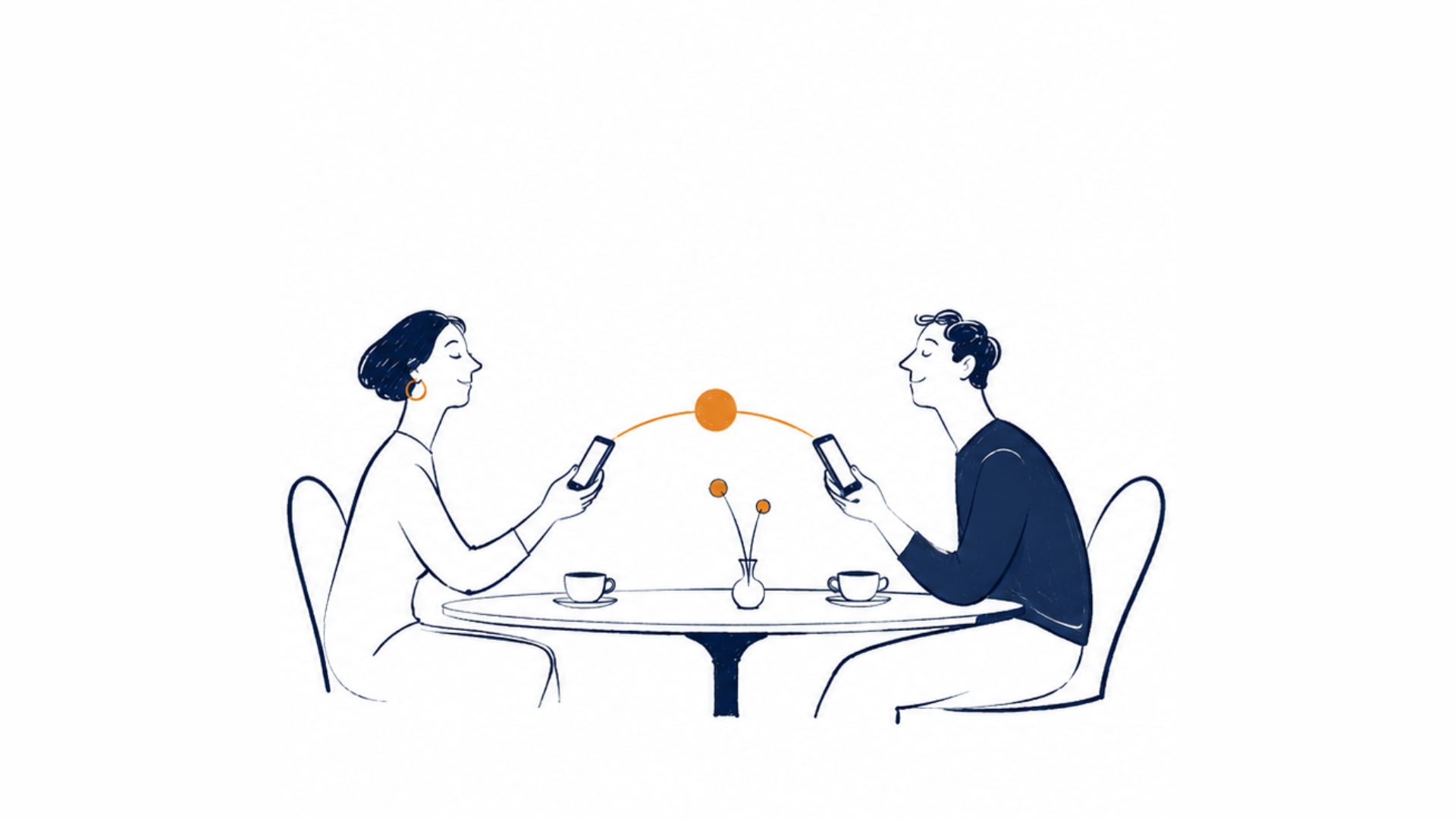

Buy Bitcoin on a mainstream central exchange, and the transaction feels effortless. You hit confirm, and within seconds your account balance updates. There is no waiting for block confirmations, no sudden surge in network gas fees, and no noticeable friction.
Yet, the moment you decide to withdraw that exact same Bitcoin to a personal hardware wallet, the experience changes entirely. You are suddenly asked to pay a network transaction fee, confirm a destination address, and wait anywhere from ten minutes to an hour while the network processes the transfer.
The answer lies in a fundamental distinction that underpins the entire digital asset ecosystem: the difference between on-chain vs off-chain transactions.
Contrary to popular belief, not every action involving digital currencies actually takes place on a blockchain. Understanding how these two transactional pathways work reveals how modern crypto networks balance speed, cost, and absolute security.
The illusion of instant settlement on centralised ledgers
When you trade assets within a major cryptocurrency exchange, you are operating entirely off-chain.
From the user’s perspective, a trade or transfer has occurred. Money changed hands, balances shifted, and the portfolio was updated. However, under the hood, not a single byte of data was broadcast to the underlying Bitcoin or Ethereum blockchain. No miners or validators were involved, and no public block space was consumed.
Instead, centralized exchanges function much like traditional banks. They maintain private, internal databases, the digital ledgers, that record who owns what within their platform. When User A sells one Ether to User B on an exchange, the platform simply subtracts one Ether from User A’s internal balance sheet and adds it to User B’s.
Because these database writes happen internally, off-chain transactions offer distinct operational advantages:
- Instant execution: Settlement happens at the speed of a standard database query, matching the performance of conventional finance;
- Zero network fees: Users avoid paying miner or validator gas fees for internal trades, making high-frequency trading economically viable;
- High capacity: A private database can handle tens of thousands of updates per second without getting congested.
This internal ledger model provides the seamless, fluid trading environment that most market participants interact with daily. However, this speed comes with a trade-off. Off-chain activity of this kind relies entirely on the infrastructure and integrity of a centralised intermediary.
What actually happens when a transaction hits the blockchain
An on-chain transaction occurs when an asset is moved across the actual, public blockchain network—such as sending funds from an exchange to a self-custody wallet, or interacting directly with a smart contract.
Once an on-chain transfer is initiated, it enters a completely open, peer-to-peer validation process. The request is broadcast to a global network of node operators. It sits in a temporary queue — known as the memory pool, or mempool — until validators or miners pick it up, verify that the sender possesses the required funds, and bundle it into a new block.
[ User Initiates Transfer ]
↓
[ Broadcast to Mempool ] → (Pending Validation Queue)
↓
[ Block Bundling & Consensus ] → (Miners / Proof-of-Stake Validations)
↓
[ Immutable Ledger Entry ] → (On-Chain Finality & Block Explorer Visibility)
This decentralized verification process imposes physical limits on speed and capacity. Public blockchains have limited block space and fixed block generation times.
When millions of users simultaneously request on-chain transfers, competition for that limited space heats up. Users must attach higher network fees to incentivize validators to prioritize their transactions.
Despite the higher costs and variable wait times, on-chain settlement provides attributes that no private database can replicate:
- Absolute transparency: Every verified transaction is permanently recorded on a public ledger. Anyone can audit the transaction using an open block explorer without asking for corporate permission;
- Censorship resistance: Because no single entity controls the network, valid transactions cannot be arbitrarily reversed, blocked, or altered once finalized by consensus;
- Trustless settlement: You do not need to trust the solvency or honest accounting of a company. The mathematics of the protocol enforce the rules.
The custody trade-off: central trust versus personal sovereignty
The choice between on-chain vs off-chain transactions is fundamentally a decision about asset custody and risk management.
When your assets remain off-chain within a centralized exchange, the platform holds the private keys to the underlying blockchain addresses. You hold an IOU — a claim on the platform’s reserves. This setup shifts the burden of security to the exchange.
It offers convenience, account recovery options, and simple interfaces, but it requires counterparty trust. If the platform experiences solvency issues or operational halts, user access to those off-chain balances can be compromised.
Conversely, completing an on-chain transaction to a self-custody wallet transfers full control of the private keys directly to you. This aligns with the foundational crypto ethos often summarized as “not your keys, not your coins.”
Self-custody eliminates counterparty risk, but it shifts the entire security burden onto the individual. Lose your private recovery phrase, or execute an on-chain transfer to the wrong address, and there is no customer support team to reverse the transaction or restore access.
On-chain finality is absolute.
Neither model is universally superior. A active day trader may prioritize the low fees and rapid execution of an off-chain exchange environment, while a long-term holder might willingly pay on-chain network fees to achieve self-sovereign security.
Scaling beyond the base layer: Layer 2 and off-chain networks
Off-chain architecture is not exclusive to centralized corporations. As decentralized networks grew, developers realized that attempting to process every micro-transaction directly on the base layer (Layer 1) creates unsustainable congestion and high fees.
To solve this, the ecosystem created secondary, decentralized off-chain structures, widely referred to as Layer 2 protocols and state channels.
A prominent example is the Lightning Network built on top of Bitcoin. Lightning allows two parties to open a dedicated payment channel between themselves. Once open, they can conduct thousands of transfers back and forth off-chain, almost instantaneously and for fractions of a penny. The main Bitcoin blockchain remains completely unaware of these individual interactions.
Only when the channel is finally closed is the net balance bundled into a single transaction and settled permanently on-chain.
Similarly, Layer 2 scaling solutions on Ethereum — such as Optimistic and Zero-Knowledge Rollups —process hundreds of transactions off the main chain, compress the transaction data, and periodically post cryptographic proofs of those state updates back to the primary Ethereum network.
These technologies redefine what off-chain means. They demonstrate that off-chain operations do not require abandoning cryptographic security for corporate trust. Instead, they use off-chain space for calculation and execution, while relying on the underlying base layer for ultimate settlement and security.
The debate surrounding on-chain vs off-chain transactions often treats the two concepts as rival philosophies, but they are better understood as complementary layers of a maturing financial stack.
No single architecture can maximize speed, low cost, decentralization, and absolute security simultaneously — a dynamic known in software design as the blockchain trilemma.
Pushing every everyday coffee purchase onto a base-layer blockchain would render the network unusable for everyone. Conversely, relying exclusively on private, off-chain databases would strip digital assets of the very properties that make them revolutionary.
The future of digital finance relies on a pragmatically divided architecture. High-value transactions, definitive asset settlement, and institutional reserves will naturally gravitate toward the unshakeable security of on-chain verification.
Meanwhile, micro-payments, daily trading, and high-frequency applications will increasingly thrive across off-chain channels and secondary networks.
Understanding how these layers interact allows users to navigate the crypto ecosystem with clarity, choosing the right tool for the right purpose.