
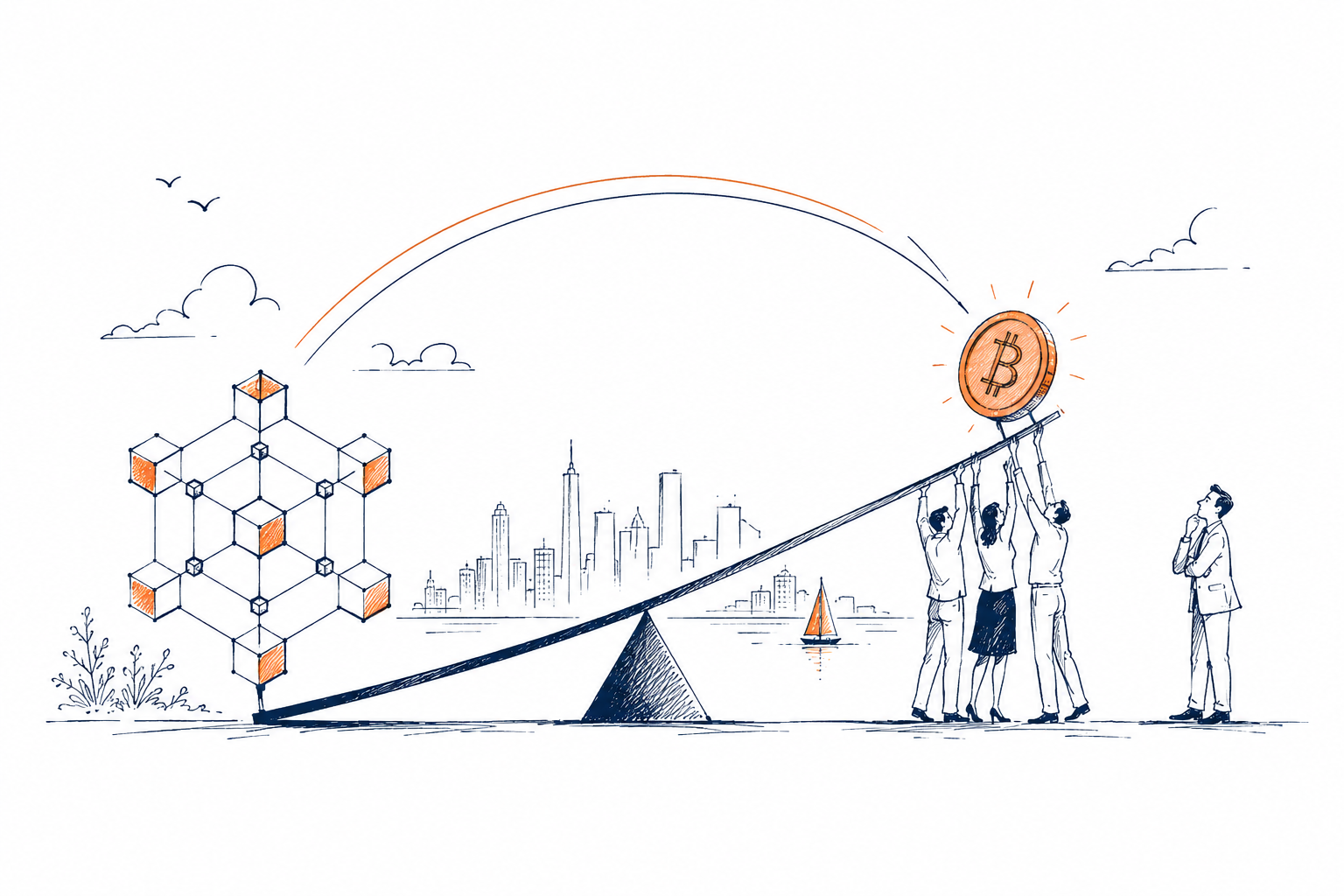

Blockchain is beginning to outgrow cryptocurrencies.
That idea would have sounded contradictory only a few years ago, when blockchain adoption and crypto adoption were widely seen as two sides of the same story. Today, that relationship is becoming more complex.
A recent analysis from JPMorgan reflects a broader shift taking place across financial markets. The bank argues that blockchain technology may continue expanding across global finance even if much of that growth occurs through permissioned networks, tokenized deposits and institutional infrastructure rather than public crypto assets.
The implication is significant.
Blockchain’s success may no longer translate directly into higher demand for Bitcoin or other digital assets.
Financial institutions are adopting blockchain differently
The first wave of blockchain adoption was driven largely by cryptocurrencies.
Bitcoin introduced decentralized money. Ethereum expanded the concept through programmable smart contracts, while decentralized finance demonstrated how financial services could operate without traditional intermediaries.
The institutions entering the market today have different priorities.
Banks are experimenting with tokenized deposits.
Asset managers are building tokenized investment products.
Payment networks are testing blockchain settlement systems.
These initiatives rely on blockchain technology, but they are not necessarily designed to increase exposure to public cryptocurrencies.
That distinction is becoming increasingly important.
Blockchain is becoming financial infrastructure
The conversation is gradually shifting away from digital assets themselves toward the systems supporting them.
For financial institutions, blockchain offers faster settlement, programmable assets, continuous market availability and lower operational costs.
Those efficiency gains can exist regardless of whether transactions are settled using Bitcoin, Ethereum or entirely different digital instruments.
As a result, blockchain is increasingly being viewed as infrastructure rather than simply the foundation of cryptocurrency markets.
That evolution creates a new way of thinking about adoption.
Technology can become mainstream even if public tokens are no longer the primary beneficiaries.
Investors may need to separate two different trends
One consequence of this transition is that blockchain adoption and cryptocurrency performance may increasingly follow different paths.
The expansion of tokenized securities, digital deposits and institutional settlement networks could continue accelerating even during periods when crypto markets remain relatively subdued.
That possibility challenges one of the industry’s longest-held assumptions.
Owning cryptocurrencies may no longer be the only way or even the primary way to gain exposure to blockchain’s long-term growth.
For investors, distinguishing between blockchain infrastructure and digital asset markets may become an increasingly important part of evaluating the industry’s future.
The next phase of blockchain could be less visible
The first generation of blockchain innovation was highly public.
Bitcoin, Ethereum and decentralized finance attracted attention because they introduced entirely new financial models.
The next stage may develop more quietly.
Instead of emerging through retail speculation, it may expand through payment systems, banking infrastructure, capital markets and enterprise financial networks operating behind the scenes.
If that transition continues, blockchain’s greatest long-term impact may not be measured solely by cryptocurrency prices.
It may be measured by how deeply the technology becomes embedded within the global financial system even if most users never realize they are using blockchain at all.