
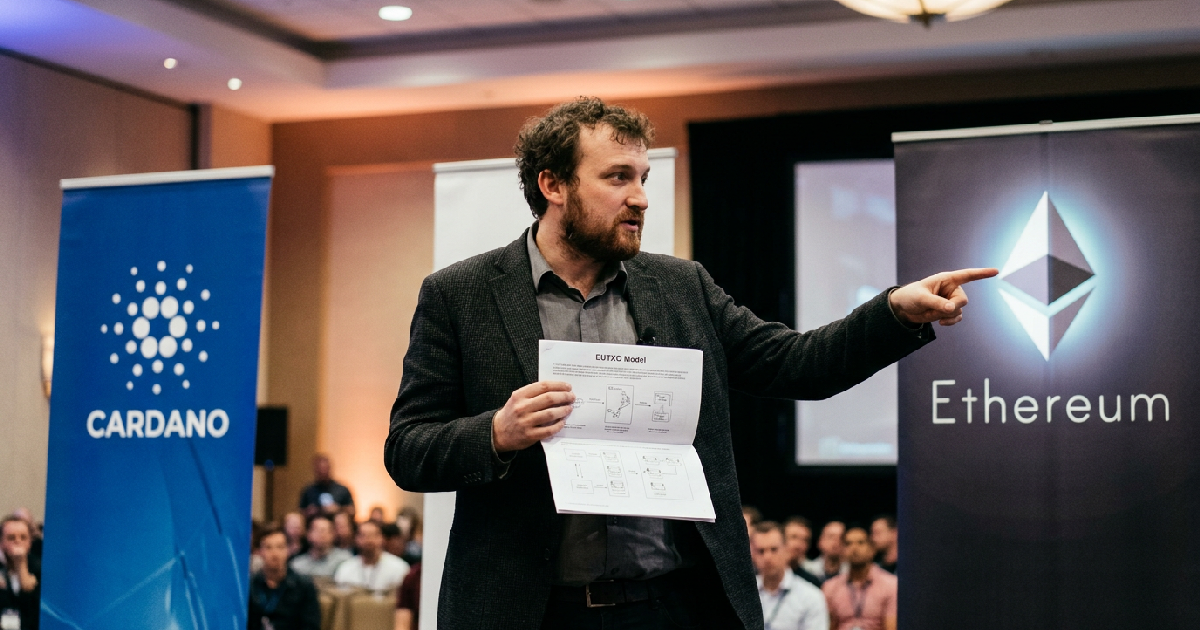

Charles Hoskinson, the founder of Cardano and CEO of Input Output Global (IOG), has leveled a serious allegation against the Ethereum Foundation, claiming the organization is copying proprietary technical models. The dispute centers on the Extended Unspent Transaction Output (EUTXO) model, a key architectural pillar that Charles Hoskinson asserts the Ethereum development community is adopting without providing appropriate credit.
The friction between the two blockchain pioneers is rooted in long-standing personal and professional disagreements dating back to the earliest days of the industry. Charles Hoskinson was one of the original co-founders of Ethereum and served as its CEO before a high-profile departure in June 2014 following a dispute with Vitalik Buterin.
Charles Hoskinson claims Ethereum is copying EUTXO architecture
While Ethereum has historically utilized an account-based model, Hoskinson maintains that the shifts currently being seen in the Ethereum network outlook echo the EUTXO model that Cardano has utilized since its 2017 launch.
The core of the current controversy lies in the fundamental design of how transactions are processed and recorded on a blockchain. Charles Hoskinson explicitly accuses the Ethereum Foundation of copying Cardano’s EUTXO model.
This system, which Cardano uses for its smart contracts, is often contrasted with the account-based systems used by traditional banking and early programmable blockchains. Unlike those models, EUTXO treats transactions as discrete events with defined inputs and outputs, which Charles Hoskinson argues offers distinct advantages in security and fee predictability.
While the Ethereum community continues to evolve its infrastructure, the lack of acknowledgment for what Charles Hoskinson identifies as Cardano’s “prior art” remains a significant point of contention. This latest friction comes as the Ethereum recovery outlook remains a focal point for the wider market.
For Hoskinson and IOG, the move toward these technical models by the Ethereum Foundation is seen as a tacit admission of the academic rigor and evidence-based development that has defined the Cardano project since its inception.
The technical divide between account-based and EUTXO models
To understand the weight of the accusation, one must look at the specific technologies mentioned in the research. Cardano utilizes the Ouroboros Proof-of-Stake (PoS) consensus mechanism, which was developed through peer-reviewed academic research. This mechanism works in tandem with the EUTXO model to host the ADA cryptocurrency.
Charles Hoskinson has long championed this approach as a “third-generation” blockchain solution intended to improve upon the limitations found in both Bitcoin and the original Ethereum architecture.
Input Output Global (IOG), formerly known as IOHK, has been the primary engineering force behind these developments. Co-founded by Charles Hoskinson and Jeremy Wood, the company has focused on a research-heavy strategy that often contrasts with the faster development cycles seen in other ecosystems.
The accusation that Ethereum is now borrowing these specific models without credit touches on the proprietary nature of this academic work and the competitive rivalry that has existed between the two platforms for over a decade.
Roots of the rivalry in the original Ethereum founding team
The animosity between the two camps is deeply historical. Charles Hoskinson served as the CEO of Ethereum during its formative phase, but a fundamental disagreement with Vitalik Buterin regarding the project’s structure led to his exit. Charles Hoskinson had advocated for Ethereum to become a for-profit entity with venture capital and a formal governing structure.
In contrast, Vitalik Buterin insisted on the non-profit model with decentralized governance that exists today. This “boardroom brawl” resulted in Hoskinson leaving the project in June 2014, reportedly “pissed off” by the outcome.
Following his departure, Hoskinson established IOHK in late 2014 and launched Cardano in late 2017. Since then, the relationship between the two founders has remained prickly, with Hoskinson occasionally criticizing Ethereum’s methods and referring to Buterin’s leadership style in disparaging terms.
This history provides the backdrop for the current claims of idea-theft, as Cardano has often been framed as a direct “Ethereum killer” in the competitive blockchain space.
Impact on the broader digital asset ecosystem
The dispute highlighted by Charles Hoskinson underscores the intensifying competition among major blockchain protocols as they seek the most efficient architectural solutions. While the market has seen Ethereum navigate key support levels recently, the technical debate over core architecture could have significant implications for developer adoption. If the industry shifts toward EUTXO-style models, the debate over who pioneered the technology will likely grow louder.
Currently, the Cardano ecosystem is supported by three distinct entities: IOG, the Cardano Foundation based in Switzerland, and the Japanese venture capital firm Emurgo. These organizations continue to manage the core development and growth of the ADA network.
Whether the Ethereum Foundation will respond to the allegations or provide credit for any technical inspiration remains to be seen, but the public call-out by Charles Hoskinson ensures the historical divide between these two projects remains a central narrative in the crypto industry.