
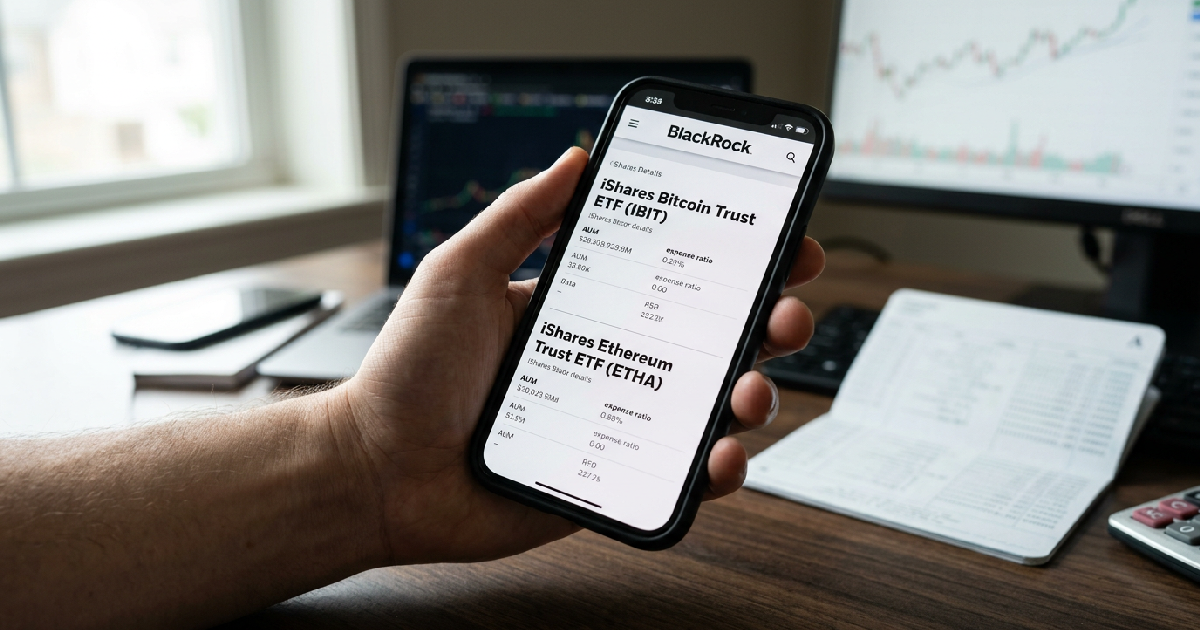

BlackRock’s IBIT Bitcoin ETF, alongside its Ethereum Trust ETF (ETHA), offers institutional-grade access to cryptocurrencies through traditional brokerage accounts. has cemented its position as a dominant force in the digital asset market through its iShares Ethereum Trust ETF (ETHA) and iShares Bitcoin Trust ETF (IBIT). As of July 8, 2026, both funds provide institutional-grade access to the two largest cryptocurrencies via traditional brokerage accounts.
While both products share Coinbase as their primary custodian and utilize cold storage for security, they represent vastly different economic use cases for a diversified investment portfolio.
Evaluating IBIT and ETHA within portfolio structures
The iShares Bitcoin Trust ETF (IBIT) seeks to reflect the performance of Bitcoin (BTC), an asset often described as digital gold due to its supply scarcity. In contrast, the iShares Ethereum Trust ETF (ETHA) tracks Ether (ETH), the native token of the Ethereum network, which functions as a utility layer for decentralized applications.
Both funds are structured as “Grantor Trusts,” meaning they are not registered under the Investment Company Act of 1940, and both value their holdings daily at 4:00 PM ET based on the CF Benchmarks Index.
For many traditional investors, the choice between these two vehicles depends on the desired risk profile. IBIT offers high-fidelity tracking of Bitcoin’s price, with a portfolio consisting of approximately 99.93% spot Bitcoin. As of July 7, 2026, IBIT’s assets under management (AUM) stood at $46.66 billion.
This flagship fund has successfully bridged the gap for institutions, including major European entities like Italy’s largest bank which recently exceeded $200M in Bitcoin ETF exposure.
ETHA, which launched on June 24, 2024, has rapidly grown to hold approximately $4.65 billion in AUM as of July 7, 2026. Because Ethereum is the foundation for much of the decentralized finance (DeFi) sector, the Ethereum network outlook often strengthens when enterprise adoption of smart contracts increases.
However, unlike direct ownership of Ether, ETHA does not currently pay a dividend or distribution, as it is a spot-only product that does not participate in network staking.
Analyzing cost structures and management fees
Management costs remain a primary concern for ETF participants. The iShares Bitcoin Trust ETF (IBIT) carries a confirmed expense ratio of 0.25%, though this was initially waived to 0.12% during its early launch phase. This fee covers the operational overhead of maintaining the trust, including BlackRock’s independent Bitcoin node used to verify holdings.
By holding the asset in cold storage via Coinbase, the fund eliminates the direct “key risk” associated with personal digital wallets.
While IBIT’s fee is clearly defined at 0.25%, specific expense ratio data for ETHA is not currently available in the fund’s confirmed metrics for 2026. Investors should monitor official iShares disclosures for the most current fee schedules regarding the Ethereum trust.
And while fees are a factor, the liquidity and ease of trading on the NASDAQ for IBIT—and major exchanges for ETHA—provide a level of accessibility that often outweighs the costs for retail and institutional buyers alike.
Market catalysts and the role of scarcity
The path forward for these digital asset trusts is increasingly linked to supply dynamics and macro-economic shifts. Bitcoin’s appeal is frequently tied to its role as a hedge against inflation. This narrative is supported by the fact that Bitcoin exchange supply maintains multi-year lows, potentially increasing the impact of institutional inflows into IBIT.
Since the fund’s portfolio is nearly 100% Bitcoin, it acts as a direct proxy for this supply-demand imbalance.
ETHA investors, meanwhile, are betting on the technical utility of the Ethereum network. The fund holds 100% Ether with a negligible cash position, focusing entirely on price appreciation.
As the market moves deeper into 2026, the success of both BlackRock products will depend on whether digital assets continue to correlate with traditional risk-on equities or if they begin to trade independently based on их distinct technological merits.