
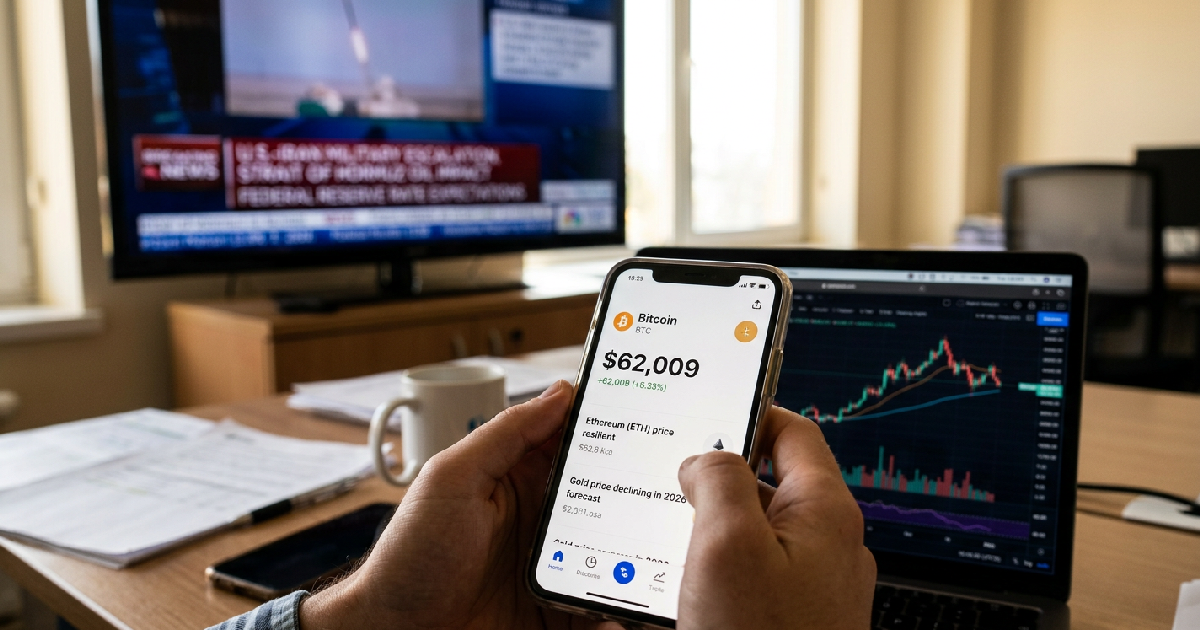

Bitcoin prices held steady above the $62,000 level on Thursday, July 9, 2026, demonstrating resilience as military activity intensified between U.S. and Iranian forces. While conventional markets reacted to news of renewed airstrikes, the cryptocurrency market maintained a relatively muted stance, with Bitcoin trading at $62,009 at the time of reporting.
This stability contrasts with the performance of traditional commodities; Brent crude oil rose for its third consecutive session, while spot gold continued a four-day decline.
Bitcoin and ether navigate geopolitical volatility
The latest market movements follow a reported round of U.S. military strikes against Iran. According to regional reports, both nations have raised the prospect of closing the Strait of Hormuz, a critical maritime corridor for global energy supplies. Brent crude reacted by climbing 1% to reach $78.80 a barrel.
This geopolitical friction has reignited inflation concerns and influenced global bond markets. Government bonds in Japan, Australia, and New Zealand fell on Thursday, while two-year U.S. Treasury yields approached their 2026 highs.
Despite the military escalation, Bitcoin has seen a weekly gain of 1.6%. The asset’s daily decline of 1.2% was significantly less volatile than many analysts expected, given that a single headline regarding the Strait of Hormuz has historically triggered sharper selloffs.
This suggests that the Bitcoin price analysis is increasingly tied to interest-rate expectations rather than immediate war-related risk aversion. Traders are now closely watching the $60,000 floor as a psychological support level that could determine the next major trend for digital assets.
Ethereum mirrored this resilience, trading at $1,730 on Thursday. While off 1.2% over a 24-hour period, ether is still up 5.7% over the last seven sessions. This relative strength comes as market observers notice a shifting pattern in how digital assets absorb global shocks.
Instead of reacting as a high-risk tech bet, many traders are treating crypto as a rates-sensitive asset in a environment where investors are tracking Treasury yields for direction. This maturing sentiment is reflected in the Fear and Greed index, which rose to 27, marking an exit from a 40-day spell in the extreme fear zone.
Gold slides as markets prioritize rate hike bets
Gold has surprisingly failed to capture a “safe-haven” premium during this escalation, extending its losses to a fourth day. Spot gold retreated to approximately $4,060 an ounce on Thursday morning.
The decline is largely attributed to shifts in the bond market; as cash begins to pay more through rising Treasury yields, non-yielding assets like gold lose their competitive appeal. Money markets recently pulled forward expectations for the next Federal Reserve rate hike to October, moving the timeline up from December.
While bullion struggles, the cryptocurrency market is proving to be a potential alternative for those looking at reduced liquid supply on exchanges. Bitcoin’s ability to hold its range despite an oil shock and a global bond selloff suggests a potential rotation out of old-school hedges.
However, analysts warn that a break below $60,000 would invalidate this thesis, suggesting the recent calm was merely a function of low-volume trading rather than a structural shift in investor behavior.
Broader performance across the altcoin sector
The broader digital asset market showed mixed results amid the regional tensions. Solana emerged as a laggard, dropping 1.8% to $77.25, while XRP slipped modestly by 0.7% to trade near $1.09. TRON stood out with a 4% gain over the week, and hyperliquid’s HYPE token maintained a 5.9% weekly increase despite a slight daily dip.
The varied performance highlights that while large-cap assets like Bitcoin are being repriced as rates assets, some altcoins remain more vulnerable to general risk-off sentiment.
Looking ahead, the market remains focused on the Strait of Hormuz and any further military developments that could disrupt oil flows. If energy prices continue to support inflation, it may lock in the more hawkish Fed stance currently being priced in.
For Bitcoin, the goal remains clear: maintaining the current range to convince institutional buyers that digital gold can withstand a storm that is currently forcing the traditional yellow metal to retreat.