
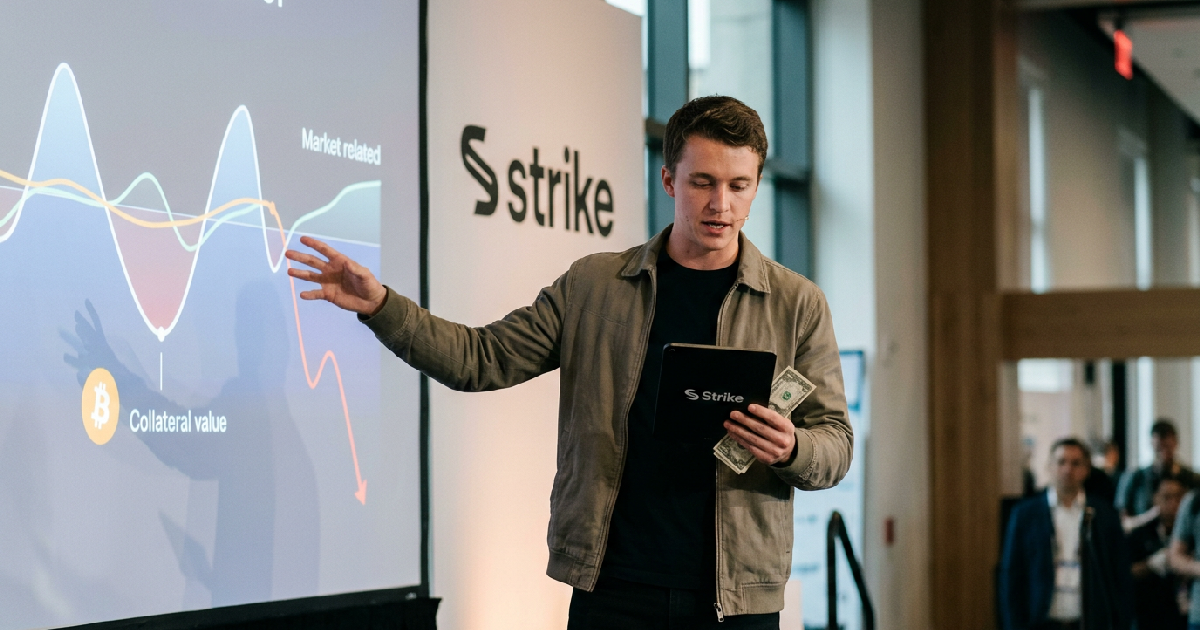

Strike CEO Jack Mallers has officially launched a new bitcoin-backed lending product designed to eliminate the threat of price-triggered liquidations for borrowers. The “volatility-proof” bitcoin loans, which debuted on July 7, 2026, allow users to secure U.S. dollar loans using their bitcoin as collateral without the risk of margin calls, regardless of market fluctuations.
As long as borrowers keep their payments current, their collateral remains untouched even during deep market drawdowns.
Jack Mallers unveils volatility-proof loans
The structured debt product represents a major shift from industry norms where strict loan-to-value (LTV) ratios typically govern digital asset credit. In traditional models, a sharp drop in the bitcoin price often forces lenders to sell off collateral to cover the debt. However, Strike’s new model forgoes these “price-triggered” actions.
Jack Mallers first announced the framework for this structure during the Bitcoin 2026 Conference in April, framing it as a way for holders to access liquidity while ensuring their bitcoin doesn’t move.
Under the terms of the new product, the lender does not monitor the spot price for the purpose of triggering automatic sell-offs. This protection is marketed toward long-term holders who prioritize security over lower borrowing costs. While crypto market liquidation risks often drive selling pressure during periods of high volatility, Strike’s model focuses on repayment reliability rather than the fluctuating value of the underlying asset.
The transparency behind this lending infrastructure was assisted by Tether, which helped Strike build its lending proof-of-reserves. This collaboration ensures that collateral held by the firm is fully accounted for and not rehypothecated.
Jack Mallers has also expressed support for a proposal by Tether Investments that may see Strike eventually merge with other entities, such as Twenty-One Capital and the mining firm Elektron Energy, though such a deal remains a possibility rather than a confirmed event.
Specific terms of the volatility-proof loan product
To manage the increased risk of holding collateral during price drops, Strike has implemented specific guardrails for these specialized loans. The volatility-proof variant carries a maximum initial LTV of 45%. This creates a larger buffer for the lender compared to standard digital asset credit products. Furthermore, these loans are currently only available as fixed-term loans for a maximum duration of six months.
Borrowers using this premium service are subject to an additional 2.95% APR premium. However, the company is offsetting these costs by offering zero origination fees, zero prepayment fees, and zero liquidation fees. These loans are accessible through the Strike app, though they are restricted to select U.S. states. They are not currently available for revolving lines of credit.
The ten-day grace period and default protocols
The absence of price-triggered liquidations does not mean the loans are risk-free. Strike mandates that borrowers must keep their interest and maturity payments current to maintain the “untouched” status of their collateral. If a borrower misses a payment, a 10-day grace period is triggered.
If the outstanding obligation is not settled within this window, Strike may then perform a partial liquidation of the collateral to satisfy the debt.
This approach stands in contrast to the bitcoin price analysis models that usually dictate lending terms, which rely on millisecond-by-millisecond price feeds. Strike’s decision to move toward a cash-flow-based risk assessment is supported by a $2.1 billion credit facility, which provides the capital necessary to meet demand for the lending business.
Approval for the loans is based strictly on the provided collateral rather than the user’s traditional credit score.
Strategic growth for the Strike ecosystem
The launch of “volatility-proof” loans is the latest addition to Strike’s suite of bitcoin services, which already includes automated recurring purchases and price-triggered orders. The company also allows users to convert portions of their paychecks into BTC and pay bills using their holdings.
This expansion into specialized debt follows a broader trend where bitcoin exchange supply is scrutinized as users look for safer ways to utilize their assets.
Looking ahead, the success of this model will depend on borrower discipline regarding interest payments. By removing price volatility from the liquidation equation, Strike is attempting to provide a “safety valve” for the broader market. If successful, this structure could change expectations for digital asset lending, especially for institutional users who require predictable access to their treasury assets regardless of short-term market corrections.