
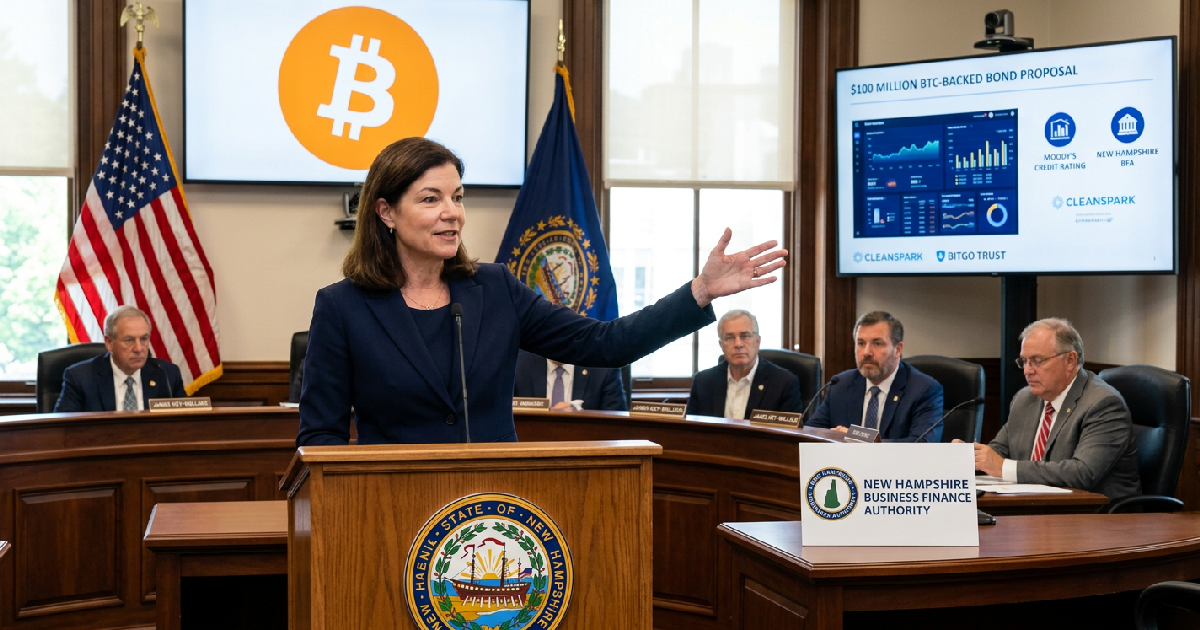

New Hampshire Governor Kelly Ayotte and the five-member Executive Council will meet Wednesday, July 8, 2026, to decide the fate of a proposed $100 million Bitcoin-backed municipal bond. The public hearing, scheduled to begin at 10:00 a.m. America/New_York time, represents the final regulatory hurdle for the New Hampshire Business Finance Authority (BFA). James Key-Wallace, the BFA executive director, requested the hearing to verify the plan’s feasibility and its potential to establish the state as a leader in responsible crypto finance.
This initiative is part of a broader effort to attract blockchain-related businesses to the Granite State. New Hampshire has previously signaled its interest in the sector by becoming the first state to pass a strategic Bitcoin reserve law in 2025. While the bond and the reserve law are distinct, both reflect a policy environment designed to spur investment and innovation. The BFA aims to create a new revenue stream to fund its investment programs without exposing the state’s general fund to market volatility.
How the Bitcoin-backed muni bond maintains taxpayer protection
The $100 million project is structured differently than a traditional municipal bond because it involves no public money. It functions as a “conduit bond,” meaning the financial responsibility for repayment lies with a private borrower rather than the government. The borrower in this transaction is NH CleanSpark Borrower Trust 2026-1, an entity linked to the Nevada-based Bitcoin mining firm CleanSpark. To secure the debt, CleanSpark will post Bitcoin as collateral, which will be held in regulated cold storage by BitGo Trust Company.
Investors in the offering stand to gain upside exposure through payments linked to the potential price appreciation of Bitcoin. However, the three-year bond includes a strict protective mechanism. If the value of the Bitcoin collateral drops below a specific threshold, a trust will automatically liquidate the assets to ensure bondholders are repaid in full.
com/bitcoin-price-analysis-market-resistance-outlook-2026/”>Bitcoin price analysis and market resistance levels seen during the term.
The concept was developed by Los Angeles-based Wave Digital Assets in partnership with Rosemawr Management and the BFA. Legal counsel from Orrick advised the BFA on the structuring to ensure the state remains legally shielded. By facilitating a bridge between private investors and the borrower, the state seeks to benefit from the digital finance sector’s growth while maintaining a clear firewall between crypto assets and taxpayer dollars.
Moody’s assigns speculative rating amid asset volatility concerns
Despite the legal protections built into the deal, institutional credit analysts remain cautious. In March 2026, Moody’s Investors Service assigned the bond a provisional “Ba2” rating. This designation is two notches below investment grade, placing the debt in the “speculative” or “junk” category. The rating reflects the inherent credit risks associated with using a highly fluctuating digital asset to back a multi-year financial instrument.
Keith Ammon, a Republican state representative from New Boston and a proponent of crypto policy, told the Granite State News Collaborative that the “Ba2” rating “makes sense” as a starting point. He suggested that a cautious rating is expected for such a novel application of blockchain technology in the municipal market. com/crypto-market-liquidation-analysis-macro-outlook-2026/”>crypto market liquidation risks that affect broader digital asset portfolios.
Academic analysis warns of high liquidation probability
The structural safeguards have not entirely satisfied outside experts. David Krause, an emeritus associate professor of finance at Marquette University, conducted a deep dive into the BFA’s proposal. In a paper dissecting the plan, Krause found that recent Bitcoin price movements make it “highly likely” that the bond’s liquidation provision will be triggered before the end of its three-year term. He argued that while the state is legally insulated from liability, a forced liquidation would present significant reputational risks.
Krause concluded that the bond serves more as a “proof of concept” for integrating digital assets into structured finance than a general-purpose tool for public funding. The challenge, according to his analysis, is that the volatility of Bitcoin contradicts the historical emphasis on predictability and stability in municipal finance. Nevertheless, the BFA and Governor Ayotte maintain that the innovative approach is a way to position the state at the forefront of the industry.
The operational side of the deal involves several established financial entities. BitGo Trust will serve as the custodian, providing multi-layer security for the collateral. The investment bank Jefferies is acting as the underwriter and payment agent.
By utilizing institutional-grade infrastructure, the BFA hopes to attract sophisticated investors who are seeking exposure to digital assets within a regulated framework. If the Executive Council provides the final approval on Wednesday, the bond will move forward as the world’s first instance of a state agency facilitating a Bitcoin-backed municipal offering.