
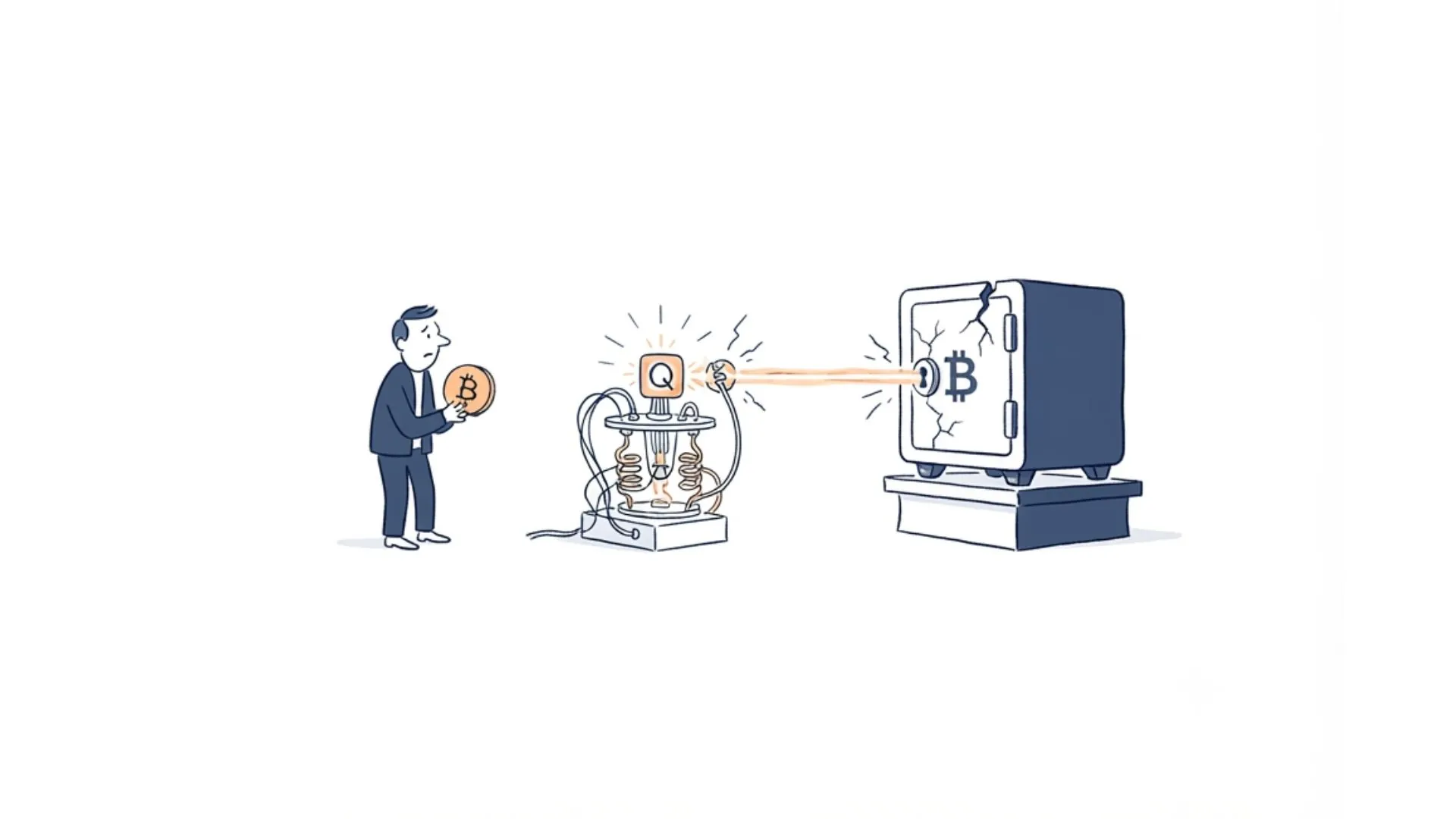

Behind the closed doors of the world’s most advanced technology laboratories, a new generation of supercomputers is quietly coming to life, forcing us to confront the reality of the quantum computing Bitcoin threat. These machines operate on the wild rules of quantum mechanics, processing complex equations in seconds that would take our current laptops billions of years to solve, promising to revolutionize everything from medicine to artificial intelligence.
Yet, for anyone involved in crypto investing, this computational leap introduces a ticking clock known in tech circles as “Q-Day“—the theoretical moment when quantum computers become powerful enough to crack modern encryption. Before you react to the sensationalist headlines and liquidate your digital assets in a panic, it is vital to separate the technical facts from mainstream media fiction.
Crypto Fear and Greed Index: The Beginner’s Guide to Surviving Market Panic
What You Need to Know Before Starting
To understand if a supercomputer can actually compromise the blockchain, we first need to look at how digital assets are secured today. Bitcoin does not rely on physical vaults, corporate brick-and-mortar walls, or traditional alphanumeric passwords that you can reset via email.
Instead, the entire system is built on an elegant framework called asymmetric cryptography, specifically utilizing the Elliptic Curve Digital Signature Algorithm (ECDSA). When you set up a non-custodial crypto wallet, the software automatically generates two distinct, mathematically linked cryptographic strings: a public key and a private key.
Think of your public key as a global bank routing number or an international IBAN. You can freely post this address anywhere online, paste it into a chat, or send it to a friend so they can transfer funds to you, as there is absolutely zero security risk in making it public.
Your private key, conversely, acts as your ultimate physical signature and biometric password combined; it provides the absolute mathematical proof that you own those specific funds, allowing you to authorize outward transactions. In classical computing, figuring out a private key from an exposed public key is an impossible task, requiring an astronomical number of trial-and-error attempts.
How the Quantum Computing Bitcoin Threat Actually Works
The true nature of the quantum computing Bitcoin threat stems from the fact that quantum machines do not use standard binary bits that represent either a 0 or a 1. Instead, they utilize quantum bits, or qubits, which can exist in a state of superposition, meaning they can represent both 0 and 1 simultaneously.
Leveraging this subatomic phenomenon alongside specific mathematical frameworks, such as Shor’s Algorithm, an operational quantum computer can run the mathematical process completely in reverse. Instead of guessing a private key through brute-force calculations, the machine can analyze a public key and cleanly deduce the private key in a matter of minutes.
An actual, real-world exploit on the network would not look like a dramatic Hollywood cyberattack with flashing red screens. It would be a quiet, highly calculated, and entirely automated process carried out over three distinct phases.
1. Scouting for Exposed Vaults
A malicious actor operating a quantum system would not start by attacking the core blockchain network all at once. Instead, they would program a script to scan the public ledger for vulnerable targets where the public key is already completely visible.
Because the blockchain is perfectly immutable and transparent, anyone with an internet connection can view historical transactions. The primary targets would be ancient, inactive wallets from the early days of mining, or modern addresses that have been compromised due to poor digital hygiene.
2. Breaking the Math via Shor’s Algorithm
Once a high-value target with an exposed public key is selected, the hacker would feed that public string into a stable quantum system running Shor’s Algorithm. For a standard computer, reverse-engineering this mathematical puzzle is like trying to find one specific grain of sand in the Sahara Desert.
For a stable quantum processor with a low error rate, this calculation becomes a completely trivial, routine task. The system processes the complex discrete logarithms almost instantly, outputting the exact private key that controls those specific funds.
3. The Silent Heist on Modern Exchanges
With the stolen private key in hand, the theoretical attacker gains absolute, undisputed control over the victim’s wallet. They can draft a transaction transferring the entire balance to a new address and sign it with the mathematically perfect signature.
When this transaction hits the network nodes or is processed by miners, it looks completely legitimate, meaning the protocols will validate the transfer without triggering any security alarms. The true market panic would only begin when billions of dollars in dormant coins suddenly start moving into major global exchanges like Binance, Coinbase, or Kraken.
Are My Crypto Assets at Risk Today?
When evaluating how this technological shift impacts your personal portfolio, it is helpful to realize that much of the immediate panic surrounding this topic is pure fiction. If you are a modern user practicing basic security habits, the chance that your funds will be stolen by a quantum computer anytime soon is incredibly low.
The way crypto wallets generate and manage your public data has evolved drastically over the years. Are my crypto assets safe from quantum computers if I hold them in a standard hardware wallet? Yes, because of a clever architectural shield implemented by early developers.
In the initial years of the network, transactions were broadcast using a format where the raw public key was written directly onto the ledger for everyone to see. Today, modern wallets do not expose your public key to the blockchain until the exact microsecond you decide to send funds out of that address.
When you simply receive crypto or let it sit, your address is actually a double-hashed version of your public key, protected by SHA-256. This means that a quantum computer looking at your wallet address cannot even see the public key it needs to run Shor’s Algorithm.
The real danger of this computational evolution is not directed at active, everyday users, but rather at what the industry calls “zombie wallets.” Experts estimate that over one million early Bitcoins are sitting in ancient addresses where the raw public keys are permanently exposed.
Many of these wallets belong to early users who lost their seed phrases over a decade ago, meaning these billions of dollars can never be moved to modern, secure addresses. If a quantum entity vacuums up these unmovable coins, it could create a massive supply shock in the global markets.
The Multi-Architecture Multisig Insight
While the industry focused heavily on updating mathematical algorithms, an overlooked operational defense lies in multi-signature (multisig) architectures. By setting up a vault that requires approvals from three separate keys generated by entirely different software providers and hardware vendors, you create an operational maze. Even if an attacker manages to break one specific cryptographic curve via a quantum exploit, they would still need to simultaneously compromise completely distinct operational systems to move a single dollar.
The Future of Crypto Security: Is Bitcoin Still a Safe Long-Term Investment?
From the perspective of institutional wealth management, assessing the quantum computing Bitcoin threat requires looking past the immediate technical code and analyzing the human governance of decentralized networks. The global developer community is not sitting idly by waiting for Q-Day to arrive; they are actively designing and debating defense protocols.
However, updating a truly decentralized infrastructure presents an entirely different set of challenges than updating software at a centralized corporation. If a centralized company wants to patch a vulnerability, its security team can force an update across all corporate servers overnight.
With a global blockchain network, any major structural change requires an absolute social and economic consensus among thousands of independent miners, node operators, institutional funds, and individual users scattered across the globe. This reality introduces a fascinating paradox for long-term asset allocators.
Major institutions and Wall Street funds have embraced Bitcoin precisely because it is incredibly rigid, immutable, and resistant to sudden, impulsive changes. Yet, that exact same institutional stability makes the network naturally slow to react when a massive technological shift requires a rapid software upgrade.
+-----------------------------------------------------------------+
|               THE DECENTRALIZED GOVERNANCE DILEMMA              |
+-----------------------------------------------------------------+
| PROS OF RIGIDITY:              | CONS OF RIGIDITY:              |
| * Protects against bad updates | * Slow implementation of fixes |
| * Guarantees monetary policy   | * Requires global consensus    |
| * Attracts institutional trust | * Risk of community splitting  |
+-----------------------------------------------------------------+
This structural dynamic becomes incredibly apparent when you look at how altcoins vs bitcoin might handle the transition to a post-quantum world. To better understand this comparison, it helps to clarify what are altcoins and their general market purpose.
When exploring the broader landscape of crypto investing, the altcoins meaning simply refers to any digital asset or blockchain network that was created as an alternative to Bitcoin. Because many of these newer networks feature highly centralized governance models or smaller validator sets, they can easily implement radical code rewrites in a matter of days.
While certain agile altcoins might boast about achieving early quantum resistance, they often sacrifice the very decentralization that makes a blockchain valuable in the first place. Bitcoin’s slower path involves years of meticulous debate over Bitcoin Improvement Proposals (BIPs) to integrate post quantum cryptography bitcoin updates.
The ultimate goal is to introduce a soft fork that allows users to seamlessly migrate their funds to new, quantum-safe address types. The real, underlying challenge for the community is deciding how to handle the billions of dollars sitting in old, abandoned wallets.
Some computer scientists argue that the only safe option is to set a global deadline, after which any unmigrated, vulnerable legacy addresses will be permanently frozen by the network to prevent a malicious entity from stealing them. For political purists within the ecosystem, freezing valid property violates the core promise of a censorship-resistant ledger, making this debate as much a philosophical battle as a technical one.
Final thoughts on navigating the quantum computing threat
The evolution of advanced supercomputers should not be viewed as an overnight cataclysm for decentralized finance, but rather as a predictable engineering milestone that the industry is actively preparing for. The mathematical reality of the quantum computing Bitcoin threat is undeniable, but the window of time required to scale these unstable laboratory machines into commercial threats gives the developer ecosystem a viable runway to deploy patches.
For the everyday investor, the optimal strategy remains grounded in timeless security principles: utilize modern non-custodial hardware wallets, never reuse old transaction addresses, and look at the market with a calm, multi-year perspective. The ultimate survival of the network will not depend on whether our mathematical models can evolve, but on whether a decentralized global community can maintain consensus when it matters most.
The future of cryptocurrency: beyond the hype to real-world utility
This content is for informational purposes only and does not constitute financial advice.