
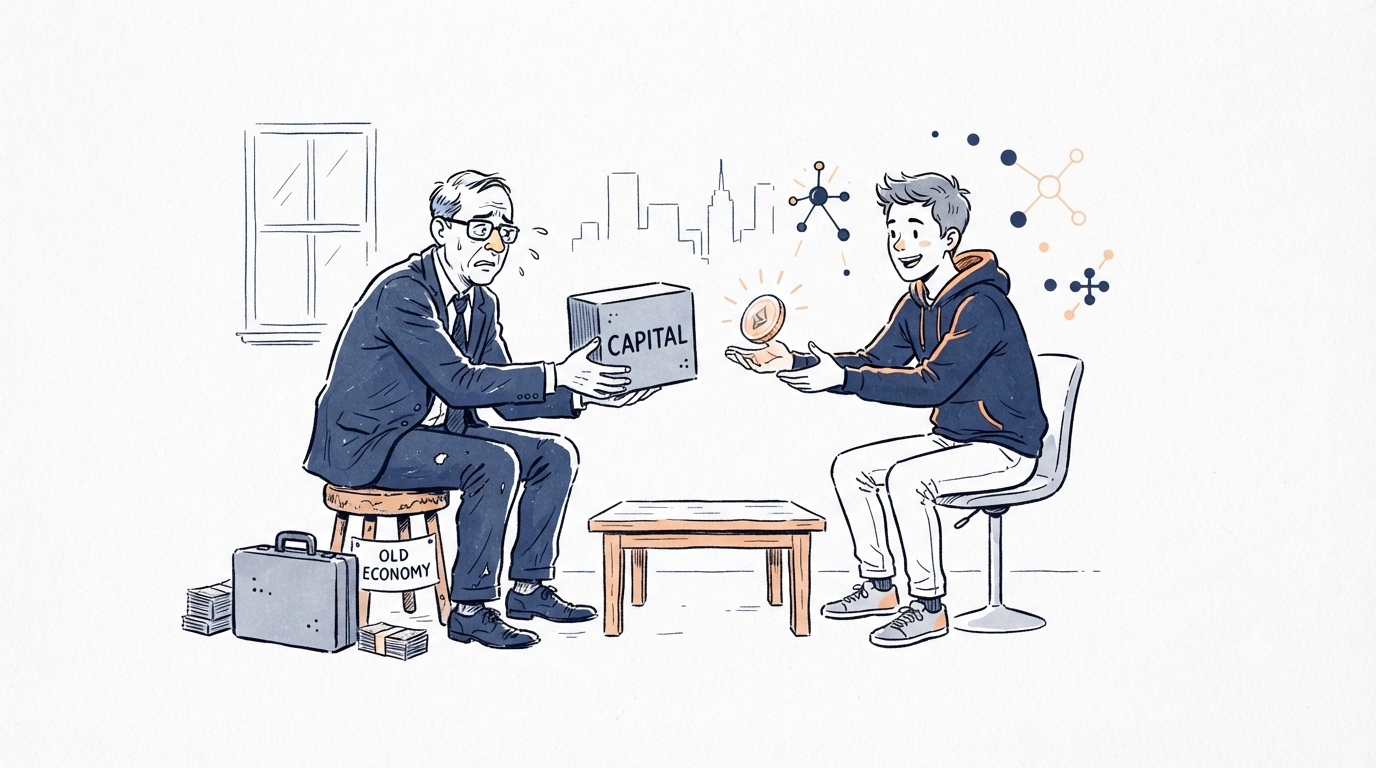

For decades, building a successful tech company required following a rigid, almost geographical playbook. You needed an idea, a pitch deck, and enough connections to secure meetings in the walled gardens of Silicon Valley.
Founders would spend months knocking on the doors of venture capital firms, hoping a small group of gatekeepers would grant them the seed money to build their vision. If they succeeded, it would take years—sometimes a decade, before regular people could invest through an Initial Public Offering (IPO).
Today, the financial architecture of the internet is being fundamentally rewired. A developer sitting anywhere in the world can write a smart contract, issue a digital asset, and instantly connect with a global pool of supporters.
This shift is giving rise to a powerful and controversial new financial ecosystem. Internet capital markets are blending crowdfunding, digital communities, and open networks to create a completely new model for crypto token funding. But as the barriers to entry collapse, the complexity of navigating this space increases.
Beyond Bitcoin: The Beginner’s Guide to the 8 Types of Crypto Tokens
What Are Internet Capital Markets?
To understand internet capital markets, you need to look at how capital historically moves. In traditional finance, money flows through heavy intermediaries: investment banks, brokerage firms, and clearinghouses.
Internet capital markets strip away the middlemen. They describe a borderless, blockchain-based environment where companies and protocols issue digital native assets—tokens—to raise capital, bootstrap liquidity, and reward early adopters.
Instead of issuing shares of stock, a startup creates a crypto token. This digital asset is recorded on a public blockchain and can be traded almost instantly by users worldwide.
This means a project can launch a token before it even has a fully finished product. The open market begins trading this asset 24/7, with its price dictated by supply, demand, and the community’s belief in the founding team’s ability to execute their roadmap.
For the first time, the line between an early-stage investor and a daily consumer is blurred. In this new digital economy, the people who use the product are often the exact same people funding its development.
How Startups Are Trading VCs for Tokens
The shift from private venture capital to public crypto token funding did not happen by accident. It is a direct response to a changing tech landscape.
As traditional venture capital became more risk-averse, demanding proven revenue models and massive user bases before writing a check, Web3 builders looked for alternative routes. They realized their communities were not just users; they were a massive, untapped source of capital and marketing power.
Here is a closer look at how internet capital markets actually function in the real world.
1. Minting the Token (The Digital Genesis)
The first step in this new funding model is the creation of the digital asset. Years ago, launching a cryptocurrency required deep technical expertise and building a blockchain from scratch.
Today, infrastructure has evolved. Startups can deploy smart contracts on fast, low-cost networks like Solana or Ethereum layer-2 solutions in a matter of minutes.
While some tokens are designed with specific utility—like paying for transaction fees or unlocking software features, many assets launched in internet capital markets start primarily as speculative instruments.
While speculation carries a negative stigma in traditional finance, in the crypto space, it serves a functional purpose. It allows startups to validate market interest and gather resources before committing millions of dollars to software development.
2. Community as the New Market Maker
Once the token is live, it usually begins trading on decentralized exchanges (DEXs). This is where the magic—and the chaos—of internet capital markets truly begins.
Unlike a traditional stock that relies on professional market makers to provide liquidity, a token’s early survival depends entirely on the community.
Discussions on social media, developer updates, and organic marketing drive the trading volume. In this environment, the market acts as a real-time, collective price discovery mechanism.
If the community loses faith, the price can collapse overnight. But if the project gains traction, the token can quickly move from decentralized pools to major global exchanges like Binance, Coinbase, or Kraken, introducing the asset to millions of new buyers.
3. The Utility vs. Speculation Balance
In the traditional tech world, companies pay platforms like Google or Meta for user acquisition. In internet capital markets, startups use their own tokens to incentivize growth.
When early adopters buy or earn a token, they become financially aligned with the project’s success. They naturally transform into brand ambassadors, sharing the product and defending the ecosystem online.
However, the most successful projects eventually transition from pure speculation to real-world utility. They integrate the token into their core product, using it for governance voting, revenue sharing, or ecosystem rewards.
When a token has a clear economic purpose, it stops being a mere internet trend and becomes a foundational piece of a functioning digital economy.
Token vs. Stock: Are You Really an Owner?
At first glance, buying a startup’s token feels very similar to buying a company’s stock at an IPO. Both involve investing money with the hope that the asset’s value will appreciate over time. However, this comparison is dangerous for beginners.
When you buy equity in a traditional company, you are acquiring a legal slice of that business. You are entitled to certain shareholder rights, potential dividends, and protection under strict financial regulations.
In internet capital markets, a token rarely represents legal equity. Buying a crypto token does not automatically make you a shareholder. In most cases, you have no legal claim to the company’s physical assets or traditional cash flow.
The value of your token relies almost entirely on the network effect and the ongoing demand within the specific crypto ecosystem.
The Institutional Reality Check: Treasury and Vesting
For serious wealth managers and institutional investors looking at crypto token funding, evaluating a project goes far beyond community hype. They look strictly at on-chain fundamentals.
One of the biggest red flags in this market is poor tokenomics. If a founding team mints a token and holds 80% of the supply with the ability to sell at any time, retail investors are essentially acting as exit liquidity.
Legitimate projects use public “vesting schedules”—smart contracts that lock the founders’ and early investors’ tokens for years, releasing them slowly to ensure long-term commitment.
Furthermore, smart startups do not keep their entire treasury in their own highly volatile token. They actively diversify their capital into stablecoins (like USDC or USDT) to ensure they can continue paying developers and funding operations during brutal, multi-year bear markets. Transparency in treasury management is what separates a sustainable business from a fleeting internet scheme.
Are Internet Capital Markets Worth the Hype?
Internet capital markets are still in their infancy, acting as a massive, real-time experiment in global economics. For anyone looking to explore this space, understanding the dual nature of the model is crucial.
The Clear Advantages
The primary benefit is democratized access. Historically, early-stage tech investments were reserved for accredited investors and specialized funds. Tokens allow anyone with an internet connection to support a protocol from day one.
The speed of execution is another massive advantage. While negotiating a traditional venture capital round can take six to nine months of legal paperwork, a token launch can mobilize millions of dollars in USD equivalent in a matter of hours.
This velocity allows teams to test, fail, and pivot faster than ever before, driven by a community that provides instant, relentless feedback.
The Undeniable Risks
However, the removal of gatekeepers also means the removal of safety nets. Because issuing a token is so technically simple, the market is flooded with inexperienced teams, flawed business models, and outright scams.
Without the requirement to show audited financials or proven revenue, prices are often driven by sentiment rather than objective data. This creates extreme volatility. A token might surge by 300% on a social media rumor, only to crash the following week when the team fails to deliver a software update.
Regulatory uncertainty also looms large over internet capital markets. Authorities globally—from the SEC in the United States to the MiCA framework in Europe, are actively debating how to classify and regulate these assets. If a token is deemed an unregistered security, the project could face severe legal consequences, wiping out investor value overnight.
The Future of Digital Funding
It is too early to say whether internet capital markets will completely replace traditional venture capital or the classic IPO. However, they have already proven that alternative, community-driven funding models are not only possible but highly effective.
Tokenization has permanently lowered the barriers to raising capital, proving that when users have a financial stake in the platforms they use, their engagement skyrockets. But as this ecosystem matures, the rules of the game are changing.
The era of launching a token based purely on an idea and a website is ending. In the coming years, internet capital markets will undergo a natural selection process. The projects that survive will be those that treat their tokens not as quick fundraising tools, but as vital, integrated components of a product that solves real problems.
For anyone navigating this space, the approach should be cautious and analytical. Look past the social media noise. Examine the team’s background, demand transparency in their treasury, and understand the token’s true utility. In the world of crypto token funding, community enthusiasm is a great starting point, but only solid fundamentals will survive the long game.
How to Choose a Market vs Limit Order Crypto Strategy to Avoid Slippage
This content is for informational purposes only and does not constitute financial advice.