
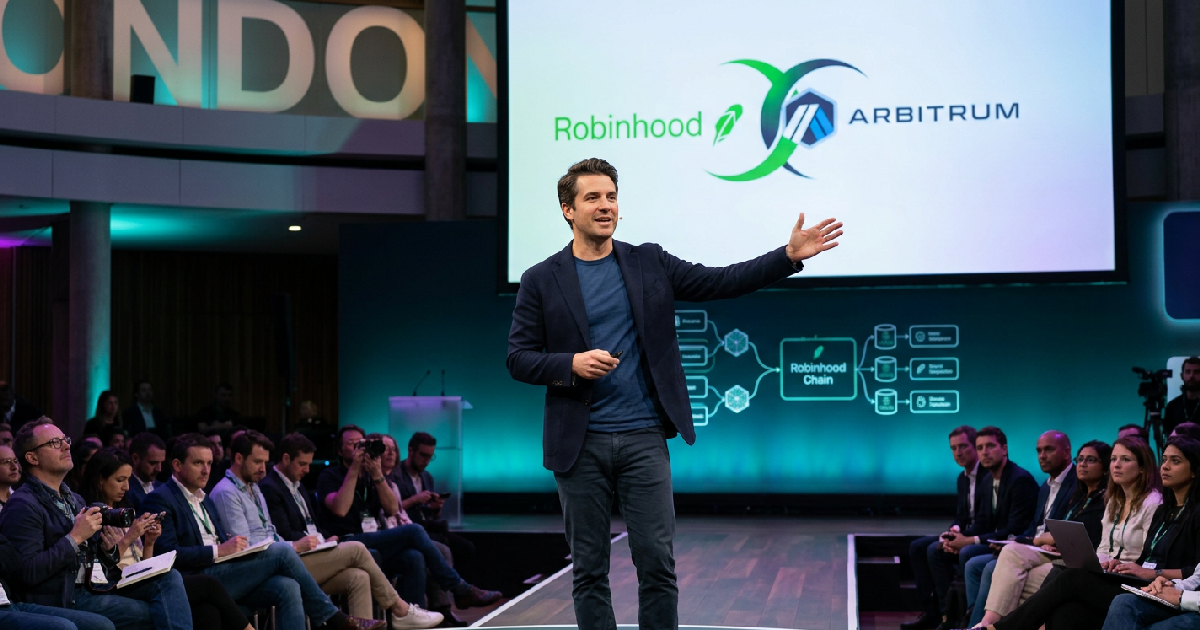

Robinhood Markets, Inc. (HOOD) officially launched the public mainnet for the Robinhood Chain on July 1, 2026, marking a significant transition from a traditional brokerage into a foundational infrastructure provider for the decentralized finance (DeFi) ecosystem.
Johann Kerbrat, Senior Vice President and General Manager of Crypto and International at Robinhood, announced the rollout during an event in London, confirming that the new Layer 2 blockchain, built on Arbitrum (ARB) technology, is now live for developers and retail users worldwide.
Robinhood Chain architecture and the Arbitrum partnership
The new network aims to serve as a specialized hub for tokenized real-world assets (RWAs), including equities and exchange-traded funds (ETFs), allowing for 24/7 trading and seamless integration with existing DeFi applications.
Alongside the blockchain launch, the company introduced Robinhood Earn, a decentralized lending product that enables users to earn an estimated 7% annual percentage yield (APY) on USDG, the company’s native dollar-backed stablecoin.
This aggressive move into onchain finance follows a successful testnet phase that began in February 2026 and signals the firm’s attempt to diversify revenue streams as traditional brokerage commission structures face continued pressure.
The technical foundation of the Robinhood Chain relies on the Arbitrum modular Layer 2 framework, a choice intended to balance the robust security of the Ethereum mainnet with the high throughput required for modern trading. By utilizing this technology, Robinhood can offer significantly faster finality, with block times recorded at approximately 100ms.
Key details
This speed is critical for institutional-grade tokenization, where milliseconds can impact the execution price of a tokenized stock or derivative.
Steven Goldfeder, Co-founder and CEO of Offchain Labs—the primary developer behind Arbitrum—hailed the launch as a landmark moment for the industry. He noted that the Robinhood Chain is uniquely positioned to deliver the next chapter of permissionless financial services.
To encourage early development, Robinhood previously committed $1 million to the 2026 Arbitrum Open House program, a fund designed to subsidize developer activity and research on the network.
For the average user, the Ethereum-compatible nature of the chain means that assets held in the self-custody Robinhood Wallet can be moved, bridged, and utilized across a vast array of established DeFi protocols. While Ethereum network outlook strengthens through these institutional integrations, Robinhood’s approach focuses on removing the “technical friction” that has historically kept retail investors away from onchain lending and borrowing.
Tokenized equities and global expansion strategy
One of the most disruptive features of the mainnet launch is the full rollout of Stock Tokens. These tokenized versions of U.S.-listed equities and ETFs are now available through the Robinhood Wallet in more than 120 countries.
Although specific availability varies by local jurisdiction, the product allows investors in international markets to gain exposure to over 2,000 U.S. stocks with the benefits of blockchain ownership, such as dividend support and around-the-clock trading windows.
This strategy mirrors the company’s recent international growth efforts, including the acquisition of WonderFi to enter the Canadian market and the announcement of crypto trading services in the United Kingdom. In Europe, Robinhood is also expanding its perpetual futures offerings to include not just cryptocurrencies, but also commodities, ETFs, and foreign exchange markets.
This expansion comes even as crypto liquidations rise across the broader market, suggesting Robinhood is betting on a long-term shift toward tokenized derivatives rather than just spot trading.
Key details
Johann Kerbrat emphasized that while crypto was originally built “by engineers for engineers,” Robinhood’s goal is to onboard the world by making these tools intuitive.
By integrating tokenized stocks into a DeFi environment, users can now use their equity holdings as collateral for loans or as margin for trading, a level of capital efficiency that is rarely available to retail investors in the traditional brokerage space.
AI-powered trading and Agentic Accounts
In addition to the blockchain infrastructure, Robinhood unveiled a new tool dubbed Agentic Accounts for crypto. This AI-powered trading feature allows eligible users in the United States to connect sophisticated AI models directly to their trading infrastructure.
Unlike fully automated bots of the past, these accounts allow users to retain strict control over capital allocation and specific trading parameters while leveraging AI to execute complex strategies in real-time.
The introduction of Agentic Accounts reflects a broader trend of “AI-driven finance” that Robinhood believes will eventually replace manual order entry for active traders. By providing an API-first approach to its own blockchain, Robinhood is inviting developers to build autonomous agents that can manage portfolios on behalf of users, potentially increasing trading volume even during periods of low human market activity.
Market reaction and the path to the everything exchange
The financial markets reacted positively to the news, with Robinhood (HOOD) shares rising 5% on the day of the announcement. Despite the rally, shares remain roughly 30% below their October record highs. Investors appear to be weighing the company’s ambitious product map against recent organizational changes, including the layoff of approximately 290 employees—10% of the workforce—intended to streamline management.
Robinhood Chairman and CEO Vlad Tenev has been vocal about his vision for an “everything exchange.” In his view, the distinction between a stock brokerage and a crypto exchange is an artificial one created by legacy technology.
By moving financial services onchain, the company can bypass the T+1 or T+2 settlement cycles that dominate Wall Street, instead offering near-instantaneous settlement for any asset class.
This transition is particularly relevant as bitcoin exchange supply maintains multi-year lows, forcing traditional platforms to find new ways to engage users through secondary services like lending and tokenized assets.
The launch of the USDG stablecoin and the 7% yield offered through Robinhood Earn further cements this goal. By controlling the stablecoin, the blockchain, and the user-facing wallet, Robinhood is creating a closed-loop financial ecosystem that captures fees at every level of the transaction, from the initial swap to the interest earned on decentralized loans.
Future outlook for Robinhood Chain developers
As the mainnet matures, the focus will shift from infrastructure to ecosystem growth. Robinhood has already partnered with several major industry providers, including Chainlink, Alchemy, Allium, LayerZero, and TRM, to ensure the network has the necessary data oracles and security monitoring tools. Developers can currently access network entry points and standard Ethereum development kits to begin deploying applications on the chain.
The company has also set up a dedicated feedback loop for developers via their internal group to refine the developer experience.
With total platform assets sitting at $377 billion and a customer base of 27.7 million funded users as of late May 2026, the Robinhood Chain enters the market with a significant “built-in” audience that few other Layer 2 solutions can boast.
The success of the network will likely depend on whether Robinhood can convince its millions of stock traders to move their portfolios into this new, onchain environment.