
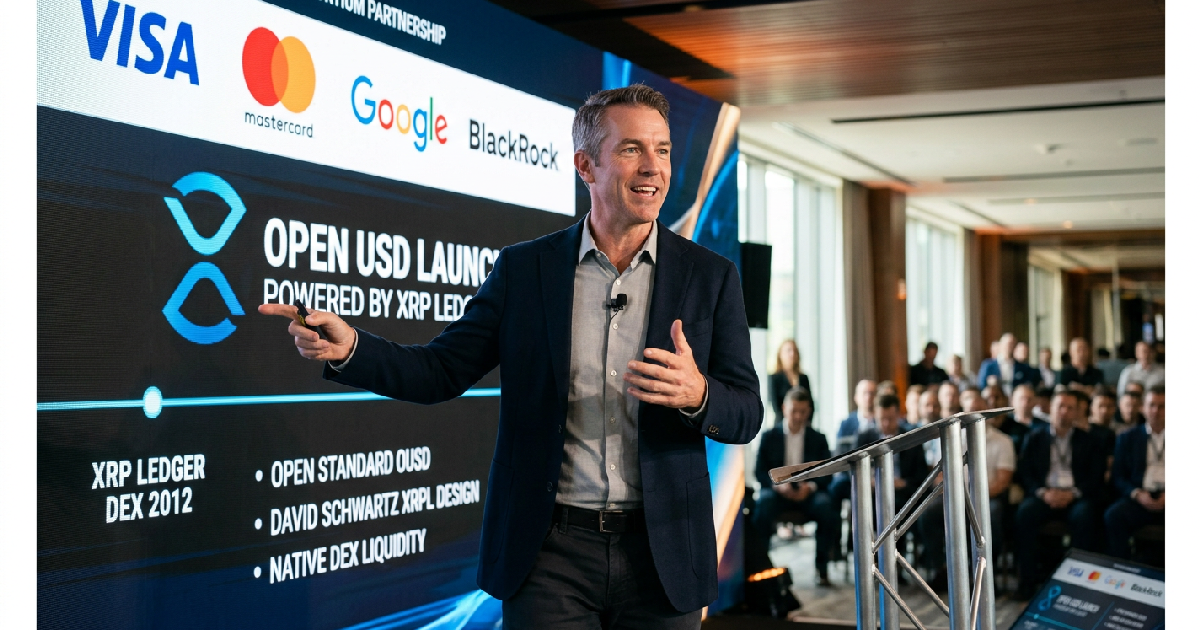

Matt Hamilton, a former Ripple developer, stated on June 15, 2026, that the XRP Ledger was “15 years ahead” of current market trends following the launch of a new institutional stablecoin.
The credit card giants Visa and Mastercard, alongside Google and BlackRock, announced the Tuesday, June 30, 2026, debut of Open USD (OUSD), a dollar-pegged asset governed by a consortium of over 140 businesses.
Early XRPL architecture and the decentralized exchange claim
Hamilton noted that the structural solutions found in this new project effectively mirror architectural choices embedded in the XRP Ledger (XRPL) as early as 2012.
The Open Standard venture, which oversees OUSD, allows members to mint and redeem stablecoins without volume limits or costs while sharing reserve earnings among partners.
Hamilton argued that this multi-issuer approach was the original vision of the XRPL creators, who integrated free token issuance and a built-in decentralized exchange (DEX) at the dawn of the industry.
At the time, global banks showed little interest in issuing their own tokens, but the recent move by major financial players suggests the market has finally embraced the decentralized liquidity model.
The XRP Ledger began development in 2011 and officially launched in 2012, featuring a decentralized exchange that has operated continuously since its inception. Matt Hamilton explicitly described the protocol as “the very first DEX in existence,” claiming that the industry’s current efforts to address liquidity fragmentation are effectively “re-inventing the wheel.”
He expressed frustration that newer projects continue to try to re-solve technical hurdles that the XRPL addressed over a decade ago.
Key details
Hamilton’s reaction was specifically prompted by a new DEX project called Mato, which was pitched during the Solana Summit Germany. He noted that while it is positive to see these solutions appearing on networks like Solana, the persistence of the same technical problems suggests the industry struggles to move forward.
As David Schwartz and the XRPL Foundation continue to promote the ledger’s utility, the OUSD launch serves as a high-profile validation of the protocol’s early multi-token issuance philosophy.
Consortium governance and the Open USD reserve model
The launch of Open USD represents a shift toward neutral governance and shared economics for digital assets. Carolyn Weinberg, the chief product and innovation officer at BNY, stated that this specific combination has the “potential to unlock the next phase of digital assets growth.” Unlike previous models, OUSD distributes the yield from U.S.
Treasury-backed reserves among its 140-plus partners, minus a small management fee to cover operational costs. This structure turns participants like Coinbase and Stripe into active stakeholders rather than passive users.
Ripple has joined the Open Standard consortium as an integration partner, ensuring that OUSD assets will be supported directly on the XRP Ledger. This integration highlights the ledger’s ability to act as a bridge for global value, especially as XRP speculative activity remains a focal point for market analysts.
By utilizing the XRPL’s native central limit order book (CLOB) DEX, these bank-issued coins can be exchanged at high speed without the need for centralized intermediaries or automated market makers.
Legislative clarity and the road to 2026 global adoption
The rapid formation of the Open Standard consortium follows significant regulatory shifts in the United States. In 2025, President Donald Trump signed the GENIUS Act into law, providing federal guidelines that gave institutions the confidence to scale stablecoin adoption.
This legal framework has allowed legacy firms to focus on real-world utility, particularly in settlement systems where liquidity and timing are critical. As legislative progress continues, the boundary between traditional finance and blockchain protocols is becoming increasingly porous.
Mastercard’s executive vice president for blockchain, Raj Dhamodharan, noted that the next phase of adoption is centered on settlement efficiency. For the early architects of the XRP Ledger, including David Schwartz, who transitioned to CTO Emeritus at Ripple in late 2025, the current landscape reflects the interoperable future they coded years ago.
Versan Aljarrah, founder of Black Swan Capitalist, pointed out that Ripple remains “right in the middle” of this announcement, positioning the XRPL to handle the projected influx of institutional volume when OUSD goes live later in 2026.