
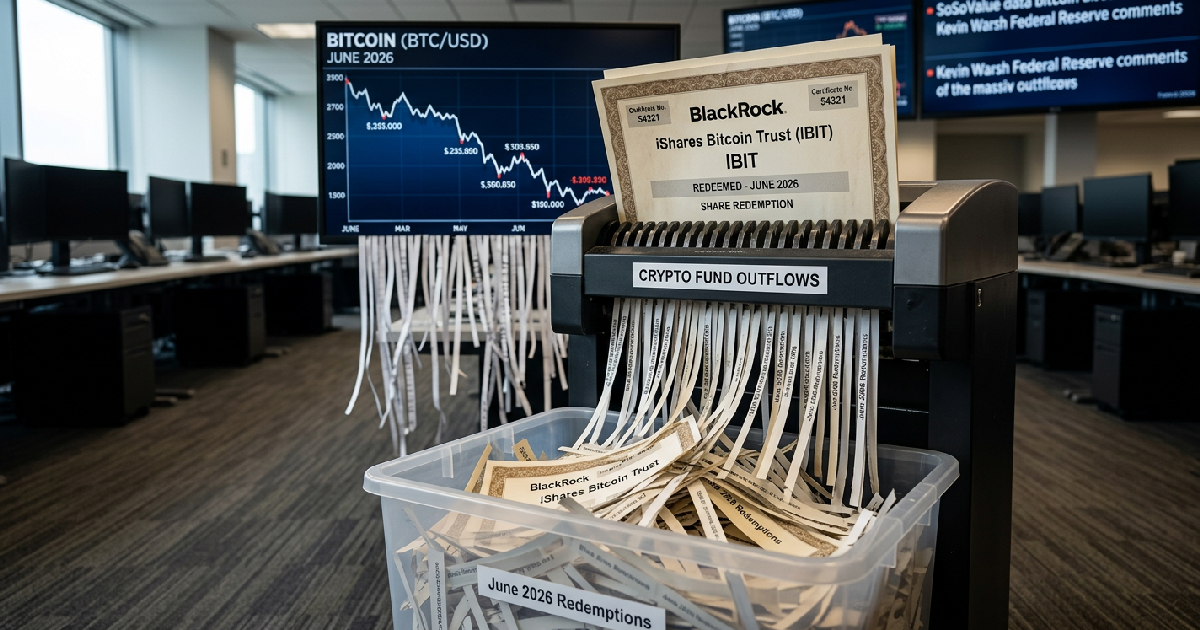

U.S. spot Bitcoin ETFs recorded a staggering $4.5 billion in net outflows throughout June 2026, marking the most severe monthly redemption period since the financial products launched in January 2024. Data from SoSoValue indicates that June’s exodus surpassed the previous record of $3.48 billion set in February 2025 by approximately 29%. This historic capital flight coincided with a 20% decline in the underlying price of Bitcoin (BTC), which traded near $58,500 by the end of the month.
The month ended on a streak of nine consecutive days of redemptions. On June 30 alone, approximately $222.6 million exited the market, with BlackRock’s iShares Bitcoin Trust (IBIT) leading the daily losses at $212 million. Total assets across the sector have now retreated to roughly $71 billion, down significantly from the $83 billion recorded at the opening of June.
Record outflows from crypto funds signal investor caution
BlackRock’s IBIT bore the brunt of the volatility, accounting for $3.55 billion of the monthly total, or nearly 79% of the category’s entire redemptions. This single-fund outflow almost matched the prior record for the entire ETF sector on its own. The Fidelity Wise Origin Bitcoin Trust (FBTC) also experienced heavy selling, including a $274.48 million exit on June 26. Such concentration suggests that large institutional holders, who previously provided a floor for the market, are now aggressively de-risking.
This widespread exit comes at a time when analysts are closely monitoring Bitcoin price analysis for signs of a new bottom. The week of June 22–26 alone saw $1.79 billion leave the sector. While Grayscale Bitcoin Trust (GBTC) saw $135.3 million in weekly outflows, smaller funds like those from Invesco Galaxy (BTCO) and Bitwise (BITB) also faced millions in redemptions, totaling $53.03 million and $34.6 million respectively during that window.
Federal Reserve policy shifts under Kevin Warsh
Market sentiment soured following remarks from Federal Reserve Chairman Kevin Warsh at a European Central Bank (ECB) forum. Appearing on a panel to discuss monetary policy, Warsh remained coy on specific forward guidance but noted he expects a “good family fight” regarding policy at the Fed’s July meeting. The market interpreted this hawkish tone as a sign that rate cuts are off the table, with some betting on a rate hike in July or September.
This shift in the macro environment has pushed bond yields higher, with the 10-year Treasury yield rising to 4.50%. Higher yields typically pressure non-yielding assets like Bitcoin. Furthermore, crypto liquidations rise alongside yields when speculative capital seeks safer returns in government debt. Warsh noted that inflationary pressures from the “AI boom” and geopolitical tensions would be central to the Fed’s upcoming discussions.
Macroeconomic data and liquidity competition
The ADP National Employment Report for June provided a “soft” reading, showing private-sector job growth of only 98,000. This was a decline from the 122,000 jobs reported in May and fell short of economist forecasts looking for 113,000. While a cooling labor market sometimes triggers hopes for a pause in rate hikes, the current environment is complicated by significant capital being diverted to other sectors.
Liquidity was further strained by the debut of SpaceX on June 12, which raised $75 billion. Within days of its launch, the aerospace company absorbed billions in risk capital, with retail buying breaking single-session records. This coincided with a spike in Bitcoin’s 30-day volatility index (BVIV), which jumped 22% in June. As volatility rose and the price broke below $60,000, many institutional desks appeared to favor the safety of treasuries or the established momentum of the AI sector.
Maturing market math and long-term outlook
Despite the record outflows, CryptoQuant CEO Ki Young Ju argues the parabolic cycle for Bitcoin is not over, though it has become “more expensive.” Ju noted that while $2.7 billion in capital drove a massive gain in 2011, this cycle has absorbed $697 billion to produce a 689% return. The math suggests that for Bitcoin to reach the next leg of growth, it must be absorbed as a core macro asset by institutions on a trillion-dollar scale.
For now, the sector remains under pressure. While newer products like Morgan Stanley’s MSBT and the Grayscale Bitcoin Mini Trust saw minor inflows in late June—adding $26.2 million and $71.7 million respectively during the final full week—these were dwarfed by the heavy redemptions from BlackRock and Fidelity. Investors are now looking toward the upcoming Nonfarm Payrolls Report to see if the slowing job market data will force the Federal Reserve to soften its hawkish stance.