
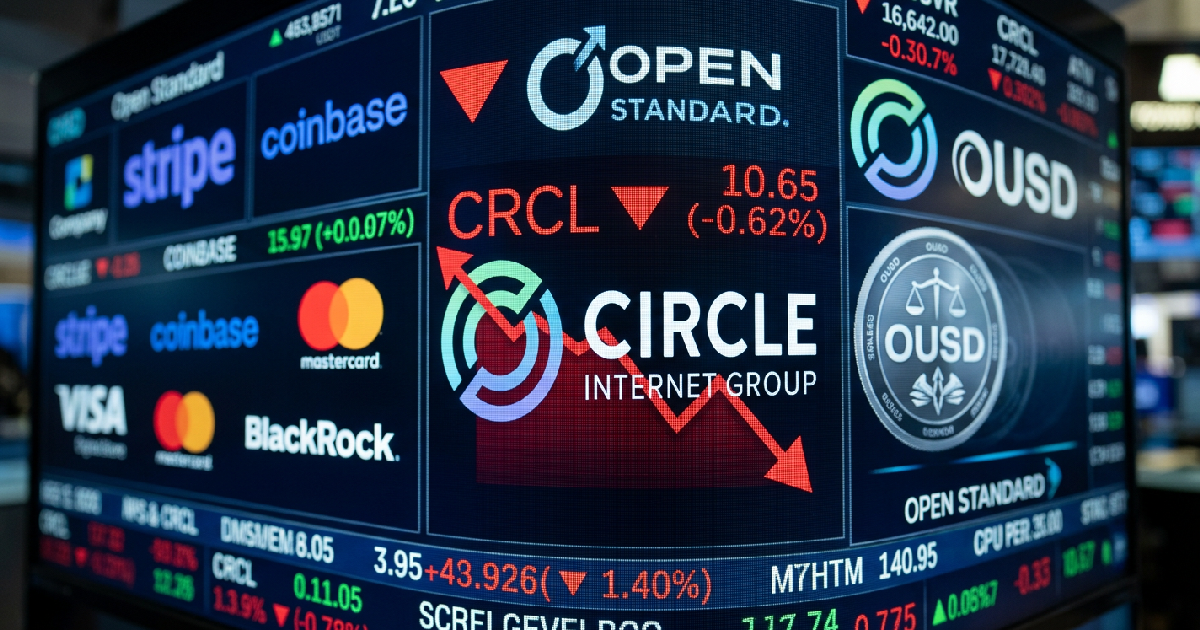

Shares of Circle Internet Group (CRCL) fell as much as 13% on Tuesday, June 30, 2026, following the public unveiling of the Open Standard consortium and its new stablecoin, Open USD (OUSD). The coalition, which includes more than 140 companies such as Stripe, Coinbase, Visa, Mastercard, and BlackRock, represents a direct challenge to the business models of established issuers like Circle and Tether.
Led by Bridge co-founder Zach Abrams, the Open Standard project aims to disrupt the industry by sharing reserve income with its partners rather than retaining it for the issuer. This “revenue-share” model targets the core economics of USD Coin (USDC), which relies on keeping interest earned from the assets backing the token.
Circle Internet Group faces revenue model competition from Open Standard
While Clear Street managing director Owen Lau noted that a 16% intraday slide in Circle stock might be an “overreaction,” the news has intensified scrutiny of the incumbent’s market position.
The market volatility surrounding Circle stock reflects growing concerns that stablecoins are evolving into a low-margin utility for finance giants. Traditionally, issuers have operated with high margins by holding customer deposits in interest-bearing U.S. Treasury bills. By promising to distribute that yield back to its 140-plus participants, Open USD could uniquely undercut Circle’s economics, according to Rob Hadick, general partner at venture capital firm Dragonfly.
The involvement of Stripe is particularly notable because of its broad suite of financial products. If a major payment processor can earn revenue simply by utilizing a specific digital dollar, the incentive for institutional partners to migrate away from USDC becomes significant.
Key details
However, analysts caution that the impact on Circle’s $73 billion market cap remains speculative until OUSD officially launches, which is expected to occur later this year.
Despite the high-profile backing, history shows that assembling a list of logos is not a guarantee of success. For example, Paxos’ Global Dollar Network (USDG) also shares reserve income with partners but has struggled to gain substantial traction.
As of June 2026, USDG holds a supply of just $3 billion, a small fraction of the dominance enjoyed by USDC and Tether’s (USDT) $145 billion market cap. This suggests that market liquidity trends are often driven by established network effects that are difficult to dislodge.
Open USD faces technical and structural uncertainties
While the consortium has attracted significant attention, the initial announcement left several critical technical questions unanswered. Noelle Acheson, author of the Crypto Is Macro Now newsletter, described the release as “vague” regarding key issues. Specifically, the consortium has not yet disclosed the ownership structure of Open Standard, the licensing framework for the issuer, or how reserve income will be distributed among its many partners.
Crucially, the consortium has not yet confirmed which blockchains Open USD will launch on natively. This lack of clarity contrasts with Circle, which has spent years ensuring USDC is available across nearly every major network. The success of OUSD will likely depend on its ability to achieve similar ubiquity in an increasingly crowded market.
If the project faces delays or integration hurdles, it may struggle to convince users to switch from established options.
Regulatory compliance remains another hurdle for any new entrant. As the CLARITY Act advances through committees, the requirements for stablecoin oversight are becoming more rigorous. Circle has long positioned itself as a transparent, regulated entity that provides regular attestations. Open Standard must now demonstrate it can meet these same standards while managing a complex web of payouts to a massive number of corporate stakeholders.
The evolving partnership between Coinbase and Circle
The OUSD announcement has also cast a spotlight on the commercial relationship between Coinbase and Circle. The two companies originally founded the Centre Consortium to issue USDC and currently continue to share economics tied to reserve income under a commercial agreement. However, that specific deal is reportedly up for renewal in August, leading to questions about the future of their collaboration.
The fact that Coinbase is a member of the rival Open Standard consortium suggests a possible shift in the exchange’s strategy. Dragonfly general partner Omar Kanji noted that while the companies might renew their agreement with revised economics, a potential breakup appears more plausible than before.
If major distribution channels begin to prioritize tokens with higher revenue shares, the competitive landscape for “money itself” could be permanently altered.
Ultimately, the challenge for Open USD is whether it can move beyond the “logo spray and pray” phase of adoption. Analysts like Omid Malekan of Columbia Business School argue that putting a name on a list is easy, but shifting corporate behavior is hard.
The real winners may not be the issuers themselves, but the exchanges, wallets, and platforms focusing on transparency that control how these digital dollars are distributed to the end user.