
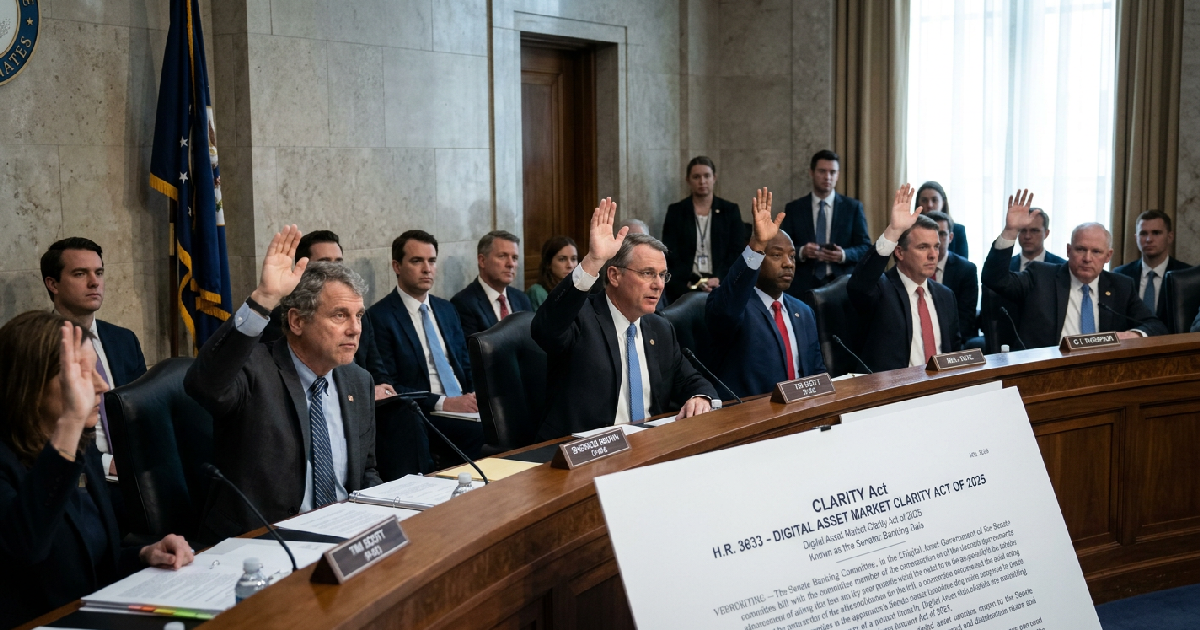

The Digital Asset Market Clarity Act of 2025 (H.R. 3633), widely known as the CLARITY Act, is moving toward a full Senate floor vote following its approval by the Senate Banking Committee on May 14, 2026. Introduced by House Financial Services Committee Chairman French Hill (AR-02) and House Agriculture Committee Chairman G.T.
Thompson (PA-15), the bill establishes a definitive legal framework for the U.S. cryptocurrency market. By drawing clear jurisdictional boundaries between federal regulators, the legislation aims to resolve long-standing oversight disputes and provide consumer protections for digital asset users.
The proposed law creates a dual-regulatory structure that divides responsibility based on asset classification. The Securities and Exchange Commission (SEC) would retain oversight of “investment contract assets,” while the Commodity Futures Trading Commission (CFTC) would gain primary jurisdiction over “digital commodities” in spot markets.
Defining digital commodities through the mature blockchain test
This shift is intended to stop the flight of American crypto businesses to offshore jurisdictions by providing the legal certainty necessary to operate within the United States.
Progress in the Senate follows a decisive 294 to 134 bipartisan vote in the House of Representatives on July 17, 2025. As market sentiment shifts alongside this legislative progress, staff from the Senate Banking and Agriculture committees are now merging different versions of the bill.
This unified text will eventually face a full Senate vote, where a 60-vote threshold will likely be required to overcome potential procedural hurdles.
A central pillar of the CLARITY Act is the “mature blockchain test,” a technical benchmark used to determine when a digital asset is sufficiently decentralized to be classified as a commodity. If a token’s network passes this test, its regulatory status can shift from SEC oversight to the CFTC.
This mechanism provides a clear path for tokens that may begin as securities but evolve into functional utility assets over time.
To qualify as a mature blockchain, a network must meet several specific decentralization criteria. No single entity or group can control 20% or more of the token supply or voting power. Additionally, the network must possess open-source code and practical utility.
For older chains, the bill mandates that at least half of all tokens must be held by parties outside the founding team, ensuring no centralized entity maintains primary control over the ecosystem.
This classification system is expected to impact how major digital assets are handled by institutional investors. As wallet adoption trends higher, the ability to differentiate between a security and a commodity becomes vital for firms managing custodial services. The act also establishes standards for Qualified Digital Asset Custodians (QDACs), ensuring that customer assets are segregated from a firm’s operational capital.
Expanding Senate provisions and bipartisan amendments
The Senate version of the CLARITY Act has evolved to include several high-profile additions and cross-party amendments. Senator Elizabeth Warren co-sponsored the Build Now Act, a community development grant housing bill that was attached to the legislation as Section 904. Furthermore, Subcommittee Chair Cynthia Lummis successfully included provisions governing digital asset activities for banks and credit unions, alongside new rules for joint SEC-CFTC enforcement coordination.
Innovation-focused lawmakers have also carved out protections for the technological foundations of the industry. Section 604 contains the Blockchain Regulatory Certainty Act (BRCA), which protects non-custodial software developers from being classified as money transmitters. This ensures that those building open-source wallets and protocols do not face the same registration burdens as centralized exchanges, provided they do not hold user funds.
Newer amendments have introduced “sandbox” environments to test emerging technologies. Senator Mike Rounds, Senator Andy Kim, and Senator Mark Warner co-sponsored a bipartisan AI sandbox amendment to study the intersection of artificial intelligence and blockchain. Meanwhile, Senator Dave McCormick and Senator Bill Hagerty introduced a portfolio margining amendment to modernize how collateral is managed within digital asset trading environments.
Registration requirements and consumer protection standards
Under the CLARITY Act, centralized participants including digital commodity exchanges, brokers, and dealers must register with the CFTC within 180 days of the bill’s passage. These entities will be required to disclose their financial condition, ownership structures, and affiliated operations. They must also adhere to strict standards regarding trade surveillance, conflicts of interest, and system safeguards to protect the integrity of the market.
Consumer protections extend to physical entry points of the crypto market as well. The act mandates the registration of digital asset kiosks, commonly known as Bitcoin ATMs. Operators of these machines must provide customer warnings and receipts, implement anti-fraud policies, and enforce withdrawal limits. These measures are designed to increase transparency for retail users and provide law enforcement with better tools to monitor suspicious transactions.
The bill also carries significant tax implications by expanding the definition of a “broker.” This change may require more platforms to file Form 1099-DA with the IRS, increasing the visibility of crypto transactions for tax authorities.
While the legislative path remains complex, the continued engagement of key figures like Senator Mark Warner and Senator Catherine Cortez Masto suggests that the bill remains a priority as committees work toward a final unified text for the Senate floor.