
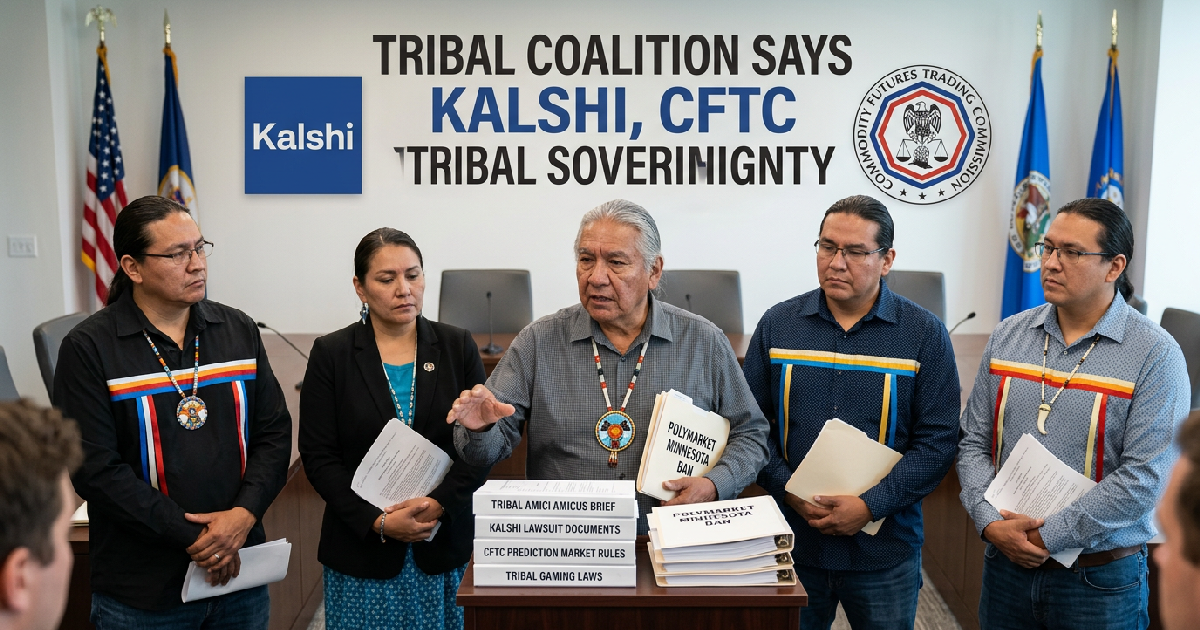

A coalition of 30 federally recognized American Indian tribes and 11 tribal regulatory agencies, collectively known as the “Tribal Amici,” filed legal briefs this month to block prediction market Kalshi and the Commodity Futures Trading Commission (CFTC) from operating on tribal land.
The coalition is urging federal courts to deny motions that would allow these platforms to bypass tribal and state gaming laws. These filings, submitted on June 11 and June 15, argue that unregulated sports-betting contracts threaten tribal sovereignty and divert essential revenue from indigenous communities.
The legal challenge centers on the authority to regulate gambling activities within American Indian jurisdictions. The Tribal Amici claim that actions by Kalshi and the CFTC amount to a “sub silentio reversal” of long-standing congressional policy and Supreme Court precedent.
By allowing prediction markets to operate under their own private regulation, the tribes argue that existing tribal-state gaming compacts are being undermined. This shift risks diminishing tribal self-determination and the ability of local governments to manage their own lands.
Financial stakes are high as these platforms process billions of dollars in volume. Bloomberg reports that Kalshi has processed $5.1 billion in notional trading volume during the World Cup, while crypto analysts state that Polymarket attracted $1.6 billion in a single week. Such figures highlight why com/bitcoin-price-77000-market-confidence-geopolitics-2026-analysis/”>market confidence in these platforms remains a point of contention for regulators. Tribal leaders argue that these revenues should support government services and tribal programs rather than flowing away from local economies.
Tribal gaming compacts under threat from private regulation
The core of the Tribal Amici’s argument is that the rise of prediction markets violates legal agreements between tribes and state governments. These compacts are approved by the United States and balance interests to ensure gaming is properly regulated.
The tribes are seeking the freedom to regulate platforms like Kalshi, Polymarket, and the recently CFTC-approved Novig. They argue that without tribal oversight, these platforms create a “private regulation” model that offers no protection for tribal interests.
In a filing on June 15, the coalition supported the State of New York’s opposition to the CFTC. This follows a lawsuit where the CFTC accused New York of infringing on its jurisdiction after the state targeted Coinbase Financial Markets and Gemini Titan over gambling promotion. This legal friction is occurring while com/mlb-home-run-predictions-odds-analysis-2026-sportsbook-review/”>MLB home run predictions and odds analysis continue to drive interest in sports betting contracts. The tribes contend the CFTC’s actions could dismantle agreements that carefully balance state and tribal interests in New York.
Revenue loss and the fight for self-governance
For American Indian tribes, gaming revenue is described as “vital” for funding economic development and self-sufficiency. The coalition asserts that prediction markets are siphoning money that should be used for healthcare, infrastructure, and tribal government services. Because these platforms often claim their activities are exempt from traditional gaming rules, they may avoid the regulatory fees and taxes that brick-and-mortar tribal casinos must pay.
The legal status of these contracts remains a major point of dispute in the courts. In March of this year, an Ohio federal court ruled against a 2025 lawsuit brought by Kalshi, stating that its sports event contracts do not qualify as “swaps.”
Kalshi is currently appealing that decision and the court’s rejection of its request for a preliminary injunction. The outcome could determine whether digital platforms can bypass state and tribal gambling prohibitions across the country.
National legal battles over prediction market bans
The struggle for control over prediction markets is widening to multiple states. This week, Polymarket joined Kalshi in a lawsuit against the state of Minnesota, challenging a ban on prediction markets that is scheduled to take effect in August. These legal maneuvers coincide with a period where com/bitcoin-signals-market-structure-analysis-2026/”>shifting market structure in the digital asset space has brought more eyes to decentralized platforms. The tribes remain firm that they must have the authority to regulate any such market operating on their land.
Furthermore, the CFTC is considering new rules that would classify certain contracts as illegal if they involve terrorism, assassinations, war, or illegal activity. While the federal government weighs these “public interest” concerns, the Tribal Amici are focused on the immediate economic impact of sports contracts.
They argue that federal approval of such markets without tribal consent ignores the legal rights of sovereign nations and threatens their financial stability.
As prediction markets handle billions of dollars in trades during the World Cup, the tribal coalition is making it clear that they will not accept the erosion of their regulatory power.
The coming months of litigation will likely decide if these digital platforms must finally adhere to the tribal-state frameworks that have governed American gambling for decades. For the Tribal Amici, the issue is not just about betting, but about the survival of tribal self-governance.