
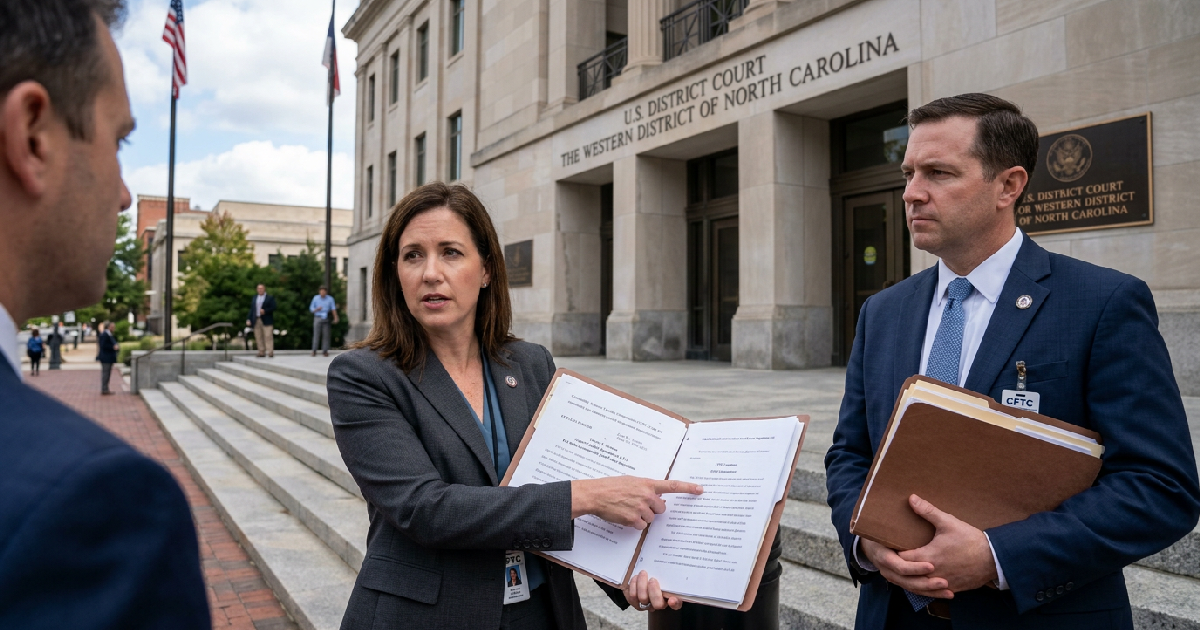

The Commodity Futures Trading Commission (CFTC) has filed a civil enforcement action against Trevor L. Vernon and his firm, Argent Capital Management LLC, for allegedly orchestrating a $14 million commodity pool fraud. The complaint, filed in the U.S.
District Court for the Western District of North Carolina, accuses the defendants of operating a Ponzi-like scheme that targeted at least 60 participants by misrepresenting trading performance while hiding “continuous and catastrophic” financial losses.
CFTC alleges Argent Capital Management operated Ponzi scheme
According to federal regulators, the alleged misconduct occurred from at least March 2022 through February 2026. Trevor L. Vernon reportedly solicited funds for a commodity pool intended to trade stock index futures, options on equity index futures, and major crypto assets including Bitcoin and Ether.
Instead of generating the profits promised in updates, the CFTC alleges that Vernon’s trades resulted in steady and substantial losses, totaling at least $8.6 million in futures and cryptocurrency trading.
The core of the agency’s complaint rests on allegations that Trevor L. Vernon misled investors by using a payout structure characteristic of a Ponzi scheme. While marketing himself as a skilled and profitable trader, Vernon allegedly used approximately $3 million of funds from new participants to pay out purported returns to earlier investors.
This tactic served to project an image of profitability, encouraging further investment while the actual pool was being depleted by market losses and misappropriation.
Beyond the deceptive payouts, the CFTC claims that the defendants sent monthly emails and quarterly updates that falsely showed rising account balances and positive returns that never existed. In reality, the trading accounts suffered from heavy losses that were never disclosed to the 60 participants who had entrusted the firm with their capital.
This Lack of transparency often mirrors the crypto market liquidation analysis seen in similar high-risk, unregistered investment pools.
The legal filing also includes allegations of misappropriation and registration violations. The CFTC asserts that Argent Capital Management LLC failed to register as a Commodity Pool Operator (CPO), and Trevor L. Vernon failed to register as an Associated Person of a CPO, as required by the Commodity Exchange Act (CEA).
These charges are part of seven counts that include fraud and making false statements to federal authorities during the commission’s investigation.
Federal investigation cites false testimony and registration failures
A significant aspect of the case involves the conduct of Trevor L. Vernon during the regulatory inquiry. The CFTC alleges that Vernon knowingly made false statements during sworn testimony taken as part of the Commission’s investigation. Providing inaccurate information under oath is a serious violation of federal commodities law and typically leads to enhanced civil penalties and permanent industry bans.
Argent Capital Management LLC, the entity named in the charges, is distinct from the established St. Louis-based firm of the same name. The North Carolina firm allegedly operated outside of regulatory boundaries, allowing the defendants to maintain their facade without the scrutiny of standard financial reporting. This case follows a pattern where fraudulent recovery schemes or unregistered pools target retail investors through falsified performance data.
By bypassing registration requirements, Vernon and his firm avoided the oversight mechanisms that ensure fund managers are subject to periodic audits. Federal regulators maintain that such requirements are essential for protecting the public from manipulation and abusive practices. The agency has classified Bitcoin and Ether as commodities, granting it jurisdiction over these assets when they are involved in pooled trading fraud.
Requested penalties and implications for crypto investors
The CFTC is seeking several permanent remedies in the North Carolina court to address the alleged $14 million fraud. These include full restitution for defrauded investors, disgorgement of ill-gotten gains, and significant civil monetary penalties. Furthermore, the agency is requesting permanent trading and registration bans against both Trevor L. Vernon and Argent Capital Management LLC to prevent future violations of the Commodity Exchange Act.
This enforcement action reflects a continued focus on retail fraud within the digital asset sector. As volatility persists, investors often look to Bitcoin price analysis to gauge market risks, but regulators emphasize that verification of a firm’s registration remains a primary defense against internal mismanagement. The CFTC’s complaint alleges that Vernon marketed the pool as highly profitable while masking losses that eventually exceeded $8 million.
The recovery process for the 60 affected participants may be difficult, as the CFTC reports that a significant portion of the $14 million raised was either lost in the markets or used for Ponzi-style payments.
While the agency seeks a court order for restitution, the final amount recovered depends on the remaining assets available from the defendants. The case remains a stark warning regarding the risks of “off-the-grid” investment pools that operate without federal oversight.