
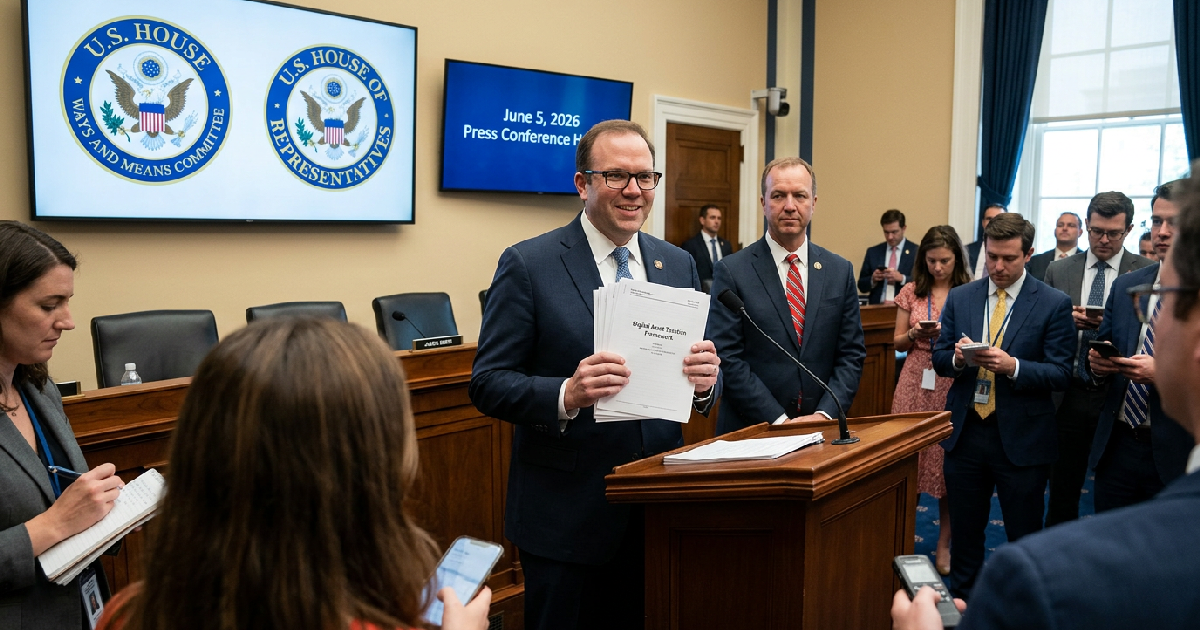

The U.S. House Ways and Means Committee circulated seven draft bills on June 5, 2026, proposing an expansive overhaul of how digital assets are taxed to provide clarity for miners, stakers, and casual users.
Chairman Jason Smith has made the establishment of a formal digital asset taxation framework a central priority for the committee, which is now preparing for a full hearing on the matter scheduled for Tuesday, June 9, 2026.
The legislative package aims to eliminate “phantom income” for crypto participants and creates tax parity between digital assets and traditional financial instruments like securities.
Representative Kevin Hern, an Oklahoma Republican on the committee, confirmed that the drafts specifically target the timing of taxation for mining and staking while proposing exemptions for certain stablecoin transactions from capital gains tax. By splitting the overhaul into seven distinct bills, the committee intends to let individual measures advance independently.
This strategy prevents a single controversial provision from stalling the entire reform effort, which supporters say is necessary to keep high-tech infrastructure and talent within the United States.
One of the most consequential proposals is the “Tax Clarity for Mining and Staking Act,” which would ensure that rewards are not treated as taxable income until they are actually sold. This would end the current “double taxation” burden where validators are often taxed at the moment of acquisition and again upon disposal.
The industry has long argued that this structure creates liquidity crises for small-scale operators who must sell assets just to cover a tax bill on coins they haven’t yet traded for cash.
Establishing a de minimis exemption for crypto transactions
The committee is also tackling the logistical nightmare of reporting small-scale crypto usage by proposing various de minimis exemptions. One specific draft includes a $10 exemption for network gas fees, ensuring that users aren’t required to calculate capital gains every time they pay to move assets on a blockchain.
This move mirrors previous efforts by politicians and treasury officials to treat digital assets more like functional currency than speculative property in daily commerce.
While the specific threshold for broader transaction exemptions is still being debated, the drafts build upon the Digital Asset PARITY Act co-authored by Representatives Steven Horsford and Max Miller. That earlier legislation suggested a $200 reporting threshold for stablecoin transactions.
Meanwhile, Senator Cynthia Lummis has previously advocated for an even higher $300 per-transaction exemption, suggesting there is significant bipartisan appetite for removing the tax friction involved in small digital payments.
The push for stablecoin reform is particularly notable as many lawmakers now view payment stablecoins as a form of digital cash. The drafts suggest that some stablecoin transactions could be entirely exempt from income tax, potentially allowing for a fixed $1 valuation for coins that conform to specific regulatory standards.
This shift is critical as stablecoin risks and treasury holdings continue to grow in importance within the broader U.S. debt and financial ecosystem.
Bringing digital assets into parity with traditional securities
A significant portion of the legislative package focuses on aligning crypto tax rules with those governing the stock market. This includes applying “wash sale” restrictions to digital assets for the first time.
If passed, traders would be required to wait 30 days before repurchasing a digital asset after claiming a tax loss on it, closing a popular loophole that currently allows crypto investors to harvest losses more aggressively than equity traders.
The drafts also aim to simplify charitable giving by eliminating the appraisal requirement for digital asset donations. Furthermore, the committee proposes extending securities lending rules to the crypto space. Under these new guidelines, qualifying crypto loans would no longer be treated as taxable sales, providing much-needed breathing room for institutional lenders and liquidity providers who currently face complex tax triggers when moving assets between wallets.
To encourage compliance during this transition, the House Ways and Means Committee has included a voluntary disclosure program. This initiative would allow taxpayers who previously failed to report crypto activities to resolve their issues without facing the full weight of standard penalties.
Cody Carbone, CEO of the Digital Chamber, praised the committee’s direction, stating his organization will work to “strengthen the drafts and deliver the tax clarity and fairness digital assets deserve.”
Impact on market stability and future compliance
The introduction of these drafts comes at a time when the market is increasingly focused on long-term structural health over short-term volatility. Better tax rules could reduce the cost of participation for both retail and institutional players, potentially leading to more stable accumulation phases. This legislative movement coincides with reports showing bitcoin supply on exchanges reaching multi-year lows as investors move toward long-term self-custody solutions.
Industry experts suggest that providing a clear tax roadmap will lower the barrier for traditional financial firms to enter the digital asset space. By mirroring mark-to-market accounting treatments used by active dealers in other sectors, the bills could professionalize the domestic crypto trading environment.
The committee, led by Chairman Jason Smith and Ranking Member Richard Neal, will begin the formal process of refining these legislative texts during the upcoming hearing on June 9, 2026.
If the U.S. successfully implements these changes, it could set a global precedent for how decentralized technologies are handled by centralized revenue services.
The focus now shifts to the testimony of the Treasury Department and industry stakeholders to see if the proposed $10 gas fee exemption and the staking deferral rules can survive the full legislative gauntlet. For now, the drafts represent the most comprehensive attempt yet to modernize the U.S. tax code for the digital age.