
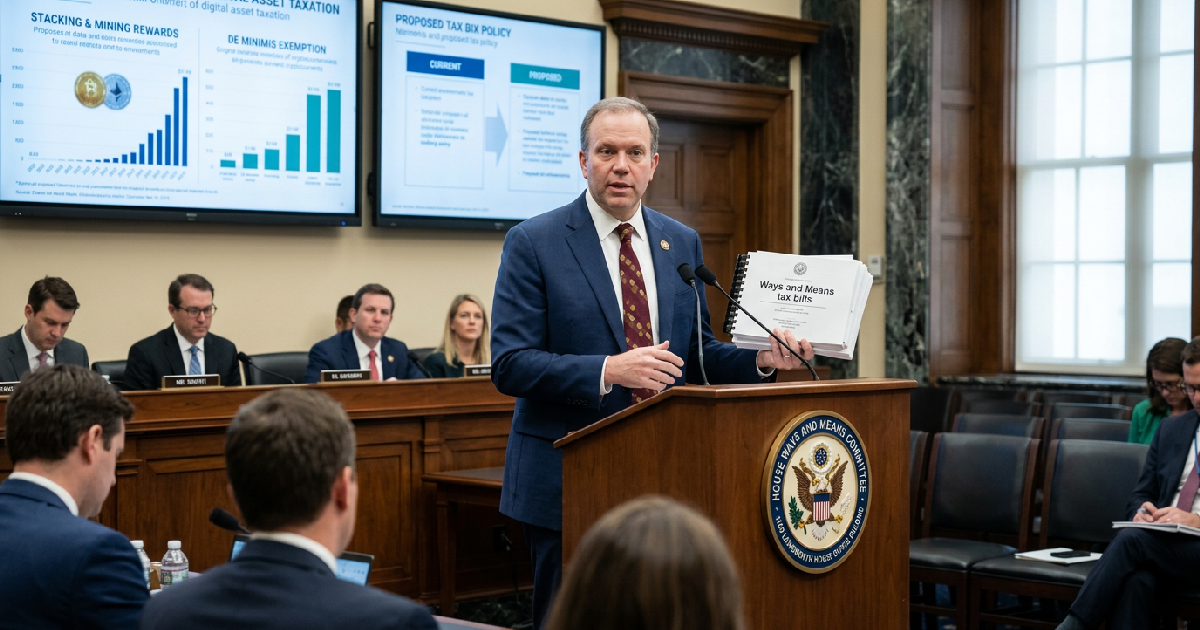

The U.S. House Ways and Means Committee circulated seven draft bills late Thursday, June 5, 2026, aimed at overhaul digital asset taxation, setting the stage for a high-stakes legislative hearing scheduled for tomorrow.
Chairman Jason Smith, who has made crypto tax clarity a priority, will lead the session on June 9 at 2:00 PM ET in the 1100 Longworth House Office Building. This package represents the first significant effort backed by leadership from a top-tier tax-writing committee to integrate digital assets into the federal code.
Republican committee member Representative Kevin Hern of Oklahoma confirmed that the panel intends to address the specific timing of taxation for staking and mining rewards. The current framework often leaves validators in a state of uncertainty regarding whether newly minted tokens are taxable at the moment of receipt or upon disposal.
By advancing seven separate discussion drafts rather than a single omnibus bill, the committee is allowing for a more granular focus on technical issues such as Bitcoin signals market structure and the application of wash sale rules.
Industry advocates have generally welcomed the move as a long-overdue modernization of rules that have remained largely unchanged since the IRS first classified Bitcoin as property twelve years ago. Alison Mangiero, the head of industry affairs and U.S. policy at the Crypto Council for Innovation, described the drafts as an "important first step.
" She praised the committee’s deliberate, structured engagement format, which involves reviewing specific legislation with expert witnesses before moving toward a formal markup process.
Addressing the burden of small crypto transactions
One of the most consequential proposals in the draft package is the introduction of a de minimis exemption to spare users from heavy capital gains paperwork on small purchases.
While past legislative attempts, such as Senator Cynthia Lummis’s 2025 bill or the Digital Asset PARITY Act, floated thresholds ranging from $200 to $600, the new drafts aim to finalize a limit that treats routine spending more like foreign currency.
This shift is intended to eliminate the compliance nightmare of calculating gains on every retail transaction.
The draft bills also seek to create parity between digital assets and traditional financial instruments. Proposed measures would extend wash sale restrictions to cryptocurrencies, preventing investors from claiming a loss on a sale if they buy a substantially similar asset within 30 days.
Additionally, the legislation would allow professional dealers and traders to utilize the mark-to-market tax regime, matching the treatment available to securities traders. As Bitcoin supply on exchanges continues to fluctuate, these rules would provide a stable framework for institutional activity.
For investors holding widely traded assets, a separate draft would allow the reporting of aggregate gains and losses for the year. This would replace the cumbersome requirement of tracking the cost basis for every individual trade.
However, this simplified reporting would not be available to high-volume users, specifically defined as those making more than 5,000 transactions annually. This carve-out ensures that while the average holder sees a reduced workload, professional firms remain under strict oversight.
Tax clarity for stablecoins and network fees
The committee is also focusing on the tax implications of dollar-pegged stablecoins. Drafts include provisions for sensible tax treatment of compliant tokens, potentially exempting minor price fluctuations from capital gains taxes. Alison Mangiero noted that this tax push represents the "third leg" of a metaphorical stool for crypto policy.
It joins internal efforts like the stablecoin-focused GENIUS Act and the broader Clarity Act, which addresses comprehensive market structure.
The hearing arrives just as the Financial Accounting Standards Board (FASB) Investor Advisory Committee is debating whether stablecoins should be classified as cash equivalents. While no consensus was reached during recent meetings, the advisory group is weighing a "high threshold" for such a designation.
The Ways and Means Committee’s legislative work will likely influence these accounting standards, particularly concerning how reserves are structured and how currency risks are disclosed to investors.
As the hearing begins Tuesday at the 1100 Longworth House Office Building, stakeholders will be looking for signs of bipartisan cooperation. Digital Chamber CEO Cody Carbone stated his group looks forward to working with lawmakers to strengthen the drafts.
While the House and Senate face a crowded legislative calendar for the remainder of 2026, the specific focus on tax parity and network fee exemptions suggests a serious intent to keep digital asset activity within the U.S. regulatory fold.