
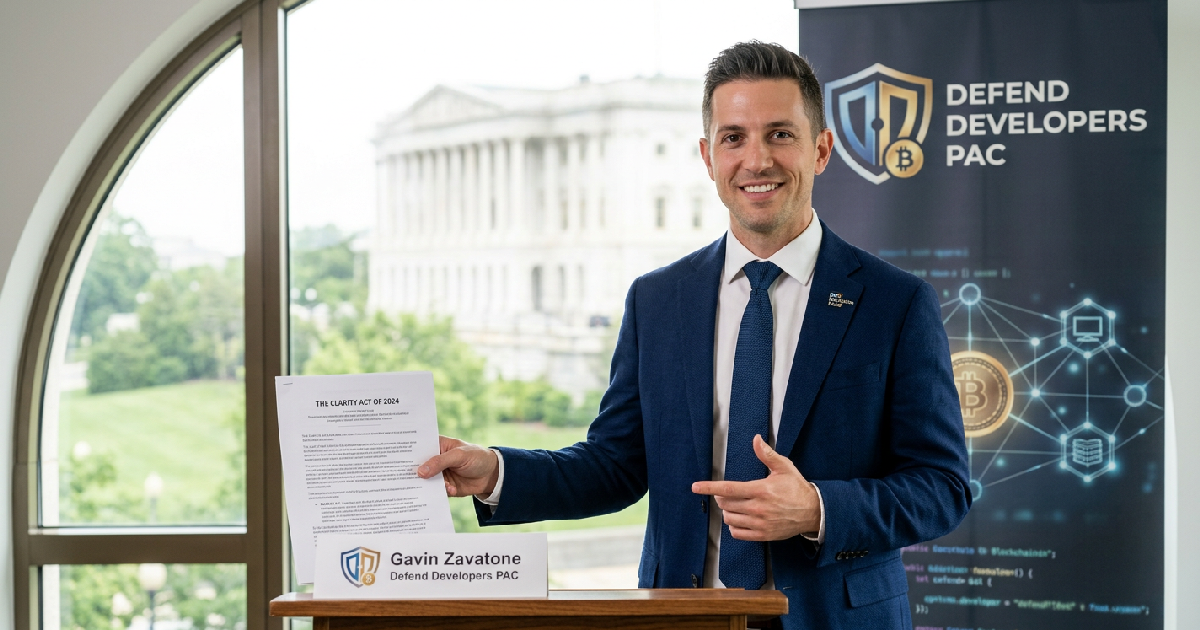

Gavin Zavatone, the policy lead at the DeFi Education Fund, launched a new hybrid political action committee named Defend Developers on Wednesday, June 3, 2026. The organization arrived as the first PAC exclusively dedicated to supporting members of Congress who champion legal protections for American blockchain developers and software engineers.
The group enters the political fray to lobby for the Digital Asset Market Clarity Act of 2025, commonly known as the CLARITY Act, which is currently awaiting a potential vote on the Senate floor.
The timing of the launch reflects a critical juncture for U.S. crypto regulation as lawmakers navigate complex industry demands. While the CLARITY Act passed the House of Representatives in July 2025 with a bipartisan 294-134 vote, its progress in the Senate has required extensive negotiation.
Senator Cynthia Lummis indicated on June 3 that while momentum is building, a floor vote is more likely to occur before the August recess than the July 4 break. Negotiations continue as lawmakers attempt to reconcile versions of the bill from the Banking and Agriculture committees.
Defend Developers argues that the current “regulation by enforcement” approach puts American technologists at a significant disadvantage. Gavin Zavatone noted that for too long, those building decentralized technologies have faced legal uncertainty and enforcement actions rather than clear guidelines.
By focusing on the “builders” rather than just exchange platforms, the PAC aims to influence the CLARITY Act legislative progress in favor of the industry’s technical infrastructure.
Defending the right to write decentralized code
The central mission of the Defend Developers PAC is to ensure that software engineers are not held legally responsible for how third parties use their decentralized tools. This principle is a cornerstone of the CLARITY Act, specifically through the “Blockchain Regulatory Certainty Act” provision.
This section seeks to shield developers from being classified as money transmitters simply because they wrote the code for a decentralized finance (DeFi) protocol.
The PAC’s board includes a wide range of industry representation to bolster its primary mission. Executives from the DeFi Education Fund, Solana Policy Institute, Uniswap Labs, American Innovation Project, and Orca Creative all serve on the board. These leaders argue that without specific protections, the United States risks losing its competitive edge to jurisdictions with more permissive standards for open-source development.
And while the focus remains on the legislative text, the financial weight of a PAC adds a new layer to the debate. By backing members of Congress who champion these protections, the group hopes to counter the influence of critics within the traditional financial sector. This development follows a period where com/xrp-speculative-activity-resistance-analysis-2026/”>XRP speculative activity and broader market volatility have often overshadowed the technical needs of the developer community.
Banking opposition and the fight for deposits
The CLARITY Act faces pushback from traditional financial institutions. JPMorgan CEO Jamie Dimon has been a vocal critic, suggesting the bill could allow crypto firms to offer rewards on stablecoins without the protections required of banks. This concern is echoed by the American Bankers Association (ABA), which worries that such products would draw deposits away from local community lenders.
A recent survey by Morning Consult on behalf of the ABA underscored these anxieties. The data showed that 61% of consumers believe Congress should be cautious about undermining the existing financial system. Furthermore, 69% of respondents expressed concern that a shift in funding could lead to fewer available loans from traditional banks.
These figures represent a hurdle for the PAC: convincing a skeptical public that crypto innovation does not come at the cost of local financial stability.
Law enforcement organizations have also raised alarms regarding the developer shield provision. Some agencies argue that granting immunity to software creators could complicate investigations into illicit financial activities. This tension between developer freedom and national security remains a contested part of the bill’s language as it moves toward a potential Senate vote. Some critics even suggest the legislation could benefit Trump-linked World Liberty Financial.
Building a strategic coalition in Washington
Despite the opposition, the CLARITY Act enjoys support from an array of former officials. A letter organized by the Blockchain Association saw 160 former national security, intelligence, and law enforcement figures urging the Senate to pass the measure. They argue that bringing digital assets into a formal regulatory framework actually aids investigators by providing clearer rules of the road than the current environment.
Infrastructure players and venture capital firms have also lined up behind the bill. Chris Dixon, the founder of a16z crypto, recently stated that the legislation gives long-term incentives to both builders and investors while ensuring talent remains in the United States.
This perspective is shared by firms like Jump Crypto, Coinbase, and Anchorage Digital, all of whom see the bill as a necessary step toward institutional maturity.
The involvement of institutional heavyweights has become increasingly common as crypto finds its way into traditional portfolios. For example, Italy’s largest bank exceeded $200M in Bitcoin exposure earlier this year, signaling that the divide between traditional finance and new code is beginning to blur. The PAC believes this trend will continue if the CLARITY Act provides the legal certainty institutions require.
Looking ahead to the August recess deadline
The road to a Senate floor vote remains complex. Lawmakers must still merge the Banking Committee’s version of the text, led by Chairman Tim Scott (R-S.C.), with updates from the Senate Agriculture Committee.
There are also ongoing discussions regarding ethics provisions and potential overlaps with the GENIUS Act, which sets ground rules for U.S. stablecoins. Senator Cynthia Lummis remains realistic about the time needed to reach 60 votes.
For the Defend Developers PAC, the next two months will be a test of their influence. The organization will focus on educating policymakers who Zavatone claims lack a full understanding of how software development works. By humanizing the “builders,” the PAC hopes to strip away some of the partisan baggage associated with digital assets.
Success for the PAC would mean a version of the CLARITY Act that prevents developers from being treated like financial institutions. As the August recess approaches, the industry will be watching closely to see if this new political muscle can push the legislation over the finish line. The outcome will likely determine whether the U.S. remains a primary hub for decentralized finance innovation.