
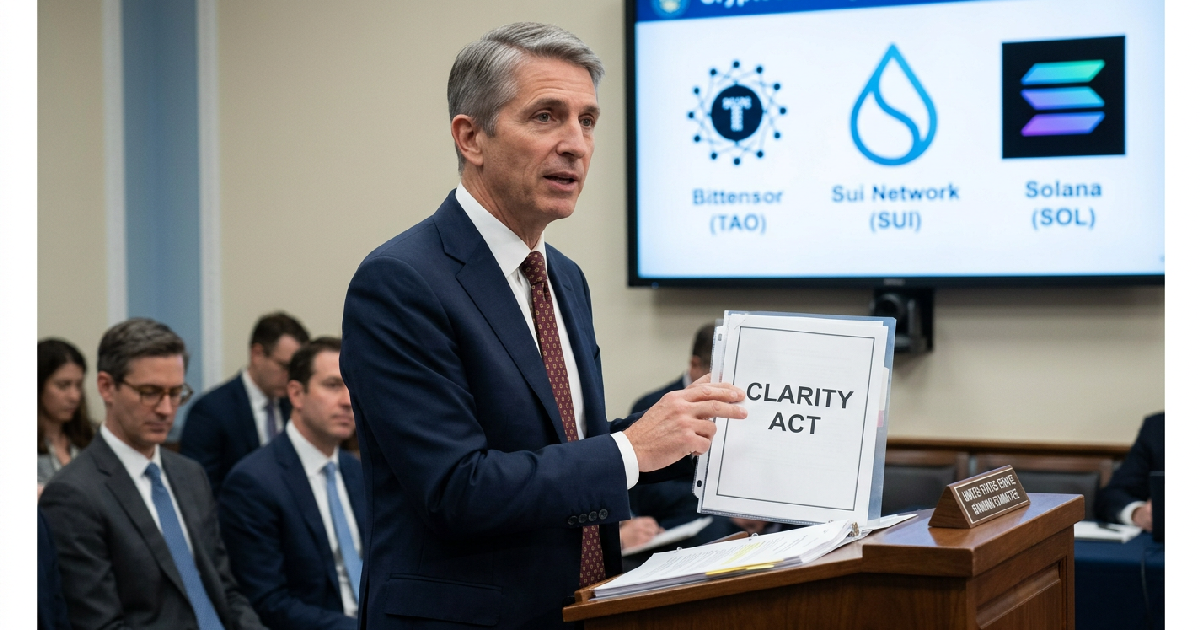

The Digital Asset Market Clarity (CLARITY) Act [H.R. 3633] reached a new legislative milestone on June 1, 2026, when it was placed on the Senate Legislative Calendar following months of committee deliberation.
The bill, which passed the House with a 294 to 134 vote last year, represents a major effort to define the regulatory boundaries between the U.S. Securities and Exchange Commission (SEC) and the Commodity Futures Trading Commission (CFTC).
As federal lawmakers look to combine competing versions of the text, specific altcoins including Bittensor (TAO), Sui Network (SUI), and Solana (SOL) have gained attention for their alignment with the bill’s emerging framework.
The CLARITY Act intends to grant the CFTC “exclusive jurisdiction” over digital commodity spot markets while maintaining SEC oversight for investment contract assets. For market participants, the legislation offers a registration regime for brokers and exchanges, potentially stabilizing the domestic crypto environment. U.S.
Treasury Secretary Scott Bessent testified before the Senate Finance Committee on June 3, 2026, urging Congress to pass the measure before the summer ends. Secretary Bessent stressed that such legislation is necessary to bring best practices onshore and preserve the country’s status as a center for innovation.
Recent developments in the Senate haven’t been without friction. Although the Senate Banking Committee approved the bill with a 15-9 vote, it has stalled due to disputes over stablecoin reward treatment, software developer protections, and conflicts of interest involving President Trump’s crypto ventures.
On June 6, 2026, Galaxy Research head Alex Thorn lowered the estimated probability of the law passing in 2026 from 75% to 60%. Thorn cited a crowded legislative schedule and unresolved disagreements over anti-money laundering provisions as primary reasons for the delay.
Solana attracts institutional backing as staking rules clarify
Solana (SOL) continues to see rising institutional interest as the CLARITY Act draft addresses several long-standing industry concerns. The current proposal includes bullish language regarding staking, suggesting that these activities would not automatically classify tokens as securities. This is a critical distinction for the Solana ecosystem, where developer activity and user engagement have remained high despite inconsistent market conditions throughout the year.
Financial institutions are already moving into the space. JPMorgan recently disclosed a $500,000 position in the Bitwise Solana staking ETF, reflecting a growing appetite for shifting market structures among major banks. The network’s economic health was further evidenced in the first quarter of 2026, when seven Solana-based applications generated eight-figure revenues.
The CLARITY Act’s support for banks offering custody, lending, and underwriting for digital assets could further integrate Solana into traditional finance.
Traders monitoring the asset often look for technical signals to confirm long-term trends. Many market analysts prioritise the 200-day moving average when evaluating the entry points for major altcoins like SOL during periods of legislative uncertainty. If the bill aligns the Banking and Agriculture committee versions successfully, it would provide the clear functional requirements necessary for deeper retail and institutional participation.
Bittensor leads decentralized AI growth under new commodity definitions
Bittensor (TAO) is positioned as a primary player in the decentralized artificial intelligence sector, a market opportunity the CLARITY Act could indirectly support. By expanding the decentralized AI ecosystem, Bittensor aims to create an open marketplace where developers receive rewards for contributing AI models. This model is frequently presented as an alternative to centralized AI firms that currently dominate the technology sector.
The bill’s focus on the CFTC’s jurisdiction over “digital commodity” spot markets is particularly relevant for TAO. Creating a registration regime for digital commodity exchanges would provide a structured environment for tokens that function as utility or work assets within technical networks.
Bittensor has seen increased visibility recently, particularly ahead of the Proof of Talk conference in Paris, where decentralized governance is a key topic of discussion.
The legislation’s latest draft also aims to clarify digital asset classifications, which may benefit AI-centric protocols. By providing functional requirements for market participants, the act seeks to foster innovation while prioritizing consumer protection. For developers within the Bittensor ecosystem, the move toward federal clarity could reduce the risks associated with building and launching decentralized intelligence models on U.S.-based infrastructure.
Sui Network targets stablecoin infrastructure and transaction efficiency
Sui Network (SUI) is gaining momentum by focusing on practical blockchain infrastructure and the elimination of barriers related to high transfer costs. The network recently revealed plans to support free stablecoin transfers regardless of the transaction size.
This aggressive push into stablecoin infrastructure aligns with the CLARITY Act’s provisions that outline support for banks to provide payment services and digital asset custody without needing additional approvals.
The potential for SUI to serve as a high-efficiency settlement layer coincides with a broader debate over the future of digital money. While Treasury Secretary Scott Bessent rejects central bank digital currency in favor of private-sector solutions, networks that facilitate free, scalable stablecoin transfers are seeing increased adoption.
Sui’s focus on removing friction from blockchain transactions has made it a notable candidate for institutional payment infrastructure.
Industry leaders remain divided on the bill’s final timing. Earlier in 2026, Ripple CEO Brad Garlinghouse publicly declared that he thought there was an 80% chance the CLARITY Act would eventually pass. However, Joshua Riezman, Chief Legal Officer at GSR, currently estimates the odds of approval in 2026 at approximately 50%.
The next phase for the bill involves a chairman’s amendment to consolidate committee wording before it can reach a final floor vote in the Senate.