
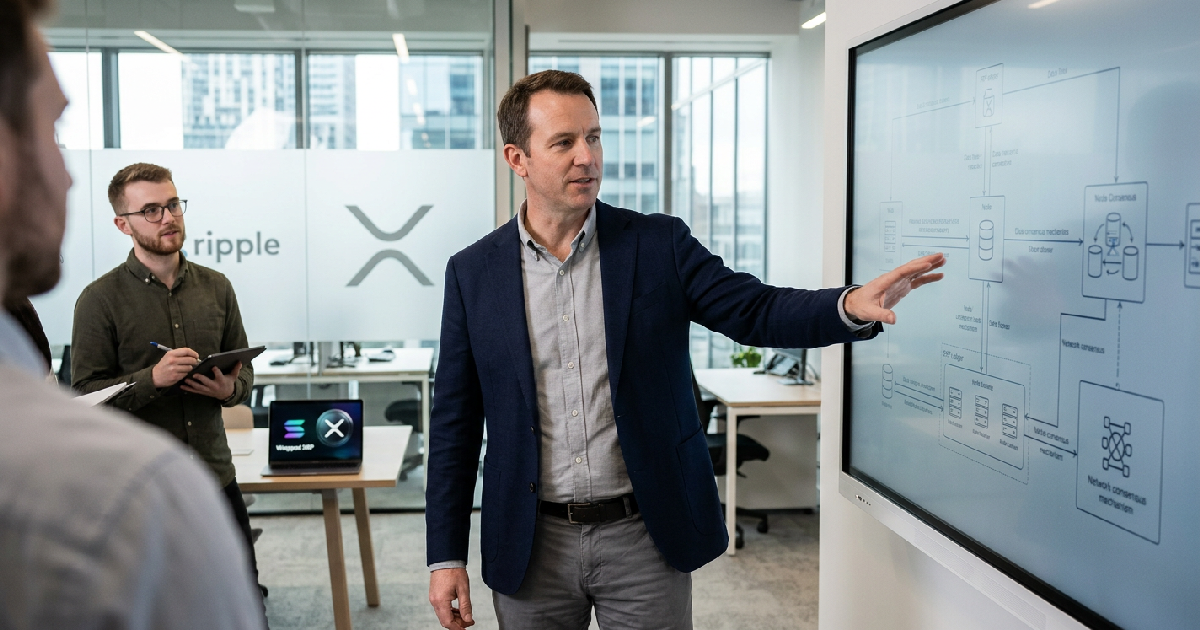

Anthony Ralphs, the founder of Nova Modus and an early Ripple technologist, says Ripple’s strategy of institutional engagement and regulatory compliance was years ahead of the current crypto industry consensus. Reflecting on the network’s early years, Ralphs noted that Ripple correctly anticipated a shift from “anti-institutional anarchism” toward the formal partnerships that define the market today.
The veteran technologist joined Ripple during the 2017 Initial Coin Offering (ICO) boom, a period he describes as being driven by “anarchist energy” with little interest in legacy finance. While most projects sought to dismantle existing structures, Ripple focused on improving infrastructure built in the 1970s. This approach, which Ralphs credits as being “very right,” prioritized constructive disruption over attempting to burn the system down.
Despite this legacy of foresight, current Ripple executives suggest that the network must now evolve by studying newer competitors. Luke Judges, Ripple’s Global Partner Success Lead and Director, argues that the company can learn from the “pragmatism and speed” displayed by the Solana ecosystem. Judges believes that XRP market dominance requires a more aggressive, market-oriented implementation to remain competitive in 2026.
Why Anthony Ralphs views the Ripple approach as a historic win
Anthony Ralphs observed that Ripple’s decision to engage with institutions was fundamentally right for the long-term health of the space. As a technologist, he resonated with building a platform designed for the established financial world. This stance was rare in 2017, when the broader market viewed regulatory engagement with suspicion or outright hostility.
This early design philosophy focused on reliability and enterprise-grade performance, traits that David Schwartz, Ripple’s CTO Emeritus, continues to champion. Schwartz, a co-architect of the XRP Ledger (XRPL), has often criticized rivals for prioritizing speed at the expense of network stability. He remains a vocal advocate for the XRP Ledger doomsday protocol and other security-focused features that support institutional trust.
However, the industry is no longer just about stability. Luke Judges, who previously built startups on Solana and managed a validator with over $30 million staked, noted that technology alone is not enough. He pointed out that Solana’s “rapid iteration” and ability to ship features based on market feedback have created a vibrant culture that other Layer 1 blockchains must now acknowledge.
Luke Judges and the push for Solana-style pragmatism
Luke Judges has been candid about his respect for the Solana ecosystem, despite his current role at Ripple. In a social media post in late 2025, he clarified that there is no point in “burying your head in the sand” regarding other chains. He believes the Ethereum Foundation has already sharpened its own strategy after losing ground to Solana’s “notoriously fast” development cycle.
The Ripple director argues that the XRP strategy is “incomplete” without adopting a more aggressive approach to cultivating a developer and decentralized application (dApp) ecosystem. He suggests that the “launch and improve” philosophy seen in Solana is a necessary evolution for older networks. This push for market relevance comes as shifting market structure forces legacy players to adapt or risk stagnation.
This does not mean Ripple is abandoning its core identity. Instead, it is seeking a middle ground between institutional reliability and the “vibrant, risk-taking community culture” that draws in new builders. The goal is to merge the structural foresight described by Anthony Ralphs with the technical agility required to survive in a multi-chain environment.
Cross-chain integration and the end of tribalism
The rivalry between XRP and Solana is increasingly giving way to technical integration. In December 2025, Wrapped XRP (wXRP) launched on the Solana blockchain through a partnership between Hex Trust and Layer Zero. This move allows users to trade wXRP alongside the Ripple USD stablecoin (RLUSD) within the Solana ecosystem, expanding liquidity across both networks.
Ripple CEO Brad Garlinghouse reacted to this milestone in April 2026, noting that the demand for XRP is driving liquidity into new paths across previously isolated ecosystems. Even David Schwartz, who once fueled the “XRP-Solana rivalry” with social media memes, has participated in Solana-related privacy discussions. This cross-pollination suggests a growing maturity in how major blockchain projects interact.
While Solana continues to push technical boundaries—such as the “Alpenglow” upgrade designed to reduce block finality to 150 milliseconds—Ripple is focused on maintaining its institutional bridge. The sentiment shared by Anthony Ralphs suggests that Ripple was indeed ahead of its time. The challenge for 2026 is ensuring it stays ahead by embracing the speed of the current one.