
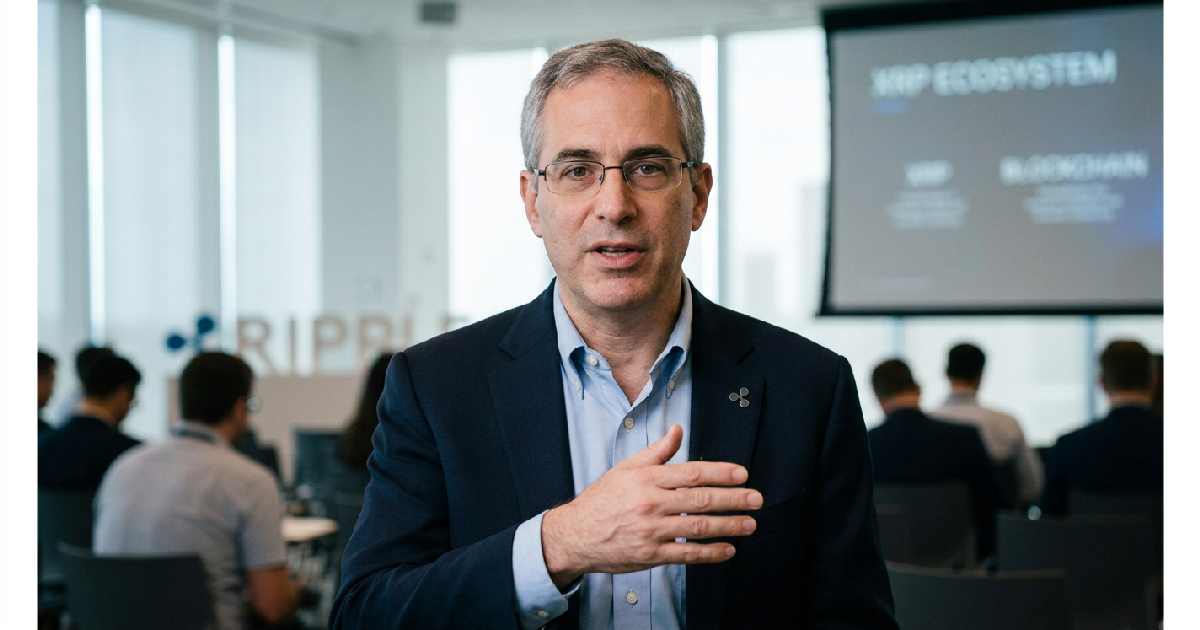

David Schwartz says Ripple itself absorbs the technical harm from XRP sales, clarifying the market impact of the company’s distribution strategy.
Responding to a recently intensifying debate that includes Chainlink executives and legal commentators, David Schwartz dismissed theories that Ripple’s programmatic sell-offs come at the direct expense of retail token holders or suppress the asset’s long-term value.
Ripple business model faces fresh scrutiny from industry critics
The veteran software architect maintained that investor sentiment, rather than the mechanical act of selling, dictates the current market price of the altcoin. Schwartz argued that rational market participants already bake anticipated sell-offs into their entry prices, effectively neutralizing the impact on those who purchase the asset today.
This defense comes as XRP legislative progress continues to be a focal point for the San Francisco-based firm following the conclusion of its multi-year legal saga with the Securities and Exchange Commission (SEC).
The latest controversy erupted after pro-crypto lawyer Bill Morgan noted that Ripple Labs Inc. had ceased direct sales to retail investors several years ago.
This observation prompted a sharp rebuttal from a Chainlink executive, who argued that Ripple’s reliance on its pre-mined holdings fundamentally shifts operational costs and investment risks onto the broader community of XRP holders.
The critic further claimed that XRP has lost its relevance as a bridge asset, alleging it has been superseded by stablecoins like Ripple’s own RLUSD.
David Schwartz was quick to dismantle this narrative, framing the relationship between the company and its holders as one of aligned incentives rather than exploitation. He argued that the transparency of Ripple’s escrow system allows the market to function efficiently.
If buyers expect future sales to lower the price, they buy at a lower price now, meaning they are not “victims” when those anticipated sales eventually occur. According to Schwartz, if there was information suggesting the token was mispriced, open markets are generally efficient enough to correct it.
The logic behind this defense is rooted in the concept of efficient markets.
David Schwartz joined the XRPL Foundation recently but continues to be a vocal defender of the ledger’s mechanics, noting that if “very rich, very rational people” truly believed XRP had a 1% chance of reaching $10,000, they would have already bid the price up to at least $20 today.
By extension, he suggests that downward pressure from company sales is a known variable that professional traders have already quantified.
Escrow releases and the company distribution strategy
Underpinning this fiscal debate is Ripple’s massive XRP distribution program, which has seen the company and its executives sell approximately 58.5 billion tokens since 2012. Originally launched with 100 billion tokens, the company established a predictable escrow schedule to manage liquidity and prevent market flooding.
Each month, 1 billion XRP tokens are released from these contracts, though typically 70% to 80% are returned to new escrow accounts to maintain supply stability, resulting in a net release of 200 to 300 million XRP.
This systematic reduction of company-controlled tokens has coincided with a 31,000% price appreciation since the project’s inception, a figure Ripple proponents use to counter the narrative of price suppression.
Even as XRP speculative activity returns to the market, the company maintains that earning revenue from diverse business ventures, rather than solely relying on XRP sales, is a net positive for holders. Ripple and its leadership team currently hold approximately 41.485 billion XRP tokens.
The company’s transparency has occasionally been used against it in regulatory settings, a point noted in Ripple’s Q1 2025 Markets Report. Despite this, Schwartz contends that the company’s substantial holdings actually incentivize it to support the success of the ecosystem. He further argued that while some sellers might dislike the continuous releases, these sales provide essential liquidity for new buyers entering the market.
Conspiracy theories and personal investment philosophy
One of the most provocative aspects of Schwartz’s recent commentary is his rejection of “secret tool” or “price switch” conspiracy theories that have circulated within the community. He publicly dismissed the idea that Ripple could artificially inflate or boost the price of XRP at will, characterizing these beliefs as outdated.
Schwartz stated that it is hard to imagine the company has kept a “magic switch” for so long without flipping it, questioning the logic of a grand conspiracy.
Instead, the CTO Emeritus places the burden of price action on broader market dynamics and investor expectations. This aligns with his personal investment philosophy, which focuses on risk mitigation.
Schwartz recently revealed he does not hold much XRP left personally, having moved most of his assets—excluding Ripple stock—away from crypto exposure due to a dislike for risk. He previously admitted to selling a significant portion of his XRP portfolio when the token was priced at $0.10.
The legal backdrop for these debates has also shifted significantly. The long-standing litigation with the SEC, which began in 2020, concluded with a finalized settlement that brought a definitive end to the years of dispute. This resolution followed a critical 2023 ruling that distinguished between institutional sales and blind sales on digital exchanges.
With the legal saga over, the focus has shifted to how Ripple integrates new products like RLUSD without cannibalizing the utility of XRP as a bridge asset.