

When headlines break about a massive security breach at a major exchange like Bybit, the immediate assumption is often a highly sophisticated, cinematic cyberattack. People imagine armies of hackers breaking through firewalls.
The reality is usually much more mundane, and far more terrifying. Massive losses often boil down to a single compromised private key, an internal operational failure, or a phishing email clicked by the wrong employee.
If a multi-billion dollar platform can face these vulnerabilities, everyday investors managing their own wealth are walking a tightrope. This is where the multisig crypto wallet comes into play. It is the Wall Street-grade solution designed to eliminate the single biggest vulnerability in self-custody: relying on just one key to protect an entire portfolio.
Before Diving In: The Single Point of Failure in Standard Wallets
To understand why a multisig crypto wallet is a game-changer, you have to look at how standard wallets operate.
Contrary to popular belief, a crypto wallet does not actually hold your digital coins. Your Bitcoin and Ethereum live permanently on the blockchain. Your wallet simply holds the private key—a unique cryptographic password—that proves you have the right to move those assets.
This single-signature (or single-sig) system is highly efficient, but it creates a massive single point of failure.
If you use a standard wallet and someone steals your private key, your funds are gone. If you accidentally throw away the hard drive containing your key, your funds are gone. It is the equivalent of a massive bank vault having only one physical key; whoever holds it, holds the power.
When comparing multisig vs single sig, the fundamental difference is risk distribution. Multisig takes that single point of failure and shatters it, ensuring that no single mistake can wipe out your financial future.
How a Multisig Crypto Wallet Works (The Treasury Scene)
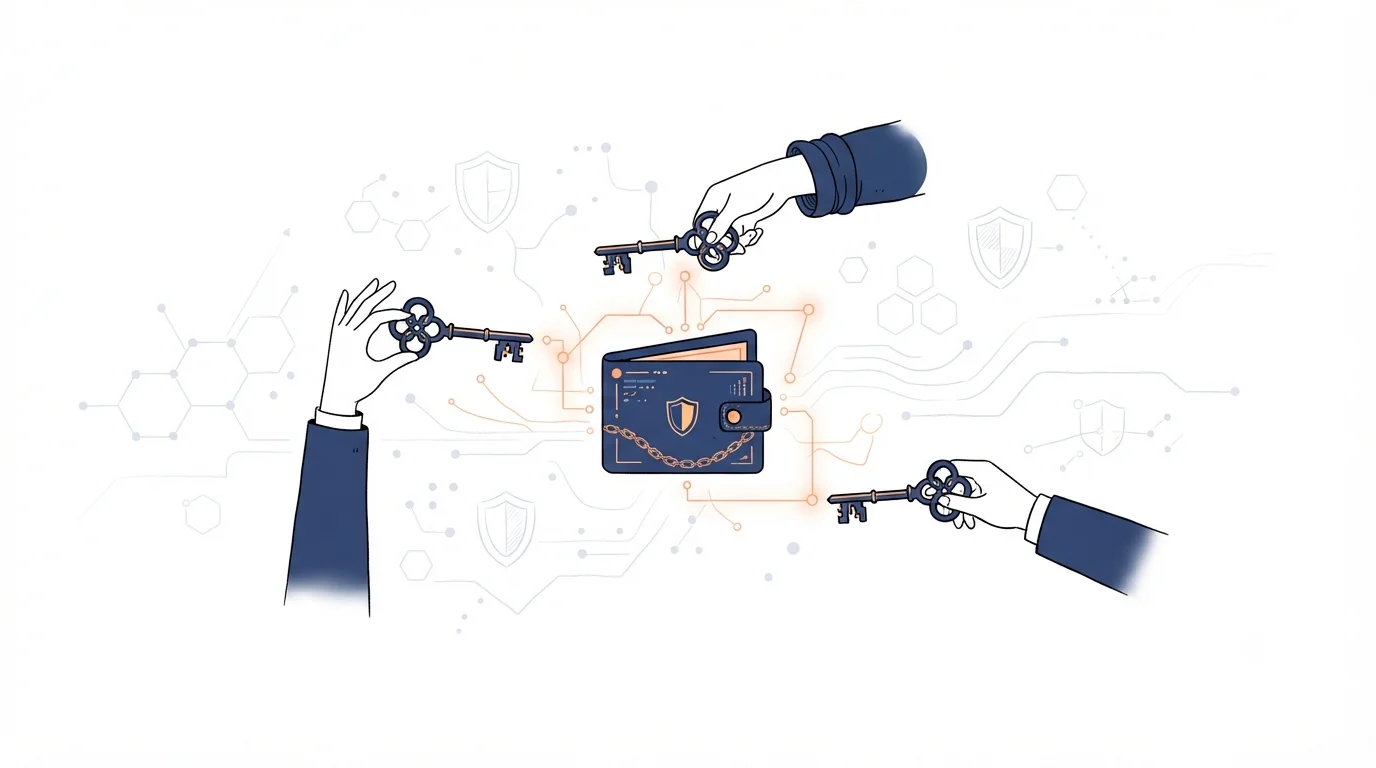
The concept of a multisig crypto wallet simply is a digital vault that requires multiple keys to open. But instead of looking at a dry technical flowchart, let’s watch a 2-of-3 multisig setup play out in a real-world scenario.
Imagine Web3 Builders Inc., a growing startup holding $5 million in USDC in their corporate treasury. To protect these funds, they use a multisig configuration requiring two out of three authorized keys to move any money.
Here is how the scene unfolds when a threat emerges:
1. The Setup Process
The company generates three distinct private keys. The CEO holds Key 1 on a hardware wallet in the office. The CFO holds Key 2 on a secure laptop. A trusted external law firm holds Key 3 in a physical cold storage vault. None of them can move a single dollar alone.
2. Initiating a Transaction (The Attack)
Late on a Friday night, the CFO falls victim to a highly sophisticated phishing attack. A hacker gains remote access to the CFO’s laptop, finds the treasury interface, and initiates a transfer of $1 million to an anonymous address. In a standard wallet, this is the end of the story. The money would be gone instantly.
3. The Blockade
But Web3 Builders Inc. uses a multisig protocol. The hacker’s transaction doesn’t go to the blockchain; it goes into a pending state. The network looks at the request and essentially says: “We see the CFO’s signature, but we need one more.”
4. The Co-Signing (The Save)
The CEO’s phone buzzes with a notification: “Pending Transaction: $1,000,000 USDC. Approve?” The CEO immediately calls the CFO. They quickly realize it is a fraudulent request. The CEO declines the transaction. The hacker is locked out, the single compromised key is rendered useless, and the $5 million treasury remains perfectly safe.
This is the power of secure crypto storage; adding just one extra layer of verification, you neutralize the most common attack vectors in the industry.
The Bybit Reality Check: Why Multisig Isn’t a Silver Bullet
It is tempting to look at the scenario above and declare multisig the ultimate, unbreakable solution. However, the crypto market demands intellectual honesty.
When we analyze major exchange incidents — like the breaches and internal vulnerabilities that have impacted giants from Bybit to FTX, we learn a harsh lesson: technical security cannot patch human flaws. Multisig is a fortress, but humans still operate the gates.
If a bad actor wants to drain a multisig wallet, they don’t attack the cryptography; they attack the signers.
Imagine a scenario where an internal rogue employee creates a fraudulent transaction disguised as a routine payment to a major liquidity provider like Binance or Kraken. The employee signs it with their key, then messages a busy, distracted executive on Slack: “Hey, standard vendor payment ready for your signature.” If the executive blind-signs the transaction without verifying the blockchain address, the multisig fails.
Furthermore, if the participants in a 2-of-3 multisig setup store their physical seed phrases in the same office, a single fire or physical robbery compromises the entire setup.
Multisig solves the technical single point of failure, but it introduces the need for rigorous operational security (OpSec). It is a highly effective tool, but it is not a replacement for human vigilance.
The Wealth Management Shift: Why Institutions Are Upgrading
Despite the human factor, the shift toward multi-signature technology is the most significant trend in digital asset wealth management today.
In the early days of crypto, investors kept small amounts on exchanges or in basic web wallets. Today, as high-net-worth individuals, venture capital funds, and decentralized autonomous organizations (DAOs) allocate millions into digital assets, they require banking-grade infrastructure.
Institutions do not rely on a single person to wire millions of dollars, and they apply that exact same logic to their digital assets. A multisig crypto wallet provides the infrastructure for corporate governance.
Instead of treating these advantages as separate features, it is best to view them as a comprehensive wealth protection strategy; distributing access, you achieve three critical things:
- Ultimate Hacker Defense: A compromised laptop or a stolen hardware wallet is no longer a fatal event.
- Operational Integrity: It enforces the “four-eyes principle,” ensuring no single rogue employee or emotional investor can make a disastrous financial decision.
- Built-in Redundancy: If you lose one of your keys, the remaining keys can still be used to recover the funds, saving you from a permanent lockout.
Is It Worth It? Final Thoughts on Taking True Ownership
So, what is a multisig wallet to the everyday user? Is it an absolute necessity, or just institutional overkill?
The answer depends entirely on the size of your portfolio and your long-term goals. If you are a beginner experimenting with a few hundred dollars on Coinbase, setting up a complex multi-signature vault will likely cause more friction than benefit. A standard wallet paired with excellent password hygiene is perfectly fine.
However, if you are managing a life-changing amount of digital wealth, securing a business treasury, or planning for your family’s financial succession, upgrading to a multisig crypto wallet is no longer optional. It is a fundamental responsibility.
As the crypto industry matures, we are moving away from the era of hiding paper passwords under mattresses. Taking true ownership of your assets means building a system that can withstand both external attacks and human error. Multisig gives you the architecture to do exactly that.
This content is for informational purposes only and does not constitute financial advice.