
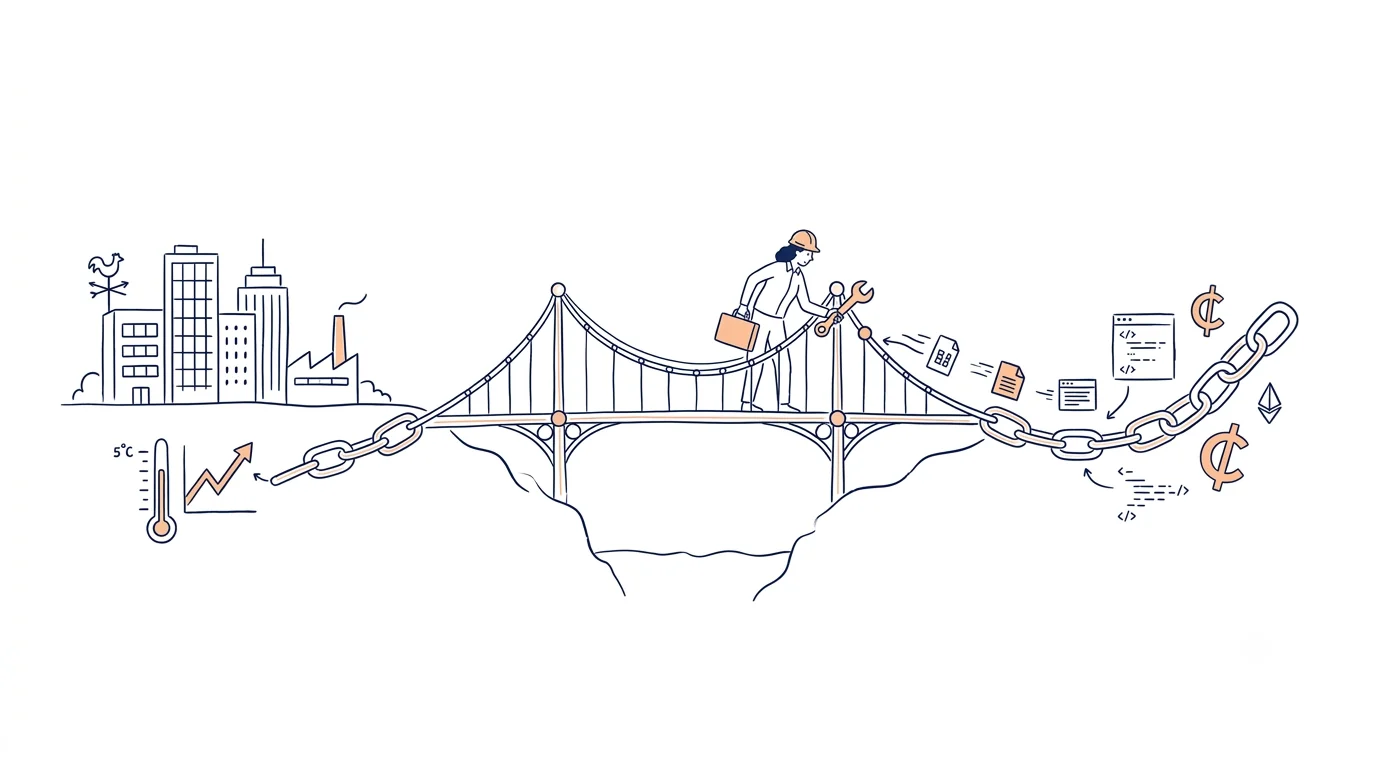

If you are diving into the world of cryptocurrency, you will inevitably hit a wall of technical jargon, but answering the question of what is Chainlink does not have to be complicated. Imagine a highly advanced, ultra-secure computer that is completely disconnected from the internet. It can process calculations flawlessly, but it cannot check the weather, read the news, or verify a stock price.
For a long time, this was the exact reality of blockchain technology. Networks like Bitcoin and Ethereum were powerful and secure, but they were entirely isolated from the outside world. This isolation limited their potential strictly to moving digital tokens back and forth.
Chainlink emerged as the fundamental bridge to solve this massive limitation. It acts as the secure connection cable that links the isolated world of Web3 with the traditional financial systems, real-time data feeds, and global markets we use every day.
Functioning as this crucial piece of infrastructure, Chainlink is not trying to be a new digital currency for you to buy coffee with. Instead, it is building the invisible data pipelines that allow global banks, trading platforms, and decentralized applications to operate securely without human intervention.
What Are Tokenized Real-World Assets?
What You Need to Know Before Diving In
To truly grasp why Chainlink is considered a revolutionary piece of technology, we first need to understand the environment it operates in. The crypto space is built on the concept of automated agreements, but these agreements have a fatal blind spot.
If you have spent any time researching crypto, you have likely encountered the term “smart contract.” For those looking for smart contracts explained simply, think of them as digital, self-executing agreements. They are lines of code that automatically execute an action when specific conditions are met.
For example, a smart contract could be programmed to release funds to a flight passenger if their flight is delayed by more than two hours. The code is immutable, meaning once it is locked into the blockchain, nobody can alter the deal. This provides incredible security and guarantees that agreements are honored.
However, this creates a significant hurdle known as the “Oracle Problem.” Blockchains are closed systems. By design, they cannot access external information to verify if that flight was actually delayed. They do not have a built-in mechanism to browse the web, check an airline database, or verify the price of USD.
If a smart contract cannot verify real-world events, its use cases are severely restricted. If you want to build a decentralized financial application, you need to know the exact, real-time price of assets. If you want to automate insurance payouts, you need to know objective facts from the real world.
This is exactly where the concept of what are blockchain oracles comes into play. An oracle is simply a piece of software that fetches external data and securely feeds it into the blockchain. Chainlink is the largest and most widely adopted decentralized oracle network in the world.
How Chainlink Works: Bridging Web3 and the Real World
So, how does Chainlink work in practice? The key word here is “decentralized.” If a smart contract relies on a single, centralized data source to function, it creates a massive security risk. If that one source is hacked, manipulated, or simply goes offline, the entire smart contract fails, putting millions of dollars in digital assets at risk.
Chainlink solves this by using a vast network of independent operators to fetch and verify data. Instead of asking one source for the price of an asset or the outcome of an event, Chainlink asks hundreds of them, aggregates the answers, and delivers a single, mathematically verified truth to the blockchain.
The Data Standard (Oracles)
The most common use case for Chainlink is providing highly secure, tamper-proof data to decentralized applications. This is heavily utilized in decentralized finance, or DeFi, where lending protocols need exact asset prices to issue loans or liquidate underwater positions safely.
Beyond finance, consider a crop insurance smart contract built for farmers. The contract is programmed to automatically pay out if the region experiences zero rainfall for thirty consecutive days. Chainlink oracles collect weather data from multiple independent meteorological sensors, verify the information, and send it to the blockchain.
Because the data delivery is decentralized, no single party can manipulate the weather report to trigger a fraudulent payout. The asset protection and security guarantees remain completely intact.
Cross-Chain Interoperability (CCIP)
As the crypto industry has matured, hundreds of different blockchains have been created. The problem is that these networks operate in silos. Assets and data on Ethereum do not naturally communicate with applications on Solana or other networks.
Chainlink introduced the Cross-Chain Interoperability Protocol (CCIP) to solve this fragmentation. You can think of CCIP as the SWIFT network of Web3. It provides a standardized, highly secure messaging system that allows data and digital tokens to flow seamlessly across different public and private blockchains.
This level of cross-chain interoperability is essential for the future of global finance, allowing traditional institutions to interact with various decentralized networks through a single, secure interface.
The LINK Token Utility
When beginners explore this ecosystem, they often wonder about the LINK token utility. Unlike some digital currencies that serve primarily as a speculative store of value, the LINK token is a working asset. It powers the economic engine of the entire Chainlink network.
When developers build a smart contract and request data from the outside world, they must pay for that service using LINK tokens. These tokens are then distributed to the decentralized node operators who fetched and verified the data, incentivizing them to act honestly and maintain the network’s high security standards.
Additionally, operators must lock up, or “stake,” their own LINK tokens as collateral. If they provide bad data or attempt to manipulate the system, their staked tokens are slashed as a penalty. This cryptoeconomic security model ensures that protecting the network is always more profitable than attacking it.
Chainlink vs. Bitcoin: Why It’s a Completely Different Game
One of the biggest mistakes newcomers make is viewing all cryptocurrencies through the same lens. Understanding Chainlink vs Bitcoin is crucial for setting the right expectations and grasping the broader digital asset landscape.
Bitcoin was designed to be a decentralized digital currency and a secure store of value. It is the ultimate pristine asset in the crypto space, designed to be slow, methodical, and highly resistant to change. Its primary goal is to protect wealth from inflation and centralized control.
Chainlink explained properly is not a competitor to Bitcoin at all. It is a piece of foundational infrastructure. If Bitcoin is digital gold, Chainlink is the armored transport service, the appraisal tools, and the secure communication lines connecting the gold vaults to the global markets.
When you purchase LINK on a major exchange like Coinbase, Kraken, or Binance, you are not buying a traditional consumer currency. You are essentially buying bandwidth and utility within a global data network. The demand for LINK is directly tied to the demand for secure, real-world data by smart contracts.
Is Chainlink Worth Your Attention?
From an institutional and wealth management perspective, evaluating any digital asset requires stripping away the internet hype and focusing on tangible utility, long-term trends, and structural risks.
The digital asset market is shifting from speculative trading toward the tokenization of real-world assets (RWAs). This means putting traditional financial instruments, like real estate, government bonds, and private equity, onto the blockchain. Chainlink is uniquely positioned at the center of this transition.
The Bull Case: Institutional Adoption
Chainlink institutional adoption is not a future promise; it is currently happening. The network has already enabled trillions of dollars in transaction value across the decentralized finance sector. It is the trusted standard for the largest DeFi protocols in the world.
More importantly, traditional finance giants are actively integrating Chainlink’s technology. Global market infrastructures like SWIFT and Euroclear, alongside major institutions, are testing and utilizing Chainlink to manage tokenized assets securely. For banks to adopt blockchain technology, they require strict compliance, privacy, and flawless data delivery. Chainlink provides the exact technological standard required to meet these rigorous institutional demands.
The Bear Case: Complexities and Market Risks
However, an objective analysis must acknowledge the hurdles. The primary risk associated with Chainlink is its inherent complexity and reliance on the broader adoption of smart contracts.
If the tokenization of real-world assets stalls, or if traditional financial institutions decide to build closed, proprietary data systems instead of relying on decentralized oracles, the core demand for Chainlink’s services could decrease.
Furthermore, while Chainlink is the undeniable market leader, the oracle sector is competitive. Newer, lightweight oracle solutions are constantly emerging, attempting to offer faster or cheaper data feeds. Additionally, the price of the LINK token remains heavily correlated with the general volatility of the cryptocurrency market, meaning macroeconomic factors will continue to influence its valuation regardless of its technological success.
Conclusion
The evolution of blockchain technology is moving past the phase of isolated digital experiments. For this technology to disrupt the global financial system, it requires a secure, reliable, and standardized way to connect with the real world.
Chainlink provides that vital infrastructure, offering decentralized data feeds, cross-chain communication, and a robust security model, it allows smart contracts to reach their full potential. It prioritizes the protection of digital assets and the integrity of automated agreements above all else.
Whether you are a casual observer or a long-term researcher, understanding the mechanics behind this network offers a much clearer view of where the intersection of traditional finance and Web3 is heading next.
The future of cryptocurrency: beyond the hype to real-world utility
This content is for informational purposes only and does not constitute financial advice.