
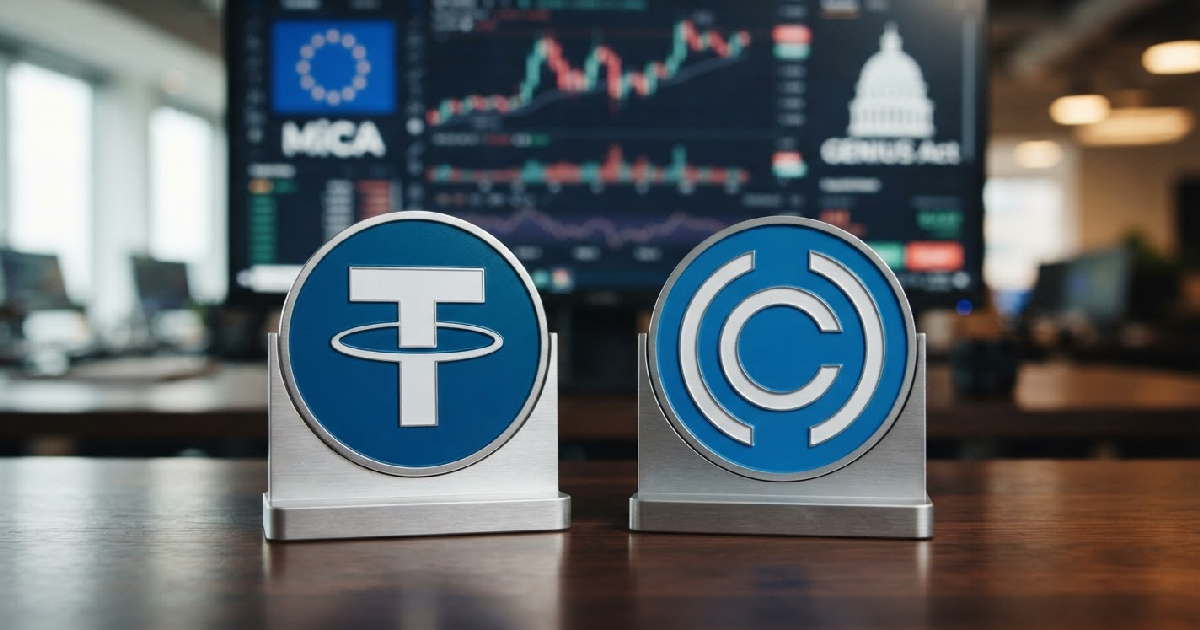

Tether’s USDT and Circle’s USDC, the two dominant stablecoins pegged one-to-one to the U.S. dollar, continue to underpin the vast majority of cryptocurrency trading. While both are backed by extensive reserves, their operational philosophies, especially concerning transparency and regulatory engagement, diverge significantly. This growing contrast creates distinct profiles for each in a market increasingly scrutinised by global financial authorities.
These two leading stablecoins, fundamentally designed as stable digital assets, are charting increasingly separate courses. The differing strategies adopted by their issuers—Tether Limited and Circle—have carved out unique positions, with regulatory standing and reserve management now central to how market participants view and utilise these critical financial instruments as of July 2026.
The evolving landscape of stablecoin dominance
USDT has maintained its position as the world’s largest stablecoin for years, first launching in 2014 on a layer built atop Bitcoin. It now operates across more than 15 blockchains, with the bulk of its supply and trading volume concentrated on the Tron and Ethereum networks.
Tether Limited, a privately held company, moved its primary operating entity to El Salvador in January 2025, under the leadership of Chief Executive Paolo Ardoino.
Tether’s first quarter 2026 report revealed total reserves valued at approximately $191.8 billion. A substantial $141 billion of this was held in short-term U.S. Treasuries, placing Tether among the world’s largest private holders of U.S. government debt. Its remaining reserves are diversified across physical gold, Bitcoin, secured loans, and various other investments.
The company has reported considerable profits, with net income around $1 billion for Q1 2026 alone. This revenue primarily stems from the interest generated by its large reserve assets. As of July 1, 2026, USDT’s market capitalization stood at $186 billion, commanding about 59% of the global stablecoin market.
Circle’s push for institutional trust
USDC is the world’s second-largest stablecoin, launched in 2018 through Centre, a joint venture between Circle and Coinbase. Circle became its sole issuer in 2023 after the collaboration concluded. Headquartered in New York, Circle is a publicly traded company on the New York Stock Exchange, having completed its IPO in June 2025 under the ticker CRCL. Jeremy Allaire serves as its Chief Executive.
Circle’s status as a publicly listed company means it files audited financial statements, offering a level of transparency appealing to investors. Its USDC reserves are managed within the “Circle Reserve Fund,” a government money market fund administered by BlackRock, alongside cash reserves in various banks. These reserves largely consist of short-dated U.S. Treasuries, overnight repurchase agreements, and cash, with Deloitte conducting monthly reviews.
Like Tether, Circle generates revenue from interest on its reserves. However, a significant portion of this income goes to distribution partners, with Coinbase being a major beneficiary. In Q1 2026, these distribution costs accounted for almost 60% of Circle’s total revenue.
Transparency and diverging regulatory paths
The distinction in transparency between the two stablecoins has long been a core differentiator. Circle’s USDC maintains a higher degree of transparency, publishing monthly attestations from Deloitte and filing audited financials with the U.S. Securities and Exchange Commission (SEC). This commitment to regular, comprehensive reporting aligns well with traditional financial standards.
Tether’s historical scrutiny and future audits
Tether, conversely, provides quarterly attestations from BDO Italia. While these attestations confirm reported reserves matched outstanding tokens on a specific date, they do not offer a full audit covering an entire reporting period. This distinction has fueled historical skepticism regarding USDT’s reserve composition and management.
Tether has faced regulatory scrutiny in the past. In 2021, the U.S. Commodity Futures Trading Commission (CFTC) fined Tether $41 million for misleading claims about its dollar backing between 2016 and 2019. The New York Attorney General also settled a separate case for $18.5 million the same year.
Despite these challenges, Tether engaged a Big Four firm, reportedly KPMG, in early 2026 for its first full independent audit, though its completion status remains unclear as of July 2026.
USDC embraces federal oversight
Circle has proactively pursued a robust regulatory framework for USDC. In 2024, it became the first global stablecoin issuer to comply with the European Union’s Markets in Crypto-Assets (MiCA) regulation. This forward-looking approach extends to the U.S., where in July 2026, Circle secured approval to operate a national trust bank, Circle National Trust.
This move places USDC custody directly under federal supervision, strengthening its appeal for institutional adoption.
USDT’s regulatory footing in the U.S. is less solid. The GENIUS Act, effective July 2025, restricted payment stablecoins to U.S.-domiciled issuers. Tether, with its El Salvador headquarters, did not qualify. In response, Tether launched USAT in January 2026, a separate stablecoin aimed solely at the American market, issued by Anchorage Digital Bank with Cantor Fitzgerald as custodian.
Similarly, USDT did not qualify under Europe’s MiCA framework, leading to major exchanges, including Binance, Kraken, and Coinbase, delisting or restricting the stablecoin for E.U. users throughout late 2024 and 2025. This regulatory exclusion forced many European platforms to move away from USDT.
Tether has also demonstrated its commitment to security by freezing over $4.4 billion in total USDT across its operational history, working with 340 agencies in 65 countries. Tether’s actions regarding frozen funds highlight a pragmatic approach to illicit activity, even amidst broader regulatory complexities.
Resilience in de-pegging incidents
Both stablecoins have experienced momentary de-pegging incidents in the past, yet both have consistently returned to their dollar peg. These events serve as crucial stress tests for their backing mechanisms and market confidence, demonstrating their inherent resilience.
USDC faced its most significant de-peg in March 2023, when the collapse of Silicon Valley Bank temporarily froze $3.3 billion of Circle’s cash reserves, about 8% of its total reserves then. USDC briefly traded down to roughly 87 cents. However, a federal backstop for SVB’s deposits and Circle’s prompt reopening of redemptions quickly restored the peg within days.
USDT experienced its most notable de-pegging during the broader market panic following the TerraUSD collapse in May 2022. It briefly dipped to around 95 cents before recovering within hours. These incidents, while concerning at the time, ultimately underscored the recovery mechanisms in place for both stablecoins.
Strategic choices for the crypto ecosystem
For most individual users engaged in routine crypto transactions, the choice between USDT and USDC often comes down to accessibility on their preferred exchanges or platforms. The negligible cost of swapping between them reinforces this practical parity for everyday use.
However, the differences become critical for institutions, regulated financial entities, or retail users prioritizing robust regulatory oversight and transparent financial reporting. In these scenarios, USDC often emerges as the more appealing option due to Circle’s public company status, frequent audits, and adherence to established regulatory frameworks. This includes compliance with MiCA and approval to operate a national trust bank.
Ultimately, many professional firms, including exchanges and trading desks, don’t limit themselves to just one. They routinely hold both USDT and USDC, leveraging whichever stablecoin best suits the specific transaction corridor, counterparty, or compliance requirements at a given moment.
This flexible approach reflects a pragmatic understanding of each stablecoin’s unique strengths and limitations in the dynamic crypto market, where macroeconomic shifts can also influence their perceived stability.