
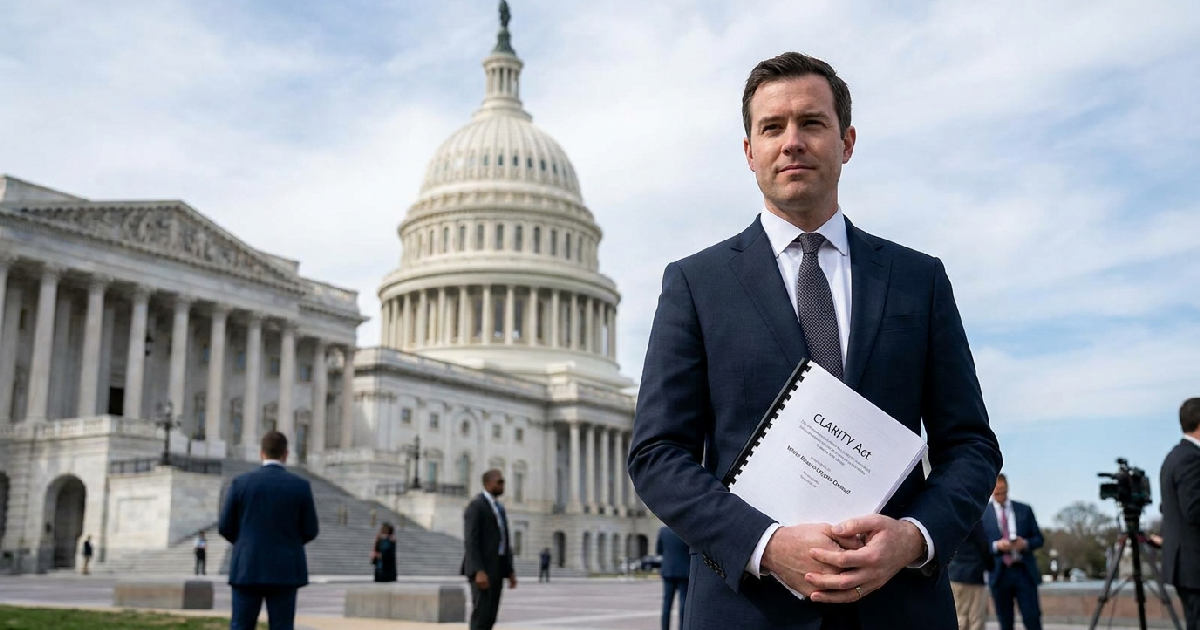

The CLARITY Act is facing a critical week in the U.S. Senate, marking a pivotal period for cryptocurrency regulation in Washington D.C. C. is gearing up for a pivotal period in cryptocurrency regulation as the CLARITY Act faces a “critical week” in the U.S. Senate. This assessment comes from Patrick Witt, Executive Director of the White House Crypto Council, who emphasizes the urgency of passing this significant crypto bill.
This crucial legislative juncture also coincides with the one-year anniversary of the GENIUS Act becoming law, a landmark stablecoin regulation enacted around July 2025. The White House is pushing the Senate to act swiftly, citing geopolitical concerns and the need for the U.S. to maintain its lead in both artificial intelligence and the burgeoning crypto industry.
Senate battle for crypto clarity
The CLARITY Act, formally known as the Digital Asset Market Clarity Act of 2025 (H.R. 3633), aims to establish a comprehensive regulatory framework for digital assets. It seeks to resolve jurisdictional ambiguities, primarily by defining asset classifications and dividing oversight between the Securities and Exchange Commission (SEC) and the Commodity Futures Trading Commission (CFTC).
The bill passed the House in July 2025 with bipartisan support, securing 294 to 134 votes, including 78 Democrats. But its path through the Senate presents a more formidable challenge. It needs at least 60 votes to overcome a potential filibuster, a tall order in the current political climate.
Despite this hurdle, the CLARITY Act did advance out of the Senate Banking Committee on May 15, 2026, following a 15-9 vote. Notably, Democratic Senators Angela Alsobrooks of Maryland and Ruben Gallego of Arizona joined 13 Republicans in backing the measure.
However, the bill’s overall chances remain uncertain. Data from prediction market platform Polymarket suggests there’s only a 40% probability of the crypto bill being signed into law this year, reflecting the tough legislative road ahead.
Key provisions of the proposed framework
The CLARITY Act’s core objective is to categorize crypto assets into three distinct types: digital commodities, investment contract assets, and permitted payment stablecoins. This classification is intended to clarify the regulatory obligations of the CFTC and SEC.
Under the bill, the CFTC would gain exclusive jurisdiction over anti-fraud and anti-manipulation enforcement in spot digital commodity markets. This means intermediaries, such as crypto exchanges, would need to register with the CFTC, bringing more structure to the market.
The legislation also retains some SEC authority over primary market crypto transactions. It introduces a limited exemption from SEC registration requirements for fundraising, dubbed “Regulation Crypto.” This would allow companies to raise up to $75 million over a 12-month period from everyday investors.
Beyond regulatory oversight, the CLARITY Act mandates that digital commodity brokers, dealers, and exchanges be treated as financial institutions under the Bank Secrecy Act. This ensures the implementation of robust anti-money laundering programs and customer identification protocols.
An important component folded into the CLARITY Act as Section 604 is the Blockchain Regulatory Certainty Act. This provision aims to shield non-custodial software developers from being mistakenly categorized as money transmitters, addressing a significant concern for innovation in the decentralized finance space.
White House push for digital asset leadership
The White House views the CLARITY Act as integral to the United States’ strategic position in the rapidly evolving global digital economy. Executive Director of the White House Crypto Council, Patrick Witt, has been vocal about the need to act now.
President Donald Trump has also actively urged the Senate to pass the CLARITY Act, having previously signed the GENIUS Act into law. He sees a direct correlation between a clear regulatory environment for crypto and America’s national economic strength.
This executive-level emphasis underscores a broader concern that delays in establishing clear “rules of the road” could stifle domestic innovation. It could also potentially push crypto businesses towards jurisdictions with more defined regulatory landscapes.
For the U.S., a failure to enact this framework could mean ceding ground to other major economies. Many countries are accelerating their own digital asset strategies, highlighting the competitive global race for dominance in this sector. This legislative push directly impacts the nation’s ability to attract and retain digital asset talent and investment.
Democratic opposition and legislative hurdles
Despite some bipartisan support, the CLARITY Act continues to face significant opposition, particularly from within the Democratic party. Their concerns span various provisions, including those related to stablecoins, decentralized finance (DeFi), and even meme coins.
Ethical considerations are another major sticking point for many Democrats, who worry about potential avenues for corruption that adequate regulation aims to prevent. While some acknowledge the bill’s potential to foster innovation and create jobs, they prioritize consumer protection and market integrity.
Senator Cynthia Lummis of Wyoming, a staunch pro-Bitcoin advocate and Chair of the Senate Banking Subcommittee on Digital Assets, recently warned of potential delays. She indicated the bill could stall until 2030, depending on the outcome of future midterm elections, illustrating the deeply entrenched political divisions.
With Republicans holding 53 seats in the Senate, the bill needs at least seven Democratic votes to reach the 60-vote threshold required to overcome a filibuster. Securing this level of bipartisan consensus remains an extremely tough task for proponents of the legislation.
This week will be crucial in determining whether the US crypto market gains regulatory clarity or faces prolonged uncertainty. The outcome will shape investment flows and innovation within the sector, influencing America’s standing on the global digital stage. Continuing delays could have long-term repercussions for the U.S. crypto economy.