
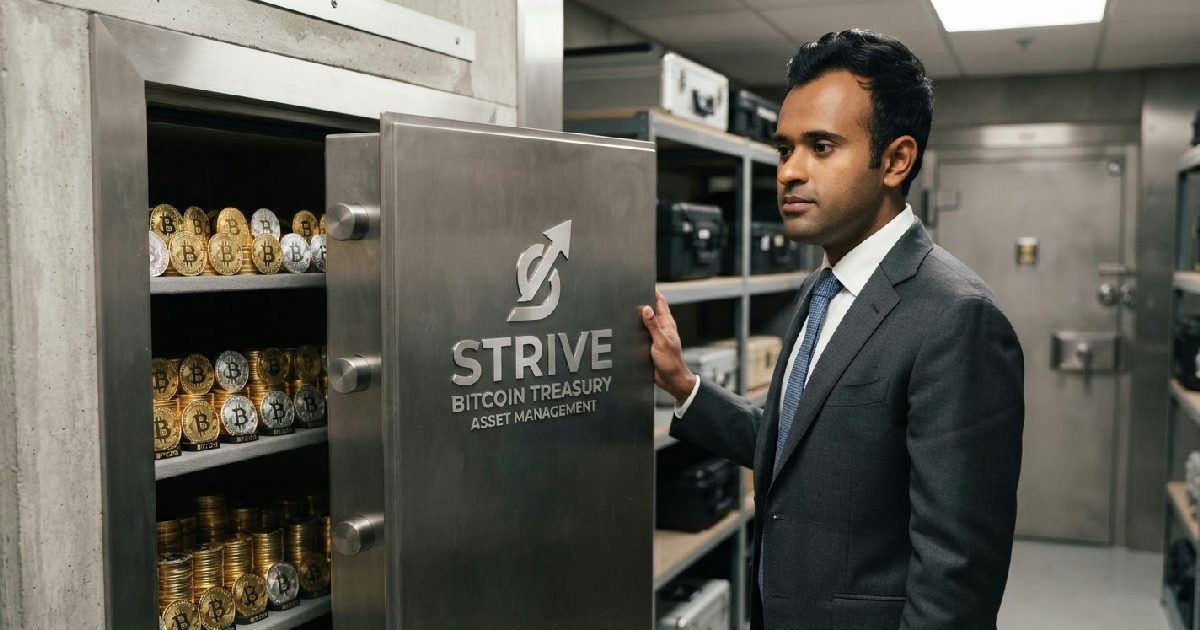

Strive has cemented its position as a major force in corporate Bitcoin adoption, purchasing 1,800 BTC for approximately $143 million. The move elevates the Dallas-based company to the fifth-largest publicly traded holder of bitcoin, sending its stock (NASDAQ: ASST) soaring 9% on Monday following the announcement. This significant acquisition bolsters the Strive Bitcoin treasury, making it a notable player in the cryptocurrency space.
The acquisition, which took place between August 24 and August 28, brings Strive’s total reserves to 23,156 BTC. According to a filing with the Securities and Exchange Commission, the company paid an average price of $79,431 per coin. The aggressive accumulation highlights a potential significant liquidity shift as corporate players continue to build their balance sheets with the digital asset.
Strive Bitcoin treasury doubles down on debt-free accumulation strategy
Unlike other firms that may use debt instruments to fund acquisitions, Strive’s approach centers on a debt-free balance sheet. The company financed its latest purchase using proceeds from at-the-market (ATM) offerings of its preferred and common shares. This strategy avoids the risks of leverage and potential forced liquidation during market downturns.
Strive CEO Matt Cole has publicly emphasized this conservative financial posture, describing the company as having “zero margin requirements and zero encumbered bitcoin.” This provides investors a pure-play exposure to Bitcoin through a corporate vehicle without the added risk of credit lines or bonds. The company’s goal is to maximize bitcoin held per share over time.
This strategy appears to be resonating with investors. The company’s stock has climbed nearly 40% year-to-date, and its “Bitcoin yield”—a metric comparing the growth in bitcoin holdings relative to its share count—reached 40.8% as of its latest filing.
This metric, up from under 37% in early June, is a key indicator of the strategy’s success in accreting Bitcoin value for its shareholders even as it issues new equity.
A rapid ascent in the corporate treasury ranks
Strive’s rise has been remarkably swift. Founded in 2025 by former Ohio gubernatorial candidate Vivek Ramaswamy, the company debuted after raising $750 million with the explicit goal of becoming a premier bitcoin treasury. Its rapid accumulation has quickly placed it among the sector’s largest players, trailing only established names like Strategy, Twenty One, Metaplanet, and MARA Holdings.
The company made waves in January 2026 when it completed the acquisition of Semler Scientific in an all-stock deal. This was the first instance of one publicly traded Bitcoin treasury company acquiring another, signaling a new phase of consolidation and strategic maneuvering within the niche sector. The move was a clear statement of intent from Strive’s management to aggressively expand its footprint.
This latest purchase saw Strive surpass the holdings of the crypto exchange Bullish, further solidifying its top-tier status. The move also caught the attention of Wall Street, with analyst firm TD Cowen reportedly raising its price target for ASST stock in the wake of the announcement, lending further credibility to the company’s Bitcoin-focused strategy.
Corporate interest in bitcoin appears renewed
Strive’s purchase was not an isolated event. It coincided with renewed activity from the largest corporate Bitcoin holder, Strategy. The software intelligence firm resumed its Bitcoin buying after a 10-week pause, announcing it had acquired 4,603 bitcoins for $369.7 million between August 24 and August 30.
The concurrent buying from two of the largest public treasuries suggests a renewed confidence among corporate strategists. Both companies were accumulating in the same final week of August, potentially viewing the price levels around $79,000 as a strategic entry point ahead of a potential market shift.
This synchronized activity could indicate a shared belief that Bitcoin is undervalued or that a new bull market phase is taking shape.
For investors, these companies offer a proxy for Bitcoin exposure within the traditional financial system. Their performance is tightly correlated with Bitcoin’s price, but their operational strategies—like Strive’s debt-free model versus Strategy’s use of debt to finance purchases—offer different risk-reward profiles for shareholders looking to gain exposure to the asset class.
The strategic rationale for public bitcoin treasuries
Companies like Strive function as “Bitcoin development companies,” providing a vehicle for public market investors to gain exposure to Bitcoin without holding the asset directly. This model can offer what the source material describes as “amplified returns,” where the company’s stock performance may outpace Bitcoin itself due to strategic acquisitions and operational leverage.
By issuing equity to buy Bitcoin, Strive makes a clear bet that the long-term appreciation of BTC will far exceed the cost of share dilution. This is a capital allocation strategy designed for a future where Bitcoin plays a much larger role as a global reserve asset. The appeal lies in the company handling the complexities of custody, security, and acquisition at scale.
However, the model is not without risk. The value of these companies is almost entirely tethered to the price of Bitcoin. A prolonged bear market would significantly impact their stock values.
Strive’s insistence on a debt-free balance sheet is a direct attempt to mitigate one of the primary risks associated with this model: the possibility of a margin call or forced sale of its Bitcoin holdings during a price collapse. This makes Strive a more conservative option within the aggressive world of corporate Bitcoin treasuries.