
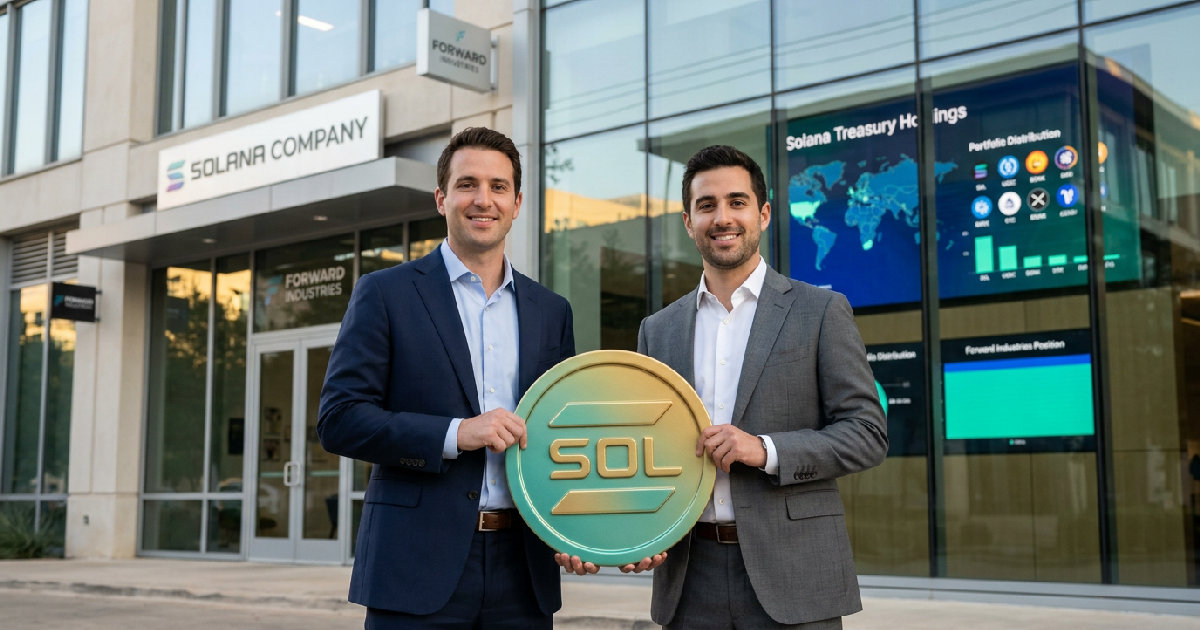

Forward Industries, Inc. (FWDI) confirmed on June 15, 2026, that Solana Company (HSDT) has rejected its non-binding proposal to consolidate the digital asset treasury sector. The Austin-based firm, led by Chairman Kyle Samani and Chief Investment Officer Ryan Navi, is attempting to acquire smaller rivals to scale its holdings.
Despite the setback, Forward remains the largest public Solana treasury firm with over 6.9 million SOL tokens.
The rejection follows a vote by the board of Solana Company on June 12, 2026, which declined the all-stock offer and ended further discussions. Forward had proposed an exchange ratio of 0.386 newly-issued shares for each share of HSDT, valuing the target at $1.63 per share. This bid represented a 10% premium over HSDT’s closing price on the day prior to the proposal.
Forward Industries is positioning itself as a “Berkshire Hathaway of Solana” to address what it describes as structural inefficiencies in the market. Ryan Navi has suggested that subscale treasuries struggle with high fixed operating costs that lead to negative cash flows. By consolidating these assets, Forward believes it can enhance shareholder value through a more robust public-markets vehicle.
Consolidation strategy faces resistance from Solana treasury firms
The bid for HSDT is not an isolated attempt. On June 6, 2026, Brera Holdings PLC, also known as Solmate, turned down a private all-stock proposal from Forward. That offer involved 1.54 shares of Forward for each share of Solmate, valuing the target at $7.19 per share. While Bitcoin signals market structure shifts toward institutional maturity, the Solana sector remains fragmented.
Solmate’s balance sheet reflects the complexity of these subscale entities. As of February 28, 2026, the company reported 1.2 million SOL alongside $9.1 million in cash. Additionally, it held approximately $7.1 million in crypto-related securities. These diversified holdings make such firms attractive targets for Forward’s expansion, yet boards remain hesitant to accept all-stock deals.
Another target, SkyAI Inc., failed to respond to Forward’s non-binding proposal before its expiration date. This pattern of silence and rejection suggests that smaller firms may be waiting for better market conditions or higher premiums. Forward argues that maintaining independent operations with high overhead is “eroding shareholder value” for these smaller players.
Financial profile of the largest public Solana treasury
Forward Industries launched its digital asset strategy in September 2025 with $1.65 billion in PIPE financing. Backers included Galaxy Digital, Jump Crypto, and Multicoin Capital. The initial acquisition involved 6,822,000 SOL at an average price of $232 per token. Since then, the firm has slightly increased its holdings to over 6.9 million SOL.
Despite 156% revenue growth over the last twelve months to $44.8 million, the company’s stock has faced significant pressure. As of June 15, 2026, Forward’s share price sits at $4.28, which is 91% below its 52-week high of $46. This decline of 40% over the last six months may be contributing to the reluctance of target companies to accept Forward’s stock as currency.
The firm has also introduced fwdSOL, a liquid staking token, as part of its broader ecosystem strategy. However, the market capitalization of $319.6 million remains well below the initial cost of its digital assets. This valuation gap is a primary driver behind the push for consolidation, as the firm seeks to prove its model through scale.
Market pressure on subscale digital asset treasuries
The core of the “win-win” argument rests on the belief that small-cap treasury firms cannot survive long-term. Public company costs, including audits and legal compliance, do not scale down for smaller portfolios. At a time when Bitcoin targets support levels amid broader market outflows, the pressure on cash-burning treasuries is increasing.
Forward’s management remains convinced that acquisitions are a “powerful growth lever” to unlock value trapped in these smaller portfolios. By bringing 2.06 million SOL from HSDT or 1.2 million SOL from Solmate under one roof, the firm hopes to create a dominant market entity. For now, the leadership of those firms appears committed to their independent digital asset strategies.
The outcome of this M&A drive will likely depend on the performance of the SOL token itself. If yields remain low and operating costs continue to drain capital, shareholders of HSDT and SLMT may eventually push for the very consolidation their boards have just rejected. Forward Industries has made its opening moves; the rest of the sector is now watching for the next bid.