
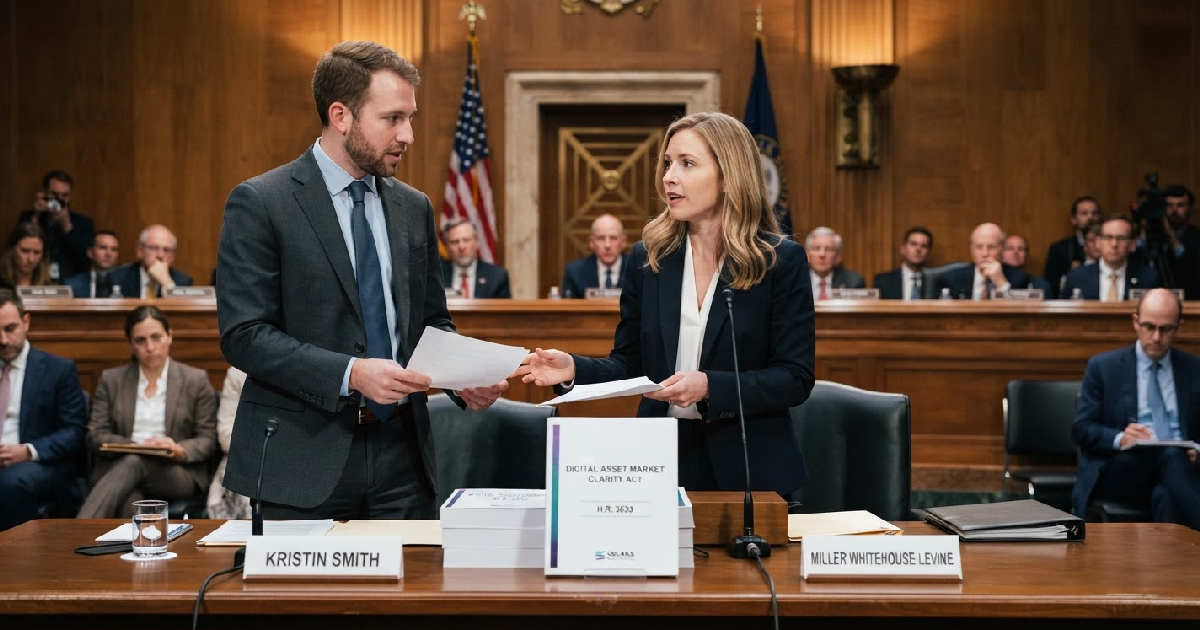

The Solana Policy Institute (SPI), an advocacy group for decentralized networks, is intensifying its efforts in Washington D.C. as the U.S. Senate considers the Digital Asset Market CLARITY Act (H.R. 3633). President Kristin Smith and head Miller Whitehouse-Levine are pushing for crucial provisions to safeguard open-source developers and validators. Their focus highlights the nuanced challenges of establishing a comprehensive federal regulatory framework for digital assets.
This legislative push comes more than a year after the bill first passed the House of Representatives, signaling a protracted battle for regulatory clarity in the crypto space.
Protecting open-source developers and validators
The Solana Policy Institute is specifically lobbying the U.S. Senate regarding the Digital Asset Market CLARITY Act, formally known as H.R. 3633. Their primary aim is to preserve protections for open-source developers and validators within the proposed legislation.
This advocacy is not singular; more than 60 leading CEOs and founders from the crypto industry have also signed a letter backing the industry’s stance on these developer protections. Such safeguards are seen as essential to maintain the decentralized nature of blockchain technology and prevent regulatory burdens from stifling innovation.
Solana Policy Institute’s role in crypto advocacy
Founded in 2025 by Miller Whitehouse-Levine, the Solana Policy Institute operates as a non-partisan, non-profit organization. Its mission centers on educating policymakers about decentralized networks, particularly the Solana ecosystem, and advocating for legal certainty for those building within these environments.
Kristin Smith, who became President of the Solana Policy Institute in May 2025, previously served as the founding Chief Executive Officer of the Blockchain Association from 2019 to May 2025. Her extensive experience on Capitol Hill, including roles as a legislative assistant and Deputy Chief of Staff, brings significant lobbying expertise to the Institute’s efforts.
The CLARITY Act’s legislative journey
The Digital Asset Market Clarity Act of 2025, or the CLARITY Act, aims to establish a comprehensive federal regulatory framework for digital assets in the U.S. This critical legislation seeks to resolve the long-standing jurisdictional ambiguities between the Securities and Exchange Commission (SEC) and the Commodity Futures Trading Commission (CFTC).
The bill has already seen significant movement through Congress. The U.S. House of Representatives passed H.R. 3633 by a vote of 294–134 on July 17, 2025, with 78 Democrats joining Republicans in support. The Senate Banking Committee then advanced its amended version of the bill on May 14, 2026, by a 15–9 vote, sending it to the full Senate.
Key provisions of the proposed regulation
The CLARITY Act proposes classifying digital assets into three categories: digital commodities regulated by the CFTC, investment contract assets under SEC oversight, and permitted payment stablecoins subject to joint oversight. It also introduces a “blockchain maturity” mechanism, allowing tokens to transition from SEC to CFTC oversight once they achieve sufficient decentralization.
Investor protection is another central tenet, with requirements for exchanges to segregate customer funds and mandates for transparency regarding token risks. The bill would also establish registration regimes for digital commodity exchanges and brokers, and update federal securities laws to allow dual registration for SEC registrants offering digital commodities.
Uncertain future for digital asset legislation
Despite the legislative progress, the path forward for the CLARITY Act remains uncertain. Kristin Smith urged the U.S. Senate to pass the bill on Tuesday, June 10, 2026. The Solana Policy Institute publicly reiterated its call for Senate leaders to preserve developer and validator protections just days later, on June 15, 2026.
The outlook for the bill becoming law this year reflects a challenging political landscape. As of June 23, 2026, Miller Whitehouse-Levine estimated a 50% probability that the CLARITY Act would become law. This estimate underscores the tight margins and ongoing negotiations required to secure its passage.
The outcome will significantly shape the U.S. digital asset ecosystem, influencing everything from institutional adoption to the ability of open-source projects to innovate without fear of unexpected regulatory hurdles.