
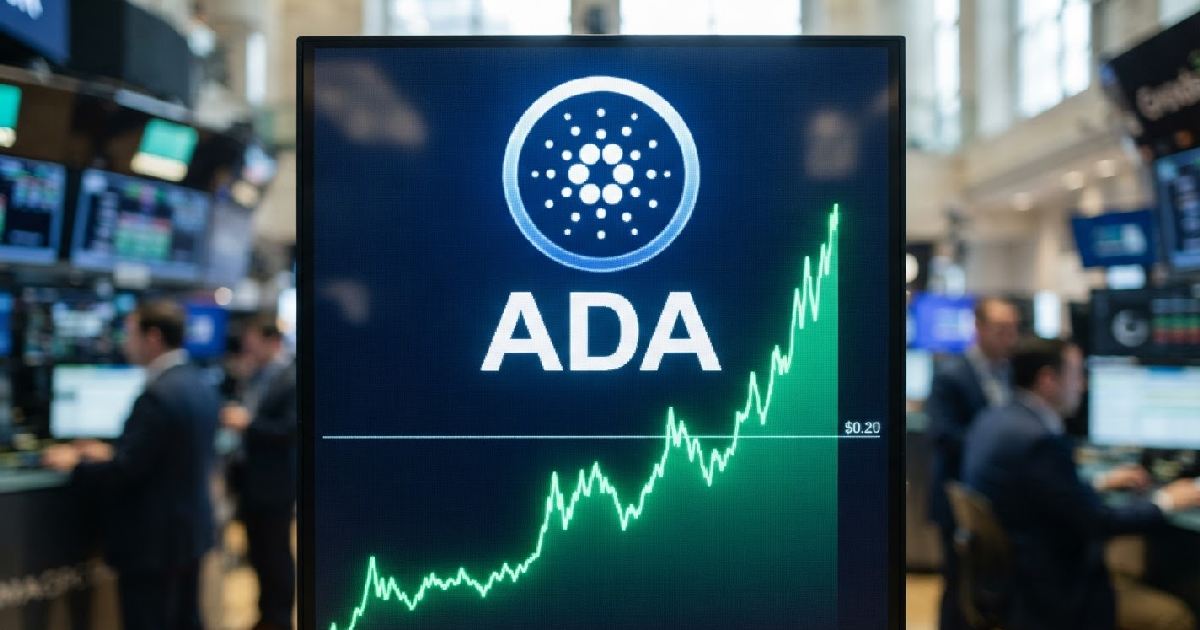

Cardano’s native ADA token has seen a significant rally this week, climbing by more than 19% and breaking above the critical $0.20 resistance level. This surge follows the network’s transition into the Dijkstra development era, a new roadmap designed to enhance scalability and introduce a unique direct treasury funding mechanism for core development.
The move has sparked considerable market activity, pushing ADA’s price to approximately $0.202 as of August 7, 2026.
Dijkstra era introduces new development roadmap
The transition to the Dijkstra era, alongside expanding interoperability initiatives, appears to have resonated with market participants. Daily gains for ADA have averaged over 6% throughout the week, with the altcoin rallying nearly 10% on August 2, 2026, as the network officially shifted its focus. This period also saw Cardano achieve a new peak in its Nakamoto coefficient, reaching 16, underscoring its commitment to decentralization.
The Dijkstra era, named after computer scientist Edsger W. Dijkstra, represents the next major phase in Cardano’s development, following the foundational van Rossem hard fork enacted on July 18, 2026. This new roadmap primarily targets substantial advancements in scalability and on-chain governance, signaling a strategic pivot for the blockchain.
Central to Dijkstra’s innovations are the planned introductions of Nested Transactions and Linear Leios, both components of the broader Ouroboros Leios research program. These are engineered to significantly increase transaction capacity while preserving the network’s proof-of-stake security and decentralized ethos. The Haskell node team aims to deliver these first two phases to mainnet by the end of 2026.
Dijkstra also extends Cardano’s governance framework, introducing new tools such as parameter update actions and on-chain Constitutional Committee elections. This strengthens the network’s move towards a self-governing system, building on the Voltaire development phase’s objectives. These governance features aim to give ADA holders more direct control over the protocol’s future.
Funding innovation through the treasury
A distinctive aspect of the Dijkstra era is its newly approved roadmap, which positions Cardano as the first blockchain to fund its core development directly from its community treasury. This unique on-chain treasury model collects a portion of transaction fees and staking rewards, providing a sustainable funding source for network upgrades, research, and community-driven projects.
This mechanism fosters greater community participation, with ADA token holders able to influence fund allocation through governance proposals. It ensures that critical development is supported by the network’s own activity rather than being solely dependent on external investment or fragmented funding approaches, as seen in some other ecosystems.
Interoperability expands with IBC integration
Beyond its internal architectural upgrades, Cardano is actively expanding its interoperability, a crucial step for broader ecosystem integration. The network recently completed its first live Inter-Blockchain Communication Protocol (IBC) integration with Injective (INJ) on testnet.
This experimental proof of concept allows for trust-minimized transfers of test ADA between Cardano Preprod and Injective Testnet. While not yet a production-ready bridge, it marks a significant step towards making ADA usable across the Injective ecosystem and potentially allowing INJ on Cardano. This opens a pathway for Cardano into the wider IBC ecosystem, which connects numerous networks within the Cosmos environment.
The integration required substantial engineering effort due to Cardano’s Extended UTXO (eUTXO) accounting model, which differs fundamentally from the account-based architecture used by Cosmos chains. This success demonstrates Cardano’s technical capacity to bridge disparate blockchain architectures. Earlier in 2026, Cardano also connected with over 80 blockchains, including Ethereum and Solana, through LayerZero.
Market reaction and ADA’s price outlook
The market has responded positively to these developments. Daily trading volume for ADA surged by over 78%, reaching approximately $747 million. This jump from $412.8 million indicates a strong resurgence of investor interest and liquidity in the token.
Moreover, the network’s Total Value Locked (TVL) rose by around 3% to $88 million, while weekly Decentralized Exchange (DEX) volume increased by 17% to $13 million. These metrics suggest growing utility and engagement within the Cardano ecosystem, not just speculative trading.
Whales accumulate ahead of price move
Significant accumulation activity from large holders, often referred to as “whales,” further underscores the positive sentiment. Santiment data reveals that whales accumulated over 240 million ADA in the past few days, with wallets holding between 100 million and 1 billion ADA sweeping up these tokens in under a week.
This accumulation pattern frequently precedes price uptrends, as major players position themselves in anticipation of further gains. Open Interest behind Cardano has also grown by 40% since July 29, climbing from $369 million to $519 million, reflecting increased leverage in the market.
Overcoming key resistance levels
From a technical perspective, ADA breaking the $0.20 resistance level is a crucial development. This price point had capped every recovery attempt throughout the year, with the altcoin ranging between $0.14 and $0.20 since July. The break above this psychological barrier suggests renewed bullish momentum.
The price action followed a sharp 41% drop from $0.24 to $0.14 earlier in the year, making the current rebound particularly noteworthy. Should ADA successfully consolidate above $0.20, analysts are eyeing $0.24 and then $0.30 as potential next target areas. However, failing to hold this level could see the altcoin revert to its previous trading range, underscoring the importance of sustained buying pressure.
Longer-term vision and challenges
The Dijkstra era signifies Cardano’s continued evolution toward a more scalable and decentralized network. By funding development directly from its treasury, Cardano aims for long-term sustainability and community-driven growth, differentiating itself from projects reliant solely on external venture capital.
However, the path ahead isn’t without its challenges. While the recent price surge is encouraging, ADA still trades roughly 95% below its all-time high of $3.09, set in September 2021. The ability for Cardano to deliver on its ambitious Dijkstra roadmap and translate technical advancements into sustained adoption will be key to its future performance.
The success of the new governance tools and the seamless integration of features like Nested Transactions will ultimately determine how effectively Cardano can scale its operations. Furthermore, the expansion of its interoperability, particularly through the IBC integration with networks like Injective, is vital for attracting new users and developers to the ecosystem, fostering a more connected blockchain landscape.
These strategic moves aim to solidify Cardano’s position among top blockchains. But maintaining momentum requires not just technical progress but also robust community engagement and effective governance to navigate the competitive and ever-evolving cryptocurrency market. The coming months will be critical in demonstrating the full impact of the Dijkstra era.