
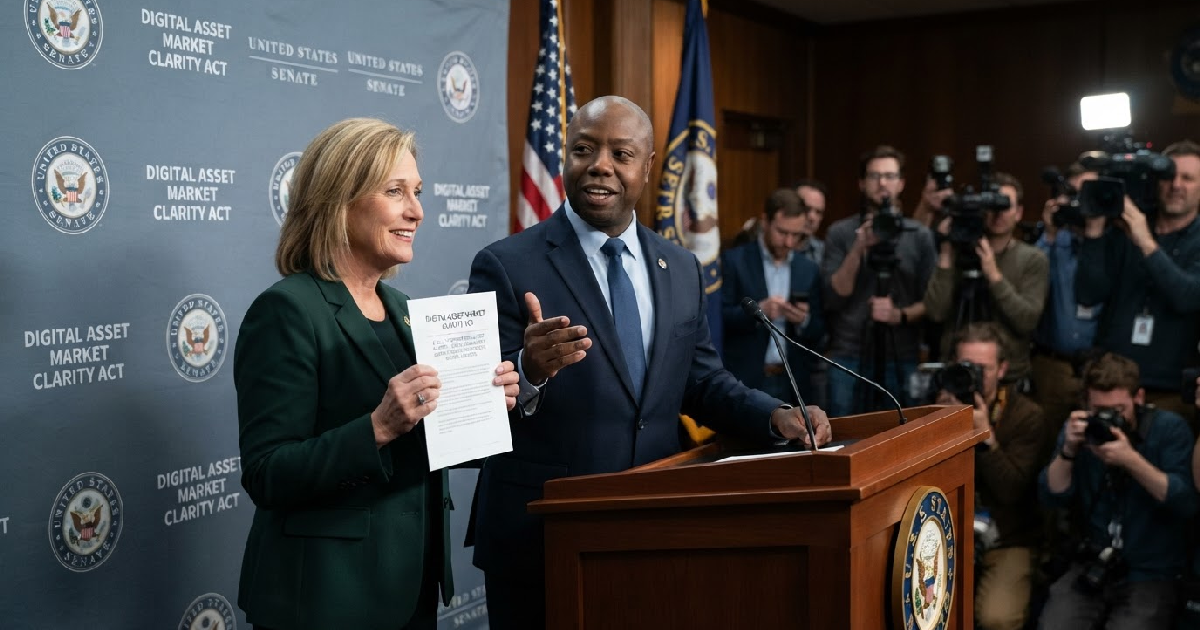

The Digital Asset Market Clarity Act of 2025 (H.R. 3633) is being pushed by U.S. Senate Banking Committee Chairman Tim Scott for a final vote before the August recess. S. Senate Banking Committee Chairman Tim Scott (R-S.C.) has pledged to push the Digital Asset Market Clarity Act of 2025 (H.R. 3633) to a final vote, aiming to secure its passage through Congress before the critical August recess.
This commitment, announced today, July 23, 2026, signals a significant advance for legislation designed to establish a clear federal regulatory framework for digital assets across the United States.
Legislative momentum builds for digital asset clarity
Chairman Scott’s move follows Senator Cynthia Lummis (R-WY), Chair of the Senate Banking Digital Assets Subcommittee, releasing an updated draft of the comprehensive legislation. The bill, also known as the CLARITY Act, represents a joint effort between the Senate Banking and Agriculture Committees to create a cohesive regulatory approach for the rapidly evolving digital asset landscape.
The Digital Asset Market Clarity Act has garnered substantial bipartisan support throughout its legislative journey, highlighting a growing consensus in Washington on the necessity of crypto regulation. It advanced out of the Senate Banking Committee by a vote of 15-9, indicating cross-aisle cooperation on complex financial policy.
Senators Angela Alsobrooks (D-MD) and Ruben Gallego (D-AZ) notably joined Committee Republicans to support the bill, playing crucial roles in its progression. Senator Alsobrooks, in particular, was instrumental in shaping compromise language around stablecoin yield provisions. This demonstrates an effort to bridge partisan divides and find common ground.
The House of Representatives previously passed the bill with an even more decisive vote of 294 to 134, with 216 Republicans and 78 Democrats voting in favor. This level of agreement, especially in the current political climate, underscores lawmakers’ increasing recognition of the urgent need for structured digital asset oversight.
Key components of the Digital Asset Market Clarity Act
The Digital Asset Market Clarity Act of 2025 (H.R. 3633) encompasses several critical elements aimed at establishing a comprehensive regulatory framework for digital assets in the United States. These include specific bill details, involved individuals, its core objectives, related legislation, and committee oversight.
-
Bill Name and Number:
- H.R. 3633, the Digital Asset Market Clarity Act of 2025 (also referred to as the CLARITY Act) (per U.Today, Fox Business, Akin Gump, House Rules Committee, Senate Banking Committee, Representative Shontel Brown).
Key Individuals and Roles:- Chairman Tim Scott (R-S.C.): U.S. Senate Banking Committee Chairman, led the committee in advancing the bill (per U.Today, Fox Business, Senate Banking Committee, Akin Gump).
- Senator Cynthia Lummis (R-WY): Senate Banking Digital Assets Subcommittee Chair, released updated text for the bill (per Akin Gump, U.S. Senator’s office).
- Senator Angela Alsobrooks (D-MD): Joined Committee Republicans to support the bill and played a leading role in shaping compromise language on stablecoin yield (per Senate Banking Committee).
- Senator Ruben Gallego (D-AZ): Joined Committee Republicans to support the bill (per Senate Banking Committee).
- Chairman Boozman: Led the Agriculture Committee portion of the bill (per U.S. Senator’s office).
- Leader Thune: Supported the bill (per U.S. Senator’s office).
- Treasury Secretary Scott Bessent: Stated the Clarity Act is on the “1-yard line” (per U.Today).
- Senator Cramer: Discussed the bill’s progress (per U.Today).
- Congresswoman Shontel Brown (OH-11): Voted against the CLARITY Act (per Representative Shontel Brown).
Key Provisions and Objectives:- Establishes clear rules for digital assets (per Senate Banking Committee).
- Creates a federal regulatory framework for cryptocurrencies and other digital assets (per Senate Banking Committee).
- Clarifies the division of authority between the Securities and Exchange Commission (SEC) and Commodity Futures Trading Commission (CFTC) (per Senate Banking Committee, Akin Gump, House Rules Committee).
- Codifies core conduct and disclosure obligations for intermediaries (per Senate Banking Committee).
- Integrates anti-fraud and anti-money-laundering requirements into the digital asset ecosystem (per Senate Banking Committee).
- Permits limited payments on GENIUS Act-permitted payment stablecoin balances (per Senate Banking Committee).
- Allows bona fide activity- or transaction-based rewards on payment stablecoin balances, provided they are not economically or functionally equivalent to interest on a bank deposit (per Senate Banking Committee).
- Directs the SEC, CFTC, and U.S. Department of the Treasury to undertake joint rulemaking within one year to clarify the line between prohibited “interest-like” returns and permissible activity and transaction-based rewards (per Senate Banking Committee).
- Establishes minimum conditions to ensure the regulatory ability and integrity of blockchain systems’ records (per House Rules Committee).
- Requires any person or entity hosting a wallet to be compliant with KYC and AML requirements of the Bank Secrecy Act (per House Rules Committee).
- Establishes a crypto investor and consumer “bill of rights” including 24/7 customer service, insurance or SIPC-like coverage, fiduciary/best-execution rules, anti-front-running rules, bankruptcy-remote custody with 24-hour withdrawals, and monthly auditor-attested proof-of-reserves (per House Rules Committee).
- Provides funding for the SEC and CFTC (per House Rules Committee).
- Ensures that if a court finds any language in this legislation ambiguous, it will defer to the interpretation of the SEC and CFTC (per House Rules Committee).
- Clarifies that the term State includes the District of Columbia, territories and possessions (per House Rules Committee).
- Strikes sections 309 and 409, which exempt certain decentralized finance activities from regulation by the SEC and CFTC (per House Rules Committee).
- Prohibits any digital asset issued by a company owned, affiliated, or controlled by the President or their family members from being required to be used in transactions with the government (per House Rules Committee).
- Prevents digital assets from being traded on any exchange or platform that controls or is controlled by a private fund (per House Rules Committee).
Related Legislation:- GENIUS Act (S. 1582) (per Senate Banking Committee, Representative Shontel Brown).
- Responsible Financial Innovation Act of 2025 (RFIA) (per Akin Gump).
Committees Involved:- Senate Banking, Housing, and Urban Affairs Committee (per U.Today, Fox Business, Senate Banking Committee, U.S. Senator’s office).
- House Committee on Agriculture (per House Rules Committee).
- House Committee on Financial Services (per House Rules Committee).
Vote Count:- Advanced out of the Senate Banking Committee by a vote of 15-9 (per Senate Banking Committee).
- Passed the House of Representatives by a vote of 294 to 134 (216 Republicans and 78 Democrats voted for the bill) (per Akin Gump).
Impact and outlook for US crypto regulation
Chairman Tim Scott’s public commitment to shepherd the Digital Asset Market Clarity Act to a final vote marks a pivotal moment for the cryptocurrency industry. It signals a strong legislative will to move beyond discussions and towards concrete, actionable regulation in the United States.
For investors and businesses operating in the U.S., the passage of this bill would mean an end to much of the current regulatory ambiguity, which has often stifled innovation and driven crypto firms offshore. Treasury Secretary Scott Bessent has already stated the Clarity Act is on the “1-yard line,” emphasizing the proximity of a potential legislative breakthrough.
The bill’s provisions, from defining regulatory jurisdiction to mandating robust consumer protections, could significantly de-risk the U.S. crypto market. This could attract greater institutional investment and foster a more stable environment for digital asset innovation, strengthening the economic growth of the country by giving entrepreneurs fair opportunities.
Senator Lummis has expressed optimism that the coming weeks represent “the best opportunity in years” for Congress to pass meaningful digital asset legislation. Chairman Scott’s backing transforms that optimism into a tangible legislative pathway, potentially establishing the U.S. as a clearer and more competitive hub for digital assets.
With Chairman Scott’s resolve, attention now turns to the Senate floor and the tight legislative calendar before the August recess. The bill’s journey through both chambers of Congress, including the substantial bipartisan votes, suggests a genuine appetite for establishing a federal framework for digital asset regulation.
The CLARITY Act also includes directives for the SEC and CFTC to undertake joint rulemaking within a year. This indicates an ongoing commitment to refining regulatory boundaries and specifics. Should it pass, the Digital Asset Market Clarity Act would deliver a foundational regulatory structure that has long been sought by the crypto industry, impacting everything from Bitcoin to XRP.