

When you hand a paper dollar bill to a cashier, the transaction is definitive. You no longer have the bill; the store does. In the digital world, however, maintaining that level of finality without a bank in the middle is incredibly difficult. Because digital data can be copied and pasted effortlessly, a decentralized network must find a foolproof way to ensure that a digital token cannot be spent in two places at once.
Traditional finance solves this through central databases. A bank tracks your balance, updates its ledger, and serves as the single source of truth. Blockchains don’t have a central office or a CEO. Instead, they rely on a network of independent computers distributed worldwide. To prevent chaos, these computers must agree on the exact state of the ledger at any given moment.
This agreement is reached through a consensus mechanism. While several frameworks exist, the ongoing debate around Proof of Work and Proof of Stake sits at the heart of how modern blockchains balance security, decentralization, and economic design. These are not merely technical specifications; they are distinct philosophies on how to manufacture trust among absolute strangers.
The Core Problem Every Blockchain Must Solve First
Before comparing Proof of Work and Proof of Stake, it is essential to understand the exact vulnerability they are built to defend against: the double-spend problem. If an attacker can broadcast two conflicting transactions simultaneously — paying a merchant while also sending those same funds back to their own wallet, the entire system loses its integrity.
To stop this, a blockchain packages transactions into chronological blocks. Once a block is added to the chain, the history becomes practically irreversible. But who gets the right to write the next block? If anyone could do it with a simple click, a malicious actor could flood the network with millions of fake blocks, rewriting history to their benefit.
To solve this, a blockchain must make block production costly, introducing a real-world expense, the network ensures that participating in validation requires an investment. If cheating costs more than any potential reward, honesty becomes the only logical, profitable path. This is where the paths of Proof of Work and Proof of Stake diverge. They both create economic barriers to fraud, but they source their costs from entirely different realms.
Proof of Work and the Physical Cost of Digital Security
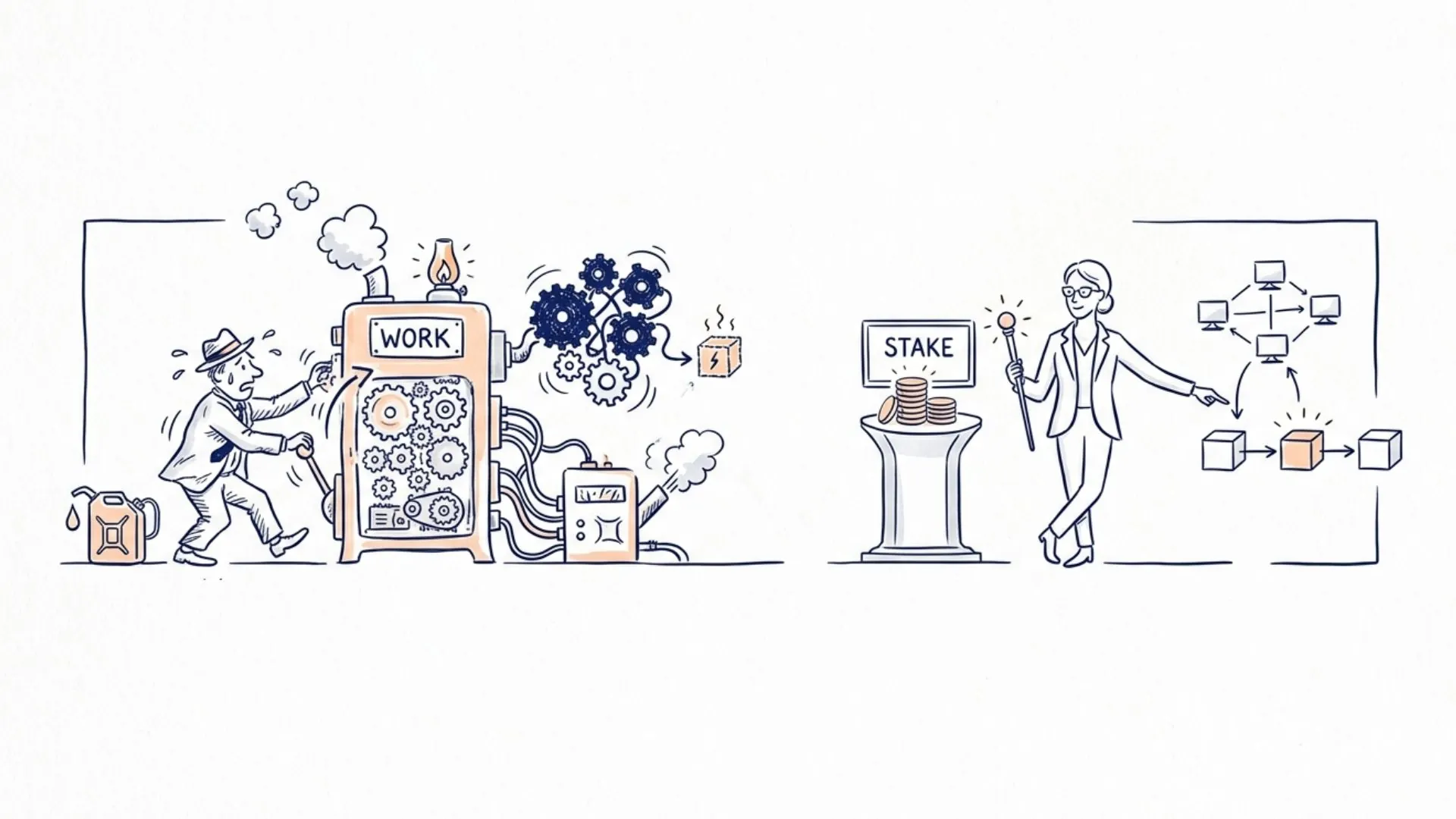
Proof of Work ties the security of a digital ledger directly to the laws of physics and thermodynamics. In this model, which powers the Bitcoin network, the participants responsible for updating the ledger are called miners.
Miners do not sit and verify transactions manually. Instead, they deploy highly specialized computers to compete in a continuous, global race to solve a complex cryptographic puzzle. This puzzle has no shortcut; it cannot be reasoned through or solved with elegant code. The only way to find the answer is through raw, computational brute force — guessing trillions of combinations per second.
When a miner’s computer finally guesses the correct solution, it broadcasts the achievement to the rest of the network. Because the puzzle is mathematically tied to the transactions inside the block, the solution serves as undeniable proof that the miner expended a massive amount of computational power and electricity to generate it.
[Transactions] + [Previous Block Hash] + [Brute Force Guessing] = Valid Block Solution
The security of this model relies on the sheer scale of this collective work. If an attacker wanted to alter a transaction that occurred ten blocks ago, they would not only have to recalculate the puzzle for that specific block, but they would also have to outpace the combined computing power of every other miner on Earth to rewrite all subsequent blocks. In a mature network, acquiring the necessary hardware and electricity to pull off such an attack requires billions of dollars in upfront capital.
Anchoring digital security to physical energy consumption, Proof of Work creates a fortress that is economically irrational to attack. The cost of trying to break the system will almost always dwarf whatever digital assets an attacker could hope to steal.
Proof of Stake and the Financial Skin in the Game
Proof of Stake approaches the problem from a purely financial angle, decoupling the security of the network from electricity bills and hardware supply chains. This is the architecture used by Ethereum and many newer protocols.
In a Proof of Stake network, there are no miners or energy-intensive guessing games. Instead, the participants who maintain the ledger are called validators. To earn the right to validate transactions and propose new blocks, a participant must lock up a specific amount of the network’s native cryptocurrency into a smart contract. This process is known as staking.
The network does not reward computational speed. Instead, an algorithm pseudo-randomly selects a validator to propose the next block. The likelihood of being chosen is typically proportional to the amount of capital the validator has locked in the system. A participant who stakes more capital has a higher chance of being selected, but the process remains randomized to prevent a single wealthy participant from controlling every block.
Once a validator proposes a block, a committee of other validators verifies that the transactions are legitimate. If everything checks out, the block is added to the chain, and the validator receives a reward composed of transaction fees and newly minted tokens.
The ultimate deterrent against fraud in this system is a mechanism called slashing. If a validator attempts to approve fraudulent data, alter transaction history, or validate conflicting versions of the blockchain simultaneously, the network punishes them. The protocol automatically confiscates a portion, or in some cases the entirety, of their staked assets.
Malicious Behavior = Automatic Slashing (Loss of Staked Capital)
In short, Proof of Stake replaces the external physical cost of electricity with an internal financial penalty. The skin in the game shifts from a recurring operational expense to direct collateral held hostage by the protocol itself.
How These Differences Impact the Ecosystem
Choosing between Proof of Work and Proof of Stake radically alters the characteristics of a blockchain, creating distinct trade-offs that directly affect network health, decentralization, and asset custody.
The Distribution of Power
In Proof of Work, power is tied to industrial capacity. To remain competitive, miners often cluster in regions with cheap electricity and favorable climates, or form massive mining pools to smooth out their revenue. This can lead to a concentration of hash power in the hands of a few large operational entities. However, anyone can theoretically buy a piece of hardware, plug it in, and contribute to the security of the network without needing permission or owning any native tokens beforehand.
In Proof of Stake, power is inherently tied to capital accumulation. Because those who hold the most tokens have the highest chance of validating blocks and earning rewards, the system can create a feedback loop where the wealthiest participants continuously expand their influence. On the other hand, running a validator requires no specialized industrial infrastructure — only a stable internet connection and a standard computer, making it far more accessible to individuals who do not want to manage hardware warehouses.
Environmental Footprint and Resource Allocation
The most visible point of contrast in Proof of Work and Proof of Stake is energy consumption. Proof of Work requires continuous energy expenditure to maintain its security wall; if miners turn off their machines, the network’s defense layer shrinks. This intentional consumption of electricity is often criticized for its environmental impact, though proponents argue it acts as a buyer of last resort for stranded, renewable energy.
Proof of Stake eliminates this energy requirement almost entirely, reducing a network’s carbon footprint by over 99%. Instead of burning electricity to prove honesty, the network relies on the opportunity cost of locked capital. The resource being consumed isn’t power — it is liquidity.
| Feature | Proof of Work (PoW) | Proof of Stake (PoS) |
| Primary Resource | Computational Power & Electricity | Staked Cryptocurrency (Capital) |
| Network Network Guard | Miners | Validators |
| Security Anchor | Cost of physical hardware and power | Risk of financial capital confiscation (Slashing) |
| Primary Criticism | High environmental and energy footprint | Risk of wealth and governance centralization |
The Paradox of the Trustless Ledger
The shift from Proof of Work to Proof of Stake highlights a fundamental paradox embedded within decentralized systems: to create a network that requires no trust, you must build an infrastructure driven entirely by economic self-interest. Neither system relies on the moral integrity of its participants. Instead, both assume that players will act greedily, and they use that greed to defend the perimeter.
When analyzing the security models of different digital assets, the question is not which mechanism is universally superior, but rather which type of scarcity you prefer to anchor a network’s security to. Proof of Work anchors its security to the scarcity of physical matter and energy, making the ledger an immutable reflection of work done in the real world. Proof of Stake anchors its security to the internal scarcity of the token itself, leveraging pure economic loss to keep validators honest.
Ultimately, both models achieve the same remarkable feat: they transform individual self-interest into a collective public good, ensuring that the ledger remains accurate, uncorrupted, and secure.