
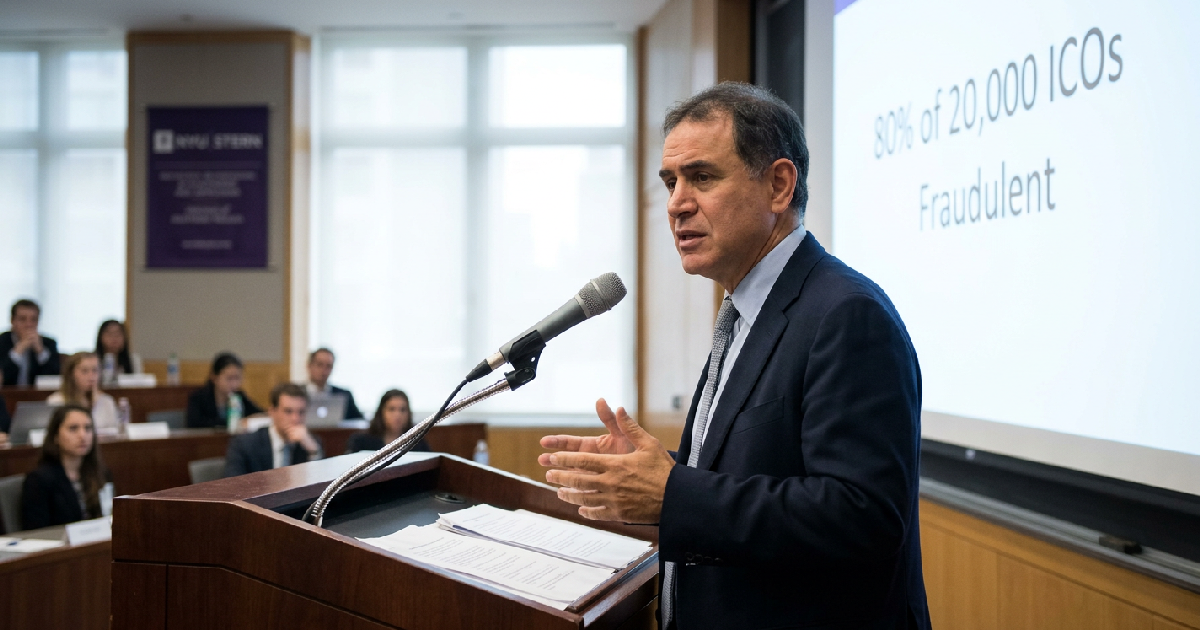

Professor Nouriel Roubini, the NYU Stern economist famously known as “Dr. Doom” for his mid-2000s financial crisis warnings, has labeled the vast majority of the cryptocurrency market as “vaporware backed by nothing.”
Speaking on the BeInCrypto Expert Council podcast, as reported on June 25, 2026, the Professor Emeritus of Economics and International Business and Chief Economist of Atlas Capital Team Inc. issued a blunt post-mortem on the industry’s nearly two-decade history.
Roubini slams crypto projects as speculative bets
Dr. Nouriel Roubini argued that despite years of blockchain development, the sector has produced only one legitimate “killer app”: stablecoins.
He reinforced his long-standing skepticism with data, pointing out that 80% of the 20,000 Initial Coin Offerings (ICOs) launched since the mid-2010s were fraudulent from the start, while 70% of the remaining non-scam projects lost their entire market value.
Blue-chip assets have also faced pressure, with Bitcoin dropping below $60,000 briefly on June 24, 2026, representing a decline of more than 50% from its all-time high of $126,080.
The economist’s latest critique focuses on what he perceives as a fundamental lack of utility and transparency across the digital asset market. According to Dr. Nouriel Roubini, the overwhelming majority of crypto projects are based on faith rather than real assets.
Key details
He dismissed the idea that Bitcoin and its peers function as currencies or reliable stores of value. Instead, he views them as speculative instruments that fail to offer the protections necessary for modern savers.
Dr. Nouriel Roubini noted that we are living through the “most dangerous period for savers in a generation,” citing a desperate need for better collateral and reserve assets.
His assessment of the altcoin market was particularly harsh, noting that many tokens currently among the top market cap rankings remain down 50% to 60% from their peaks. This volatility, in his view, disqualifies them from being serious financial instruments.
This skepticism mirrors broader trends where crypto liquidations rise alongside treasury yields as investors flee to safer traditional assets during periods of macro uncertainty.
The NYU professor did not spare the foundational technology either. He has previously testified before the U.S. Congress, calling blockchain the “least useful technology in human history.” While he has softened his stance on the utility of tokenization, he persists in his belief that unbacked tokens lack any intrinsic claim on real-world utility or assets, essentially functioning as digital vaporware.
Stablecoins identified as the only legitimate blockchain use case
While Dr. Nouriel Roubini remains a committed critic of the broader market, he conceded that stablecoins serve a functional purpose. He identified them as the sole “killer app” of the crypto era but added significant caveats to this endorsement. He noted that while stablecoins work effectively as a payment rail, they offer no real return to holders and carry their own set of systemic risks.
In his analysis, stablecoins are essentially a “digital wrapper around fiat currency,” meaning they inherit the same debasement risks as the underlying US dollar or Euro. He argued that simply digitizing a traditional currency does not solve the long-term problem of inflation or the loss of purchasing power.
The limited utility of stablecoins exists in contrast to the increased activity in AI-driven decentralized exchanges, which Roubini would likely categorize as more speculative complexity.
This evolving stance on stablecoins is timely. The market for tokenized assets has expanded significantly, growing to approximately $32 billion in 2026 from roughly $6 billion at the start of 2025. This growth suggests that while the “Dr.
Doom” persona rejects the speculative “vaporware” side of the industry, the institutional appetite for digitizing real-world value is accelerating. It remains to be seen how VanEck and Grayscale spot ETF filings and other products will change this trajectory in the coming months.
Building a bridge to institutional collateral
Dr. Nouriel Roubini is moving beyond mere criticism by launching a rival financial product designed to address the flaws he identifies in the current crypto market. Through his firm, Atlas Capital Team Inc., he recently co-authored a whitepaper defining “Technodollars” and announced the launch of USAFi. This project aims to bring regulated, institutional-grade collateral onto permissionless blockchains.
USAFi is a tokenized fund based on the Atlas America Fund (Nasdaq: USAF), an SEC-registered, NASDAQ-listed ETF with roughly $17 million in assets under management. Unlike the “vaporware” Dr. Nouriel Roubini detests, USAFi is backed by tangible assets, including U.S. Treasury bonds, gold, and real estate investment trusts (REITs).
The goal is to provide a store of value that is more resilient than standard stablecoins or unbacked cryptocurrencies.
The token is scheduled for a Q3 2026 launch under the oversight of Dubai’s Virtual Assets Regulatory Authority (VARA). By choosing a regulated framework, Dr. Nouriel Roubini is attempting to prove that the technology can be used responsibly if it is tethered to traditional capital markets. This reflects a larger movement in the industry toward tokenized assets with verifiable, real-world collateral.
A blunt post-mortem on the initial coin offering era
Looking back at the explosion of tokens that began years ago, Dr. Nouriel Roubini described the ICO era as a “cesspool” of manipulation and fraud. The statistics he cited—80% scams and a 70% failure rate for the rest—serve as a warning to retail investors who continue to chase the latest trends.
He remains adamant that the permissionless nature of many blockchain projects is exactly what allows these predatory schemes to flourish.
His historical face-off with Ethereum creator Vitalik Buterin in 2019 remains a cornerstone of his argument. At that time, he criticized the Ethereum ecosystem for being over-centralized and riddled with manipulation. Years later, his perspective has not changed; he continues to draw a hard line between speculative, unbacked tokens and regulated financial products that use a digital delivery mechanism.
The “Dr. Doom” outlook suggests that the current bear market is not just a temporary dip but a reality check. For Dr. Nouriel Roubini, the future of digital finance does not belong to decentralized experiments or “faith-based” tokens. Instead, he believes it belongs to highly regulated, tokenized versions of the assets that have anchored the global economy for centuries.