
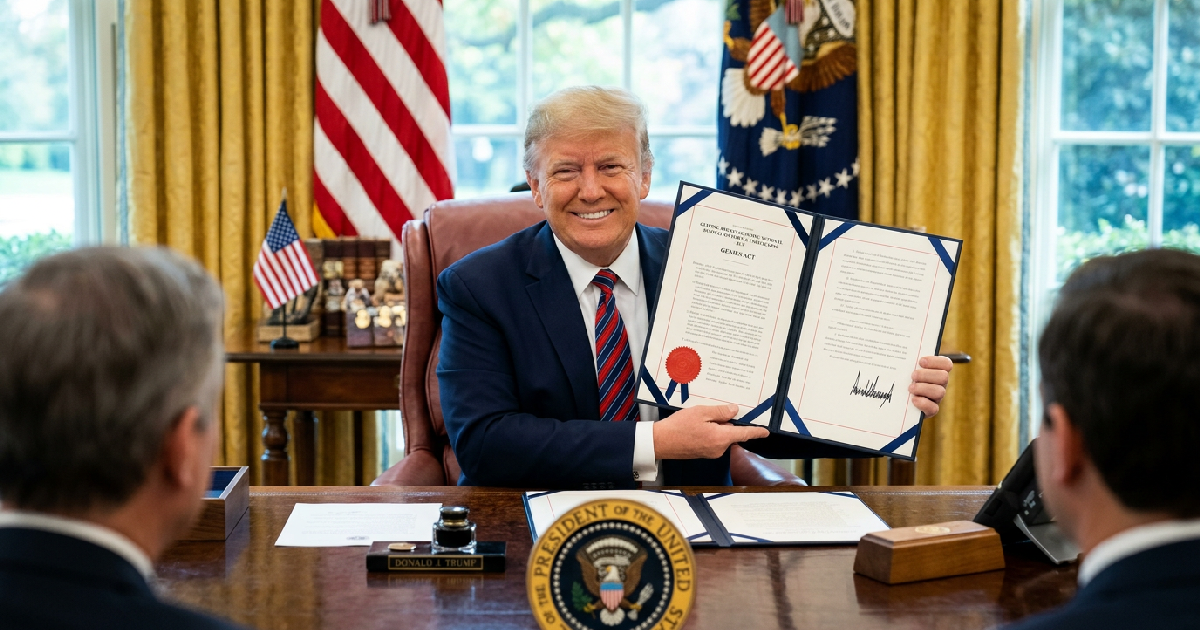

The Guiding and Establishing National Innovation for U.S. Stablecoins Act (GENIUS Act) stands as the first federal law designed to create a comprehensive regulatory framework for payment stablecoins. Signed into law by President Donald Trump on July 18, 2025, the legislation seeks to protect consumers, solidify the U.S.
dollar’s global standing, and facilitate innovation within a strict legal structure. Introduced by Senator Bill Hagerty (R-TN) on May 21, 2025, the Act passed the Senate with a bipartisan 68–30 vote before clearing the House on July 17, 2025.
Definitional boundaries of the GENIUS Act
The law is currently in a critical implementation phase as federal regulators work toward a July 18, 2026, deadline to finalize mandatory regulations. Treasury Secretary Scott Bessent has described the framework as a means to protect the financial system from national security threats while allowing American firms to lead in the payment stablecoin ecosystem.
By mandating that issuers hold high-quality reserves, the Act aims to drive demand for U.S. Treasuries and ensure that digital assets marketed as “stable” actually maintain their value relative to the dollar.
A central pillar of the GENIUS Act is its legal definition of a “payment stablecoin,” which it classifies as a digital asset used for payment or settlement where the issuer is obligated to redeem it for a fixed monetary value.
Crucially, the law explicitly excludes bank deposits, central bank money, and traditional securities from this specific classification. This clarity is intended to distinguish stablecoins from other financial instruments as market sentiment shifts following legislative progress in various sectors of the digital asset economy.
Issuance is restricted to Permitted Payment Stablecoin Issuers (PPSIs), which are treated as financial institutions under the Bank Secrecy Act (BSA). These entities must establish robust anti-money laundering (AML) protocols and customer identification programs.
Key details
The National Credit Union Administration (NCUA) and other agencies recently issued a Notice of Proposed Rulemaking (NPRM) for customer identification on June 18, 2026, with the public comment period remaining open until August 21, 2026.
Key details
National security and the prevention of illicit finance were primary drivers for the legislation. On April 8, 2026, the Financial Crimes Enforcement Network (FinCEN) and the Office of Foreign Assets Control (OFAC) issued proposed rules regarding AML and sanctions compliance.
These rules aim to enhance the government’s ability to enforce sanctions and monitor suspicious transactions involving stablecoin issuers, who are now subjected to the same rigorous scrutiny as traditional banks.
Mark Hays, Associate Director for Cryptocurrency and Financial Technology at Americans for Financial Reform, has noted that stablecoins “haven’t proven to be all that stable” in the past. To address this, the GENIUS Act mandates strong reserve requirements, requiring that token value be backed by U.S. dollar-denominated assets. By standardizing these requirements, the U.S.
government hopes to foster a digital payment ecosystem that is both innovative and resistant to the “nefarious actors” that have previously targeted the digital asset markets.