
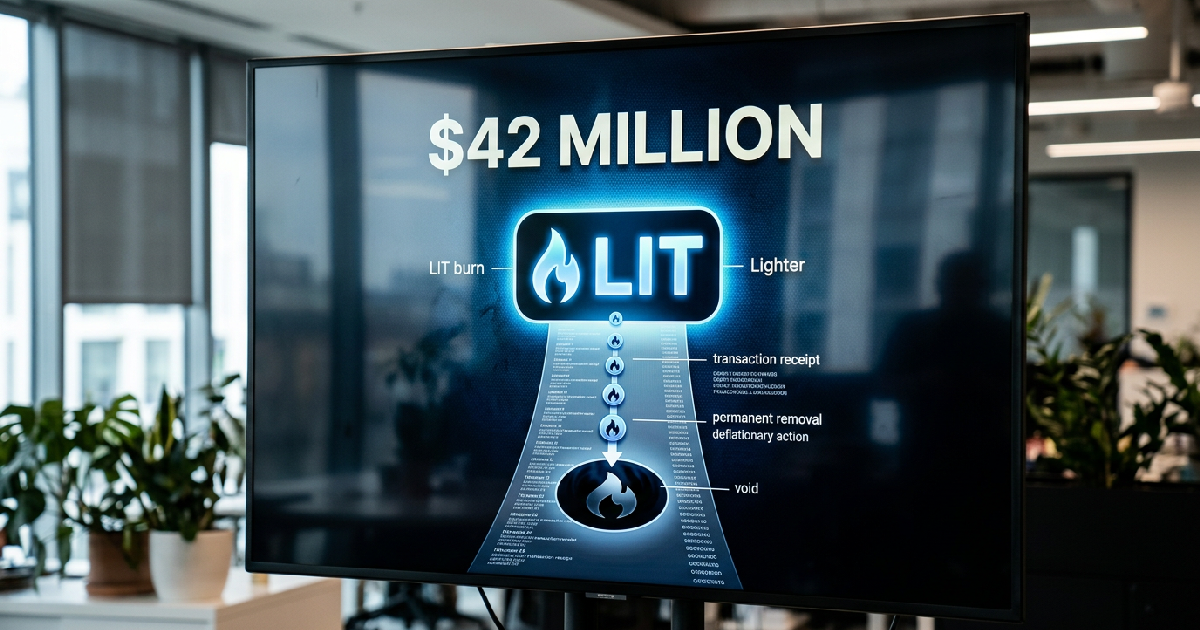

Lighter (LIT) executed its first revenue-funded token burn on July 11, 2026, permanently removing 15,638,702 LIT tokens from circulation in a transaction valued at more than $42 million.
The decentralized perpetual futures exchange carried out the operation by sending the assets to a burn address on the Ethereum mainnet, effectively implementing a deflationary mechanism using 100% of protocol revenue.
Deflationary tokenomics and protocol revenue analysis
This supply reduction accounted for approximately 6.3% of the current 250 million tokens in circulation and follows a quarter in which the platform recorded significant fee growth.
The burn was funded by exchange trading fees accrued through the second quarter of 2026, marking a pivotal shift in the project’s tokenomics. Lighter utilized a continuous 24-hour time-weighted average price (TWAP) order process to buy back the tokens from public markets before destroying them.
Market reaction to the event was immediate, with the LIT price surging 13.9% post-burn to hit a local high of $2.70. As of July 12, the token has maintained its momentum, rallying 3.68% in the last 24 hours while daily trading volume spiked by 13.52%.
The decision to destroy over 15.6 million tokens stems from a June 2026 overhaul of Lighter’s economic model. By directing 100% of protocol revenue toward permanent supply reduction rather than simple treasury management, the platform aims to link its commercial success directly to token scarcity.
Data from DefiLlama indicates that total fees paid to Lighter since its launch have reached approximately $69 million, providing the exchange with a substantial war chest for market buybacks.
This programmatic approach is particularly notable given the platform’s high-performance architecture. Built as a zero-knowledge (ZK) rollup on Ethereum, Lighter has processed over $1.6 trillion in perpetual futures volume since its inception.
The recent burn represents 1.5% of the total 1 billion LIT supply, a figure that far exceeds typical quarterly reductions in the decentralized finance sector. Such moves are often seen when Ethereum network outlook strengthens, leading to increased activity across specialized ZK-rollup exchanges.
Transparency remains a core component of this strategy. To verify the permanent removal of these assets, Lighter shared the Ethereum transaction hash publicly. This allows any user to confirm that the $42 million worth of tokens are no longer accessible to the protocol or the market.
For investors, this verifiable proof is essential, especially as crypto market liquidation analysis increasingly favors projects with transparent supply sinks over those with unlocked or inflationary rewards.
Technical resistance and LIT price range dynamics
Despite the fundamental boost from the burn, technical indicators suggest LIT faces near-term challenges. Recent price action established a range between $2.31 and $2.68, which the token has tested twice in July without a decisive breakout.
While demand remains strong, the 1-day chart reveals a bearish divergence; the Relative Strength Index (RSI) produced a lower high while the price reached a higher high, signaling that the current rally could be overextended.
Traders are currently closely watching the 23.6% Fibonacci retracement level located at $2.30. This level served as critical support when the token fell 13% earlier in the month before rebounding to its current price of approximately $2.60. A successful breakout past the $2.70 resistance could open the door for a target of $3.06 or $3.21.
Conversely, if the token fails to hold the $2.31 floor, analysts warn a deeper pullback toward the $2 mark may become more likely in the coming weeks.
Staking impact on liquid supply
The scarcity created by the burn is compounded by Lighter’s existing staking framework. Currently, approximately 125 million LIT—representing half of the circulating supply—is locked in staking contracts. The project recently introduced a new staking yield target of 6% annualized, while annual staking emissions are estimated at 7.5 million LIT.
This high stake-to-circulation ratio significantly lowers the available liquid supply, potentially amplifying price volatility during periods of high buying interest.
The combination of programmatic burns and a high staking ratio creates a unique environment for the LIT token. With the Total Value Locked (TVL) in Lighter exceeding $488 million as of May, the protocol’s liquidity appears stable enough to support continued trading growth. If the exchange maintains its recent performance, the next quarterly burn could serve as a repeat catalyst for the asset’s valuation.
Broader implications for the Ethereum ZK-rollup sector
Lighter’s operational model represents a convergence of high-frequency trading efficiency and decentralized security. The platform’s ability to use millisecond latency off-chain matching while maintaining on-chain settlement through ZK-SNARKs has allowed it to compete with centralized giants. This performance is a major factor in why altcoin demand shifts toward new tokens that can offer both utility and sustainable deflationary pressure.
The success of the July burn provides a roadmap for other decentralized perpetual exchanges looking to capture market share. By prioritizing token scarcity via revenue-funded buybacks, Lighter is positioning the LIT token as a direct barometer for the exchange’s trading volume.
As the market digests the impact of the 15.6 million tokens removed from the ecosystem, the focus now turns to whether the $2.30 support level can hold firm against the current technical divergence.