
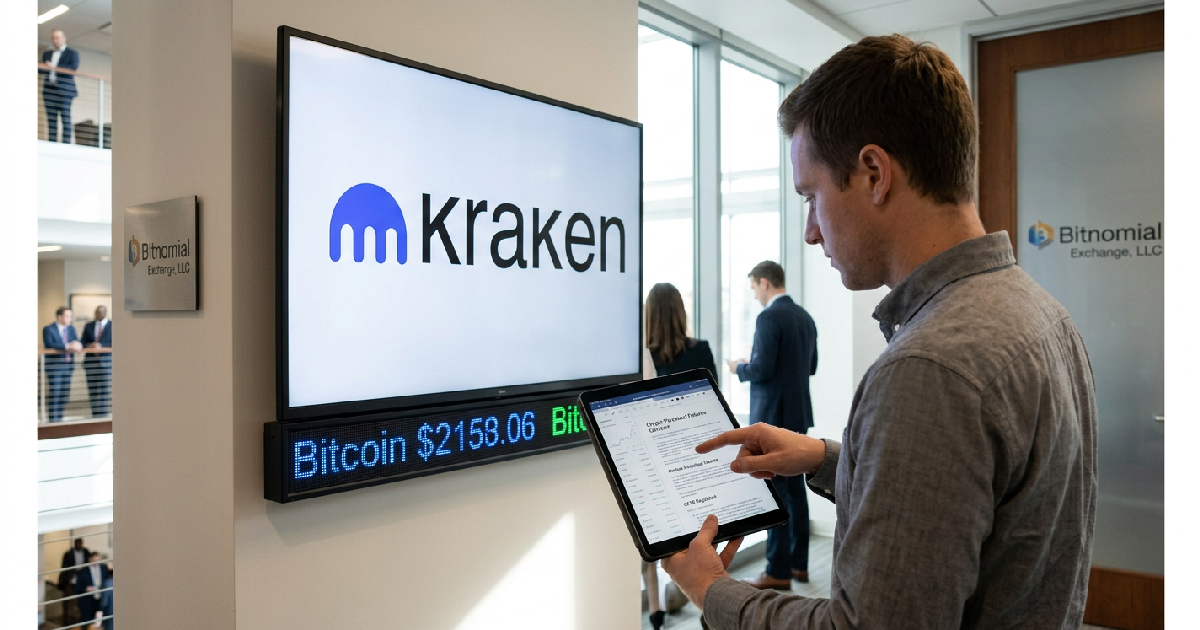

Kraken is finalising plans to launch the first CFTC-regulated crypto perpetual futures in the United States, marking a major shift in how domestic traders access the most popular segment of the digital asset derivatives market.
The cryptocurrency platform, owned by parent company Payward, will facilitate these trades through Bitnomial Exchange, LLC, a CFTC Designated Contract Market, and NinjaTrader Clearing, LLC, which operates as Kraken Derivatives US. Retail and institutional clients who meet eligibility requirements will have access to the new product suite by June 28, 2026.
The move represents a concerted effort to repatriate trading volume that has historically fled to offshore exchanges due to a lack of domestic regulatory frameworks for perpetual contracts. Last year, the global crypto perpetuals market generated over $60 trillion in trading volume, dwarfng spot market activity.
By bringing this asset class onshore under the oversight of the Commodity Futures Trading Commission (CFTC), Kraken aims to bridge a decade-long product gap between U.S. and international trading desks.
Perpetual futures differ from traditional futures because they have no fixed expiration date, allowing traders to hold positions indefinitely without needing to “roll” their contracts to a new month. This has made them the preferred tool for high-frequency traders and speculators.
However, the complexity of these instruments has previously kept them out of reach for U.S. retail users, many of whom have watched as Bitcoin signals indicate shifting market structure within traditional finance circles.
Integration with Kraken Pro and Bitnomial Exchange
Eligible U.S. traders will access these new instruments directly through the Kraken Pro interface. The platform is designed to be a unified dashboard, where perpetual futures will sit alongside existing spot markets, margin trading, and CME-listed futures. This integration allows users to manage their entire portfolio through a single “futures wallet,” streamlining the capital efficiency required for complex trading strategies in volatile markets.
The structure relies on the parent company Payward’s recent acquisition of Bitnomial, which provides the necessary regulatory rails. As a CFTC-registered exchange, Bitnomial Exchange, LLC ensures that every contract is governed by federal standards for transparency and market integrity.
Clearing and settlement services will be handled by NinjaTrader Clearing, LLC, which is an NFA Member and CFTC-registered Futures Commission Merchant (FCM) rebranded for this purpose as Kraken Derivatives US.
This launch follows a series of aggressive expansions by the firm. In July 2025, Kraken introduced support for CME-listed cryptocurrency futures to its U.S. user base. More recently, in May 2026, the firm rolled out CFTC-regulated spot margin trading. The addition of perpetuals completes the trifecta, positioning the company as a primary rival to institutional-heavy competitors while maintaining its appeal to the retail “pro” demographic.
What traders should expect from CFTC-regulated perpetuals
The upcoming contracts are designed to mimic the mechanics of international “perps” to ensure a familiar user experience. They will feature continuous pricing based on an index of spot prices and will utilize an eight-hour funding rate mechanism. This funding rate is a periodic payment made between long and short traders to keep the perpetual price tethered to the underlying spot price of the asset.
At launch, Kraken plans to support a diverse range of assets beyond just market leaders. The initial list includes:
- Bitcoin (BTC) and Ethereum (ETH)
- Solana (SOL) and Ripple (XRP)
- Cardano (ADA) and Avalanche (AVAX)
- Dogecoin (DOGE), Litecoin (LTC), and Chainlink (LINK)
The inclusion of XRP is particularly notable given the asset’s long-standing regulatory journey in the U.S. court system. Traders often look for these assets to provide high-leverage opportunities, especially as an analyst maps XRP market dominance heading into the second half of 2026. Kraken’s decision to include these altcoins suggests confidence in the liquidity and stability of the underlying spot markets.
The impact of regulated derivatives on U.S. market liquidity
Bringing $60 trillion worth of potential volume under CFTC oversight is not just a win for Kraken; it is a significant development for U.S. market depth. When derivatives are traded on unregulated offshore venues, the “price discovery” often happens away from the U.S. financial system.
By moving this activity onshore, institutional liquidity providers may feel more comfortable participating, potentially reducing the extreme volatility often seen during “futures-led selloffs.”
Moreover, the launch provides a safer alternative for traders who previously risked capital on platforms with questionable internal controls. We have recently seen how technical failures or security breaches can destabilize the market, such as when the StablR exploit triggered unauthorized stablecoin sales that rattled investor confidence. A CFTC-regulated environment imposes strict reporting and capital reserve requirements that offshore entities often bypass.
While the launch window is set for late June 2026, the industry will be watching closely to see if other major U.S. players follow suit. For now, Kraken’s head start allows it to capture a massive market of “eligible” traders who have spent years waiting for a legal pathway to leverage the world’s most traded crypto products on home soil.