
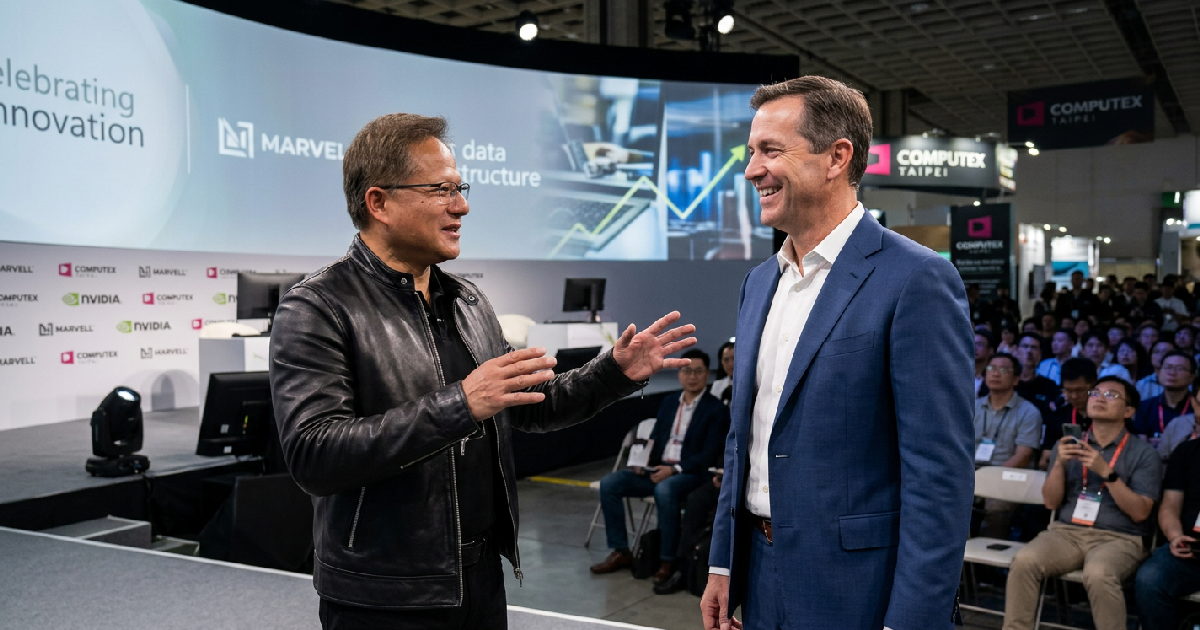

Nvidia CEO Jensen Huang publicly declared Marvell Technology is the next trillion-dollar company during an appearance at the Computex trade show in Taipei on June 2, 2026. The high-profile endorsement triggered a massive market reaction, sending shares of Marvell Technology (NASDAQ: MRVL) up 33% in a single trading session. This sharp rally added roughly $56 billion in market value, pushing the company’s valuation above $250 billion.
The comment was made during a surprise appearance by Jensen Huang at the keynote address of Marvell CEO Matthew Murphy. Huang spent approximately 10 minutes on stage, detailing why Marvell’s networking and optical connectivity chips are essential for modern data centers. As AI workloads are distributed across thousands of linked processors, the need for rapid data sharing between these nodes has become a critical bottleneck for the industry.
According to market reports, the stock extended its gains to over 45% within a two-day window following the announcement, representing a $90 billion increase in market capitalization. This momentum follows a roughly $2 billion equity investment from Nvidia into Marvell, which integrated the firm’s optical networking and custom accelerators into Nvidia’s AI factory architecture. While the investment preceded the remark, the formal endorsement has significantly amplified the market’s focus on Marvell’s role in AI infrastructure.
Market reaction and the connectivity bottleneck
Trading activity for Marvell Technology reached record levels immediately following the Taipei appearance. Shares surged in premarket trading on June 2, and roughly 10 minutes after the opening bell, the stock was trading at $267.41. By the end of the session, MRVL closed at $290.79, marking its largest single-day percentage gain on record. This reflects a shift in investor focus toward the infrastructure layers that enable large-scale AI.
The surge highlights a growing consensus that connectivity is the next limitation for AI systems after raw compute power and memory. Marvell Technology builds the switches and custom silicon that link massive clusters of processors together. These data center products now serve as the primary revenue driver for the firm, as investor sentiment shifts toward specialized hardware providers that support the AI buildout.
However, Marvell Technology face fierce competition from Broadcom, another networking heavyweight in the silicon space. Despite the recent gains, some skeptics argue that Marvell is trading at a steep valuation. Analysts remain divided on the long-term sustainability of the current price levels, particularly as competitors scramble to capture a larger share of the networking and optical interconnect market.
Michael Burry warns of concentrated AI demand
While Jensen Huang remains bullish, Michael Burry of Scion Asset Management is taking a different view. The investor famously featured in “The Big Short” has placed put options on one million Nvidia shares, warning of a potential “tokenmaxxing bubble.” Burry’s primary concern centers on customer concentration risk, noting that Nvidia’s top three customers now represent 64% of its accounts receivable.
This figure is up from 56% in the previous quarter and roughly 33% in 2020. Burry suggests that if these few major buyers scale back their data center spending, the entire AI hardware sector could face an aggressive fall. This warning comes as macro warning signs continue to affect the tech sector, with rising yields often putting pressure on high-growth valuations.
A February report from Moody’s also identified hidden financing risks, revealing that major tech firms like Microsoft and Amazon have $662 billion in future data center lease commitments. These obligations are not yet reflected on balance sheets but will become real cash costs once leases begin. As the market monitors these financial liabilities, companies like Marvell and Nvidia could see increased volatility.
The future of the trillion-dollar thesis
For Marvell Technology to fulfill Jensen Huang’s prediction of a trillion-dollar valuation, it will need to maintain its dominance in a rapidly evolving networking market. Jensen Huang explained that because useful AI has arrived, demand is “going through the roof,” specifically for disaggregated computing problems that require the massive connectivity Marvell provides. This is critical for the “AI factories” currently being built by global technology giants.
But the market is also seeing signs that the initial frenzy may be slowing. Reports of falling rental prices for H200 GPUs have raised questions about near-term demand. Furthermore, as major institutions increase their exposure to the tech sector, the concentration of capital in a few key semiconductor stocks remains a point of concern for risk managers.
Whether Marvell can sustain its $90 billion market cap expansion depends on the long-term permanence of AI infrastructure spending. For now, the “next trillion-dollar” label from Nvidia’s chief executive has fundamentally reset Marvell’s position in the global semiconductor hierarchy. The coming quarters will determine if the company can deliver on the execution required to reach that 13-figure milestone.