
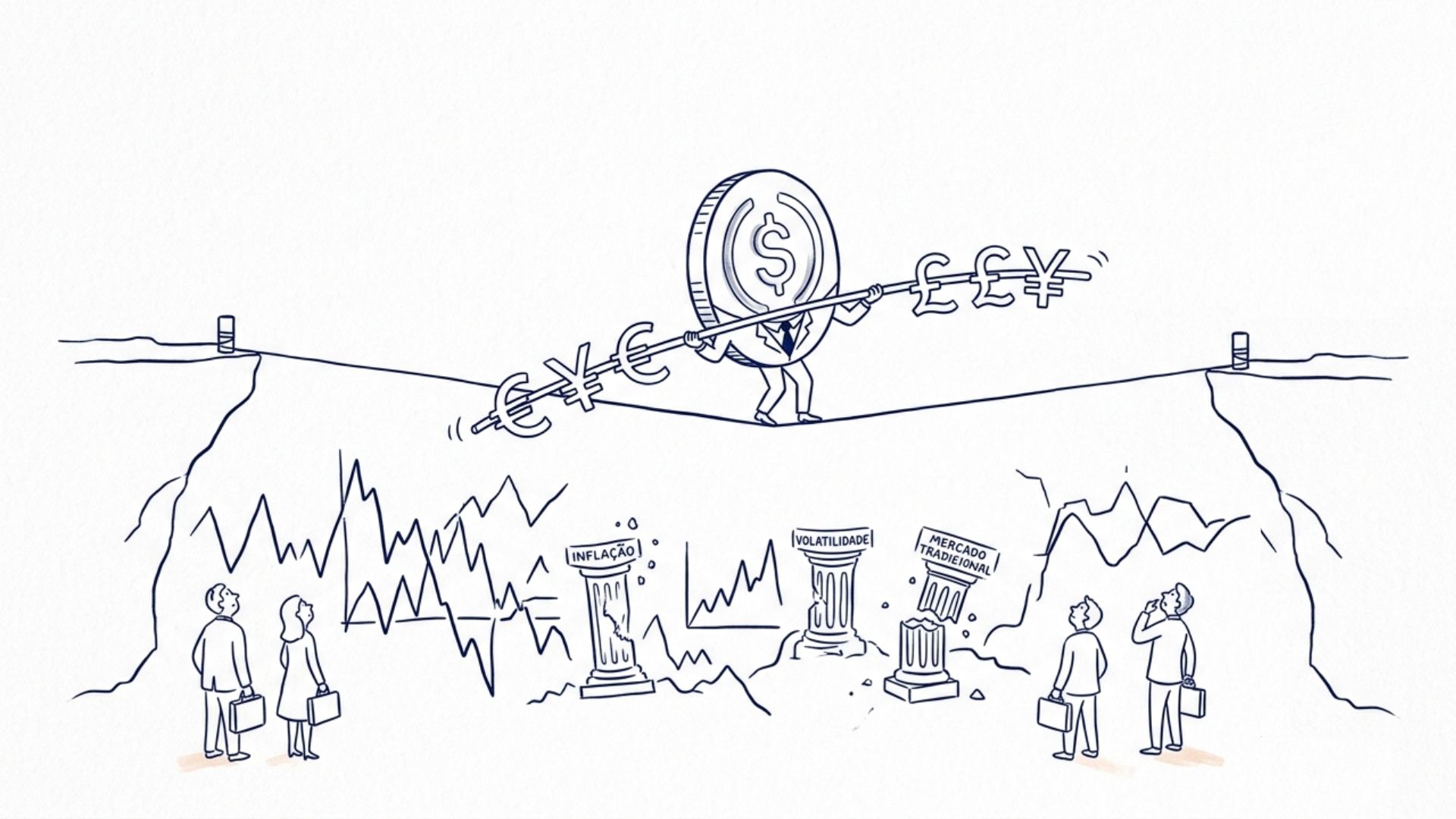

For anyone taking their first steps into the cryptocurrency market, a glaring contradiction quickly emerges. If Bitcoin can swing 10% in a single afternoon, how can a digital token reliably maintain a value of exactly one dollar, day after day?
The standard answer is simple: “Because it is a stablecoin.” But that explanation is a hollow one. A stablecoin is not a physical law; it is a financial promise. And in finance, a promise is only as good as the infrastructure that backs it up when the market starts to panic.
Among the various projects designed to mimic fiat currency on the blockchain, USD Coin (USDC) has carved out a unique and highly successful niche. It is not the oldest stablecoin, nor is it the one with the highest daily trading volume.
Instead, USDC has become the market’s definitive case study in how a digital asset can maintain a strict 1:1 peg with the US dollar by choosing institutional compliance over cryptographic purism.
The Banal Alchemy of Minting a Digital Dollar
To understand why USDC works, you have to look past the blockchain code and look at the paperwork. Unlike Bitcoin, which is minted through computational energy and mathematical algorithms, USDC is created through a remarkably traditional banking process.
The mechanism is built on a simple “mint and burn” protocol:
- The Deposit: A user sends physical US dollars to Circle, the financial technology firm behind USDC.
- The Mint: Once the fiat currency is safely in Circle’s bank accounts, an identical amount of USDC is minted on the user’s blockchain of choice (such as Ethereum, Solana, or Algorand) and sent to their digital wallet.
- The Redemption: When a user wants their physical dollars back, they send the USDC back to Circle. The tokens are permanently destroyed (burned), and the equivalent amount of fiat currency is wired back to the user’s traditional bank account.
There is no complex algorithm trying to balance supply and demand through automated trading, and there is no underlying basket of volatile assets. It is a digital receipt system.
However, because this bridge connects the wild west of blockchains with the highly regulated traditional banking sector, it cannot operate anonymously. Before a user can convert a single dollar into USDC through official channels, they must pass through rigorous Know Your Customer (KYC) and Anti-Money Laundering (AML) checks.
This process represents the first major trade-off of the stablecoin model: to achieve absolute price stability, users must surrender the permissionless anonymity that originally defined the crypto movement.
The Compliance Premium: Winning the Trust War
The concept of a fiat-backed stablecoin is not new. Tether (USDT) pioneered this space and remains the most liquid stablecoin in existence. However, Tether’s early history was plagued by persistent questions about whether it actually held a physical dollar for every digital token it issued. When regulatory investigations challenged those claims, it created a massive credibility vacuum in the industry.
USDC was designed specifically to exploit this vulnerability. Created by a consortium that brought together Circle and Coinbase, the token was built from day one to prioritize regulatory alignment over crypto-anarchist ideals.
Instead of operating from offshore jurisdictions, Circle registered as a Money Services Business in the United States, placing itself directly under the supervision of the Financial Crimes Enforcement Network (FinCEN). Instead of asking users to trust their internal spreadsheets, they hired Grant Thornton, one of the world’s largest independent accounting firms, to conduct monthly audits of their reserves.
This strategy proved that in the stablecoin market, trust is a product. By proving that its digital tokens were backed by actual cash and short-term US Treasuries held in regulated US financial institutions, USDC became the preferred safe haven for risk-averse market participants.
This reputation for compliance allowed USDC to cross over from speculative trading desks into practical, real-world utility. When the US government wanted to send financial aid to healthcare workers in Venezuela without relying on the country’s collapsed and heavily restricted traditional banking system, they bypassed local banks entirely.
They converted the funds into USDC and distributed them directly to local digital wallets.
The transaction was global, instant, and cheap — fully utilizing blockchain technology — but it was only politically and legally viable because the US government trusted the institutional backing of the issuer.
The Invisible Risks of a Centralized Core
Because USDC is so effective at behaving like a digital dollar, it is easy to forget that it carries a completely different risk profile than decentralized cryptocurrencies.
When you hold Bitcoin or Ethereum, your primary risk is market volatility. The price can crash, but no central entity can freeze your wallet, seize your funds, or declare bankruptcy and take your assets with them. The security of the asset is guaranteed by the mathematical rules of the network.
USDC flips this dynamic on its head. When you hold USDC, you face virtually zero market risk, but you assume significant counterparty and regulatory risk.
Because Circle operates under US law, it retains the technical capability — and the legal obligation — to blacklist Ethereum addresses and freeze USDC tokens on-chain if ordered to do so by law enforcement. If a wallet is suspected of being associated with illicit activity, those digital dollars can be rendered useless with a few keystrokes in Boston, entirely bypassing the decentralized consensus of the blockchain.
Furthermore, the stability of USDC is inextricably linked to the health of the traditional banking system. If the partner banks holding Circle’s cash reserves face a liquidity crisis, or if federal regulators abruptly change the rules regarding how stablecoin reserves can be invested, the 1:1 peg can falter.
Holding USDC is not a bet on the triumph of decentralized technology; it’s a bet on the continued solvency, legality, and operational competence of Circle and its banking partners.
The Ultimate Paradox of Stablecoins
The success of USDC exposes a profound paradox at the heart of the digital asset economy.
Cryptocurrency was conceived as an escape hatch from the traditional financial system — a way to transact globally without trusting central banks, commercial lenders, or government regulators. Yet, the single most critical asset for the day-to-day survival of the crypto ecosystem is a token that relies entirely on those very institutions to exist.
Traders need USDC to lock in profits, DeFi protocols need it as reliable collateral for loans, and businesses need it to pay global invoices without exposing themselves to wild price fluctuations.
But every time USDC is used to facilitate a decentralized transaction, it is backed by a physical bank account in the traditional system, verified by a traditional auditor, and sanctioned by federal regulators.
Ultimately, USDC did not replace the traditional financial system. Instead, it built a highly efficient, high-speed API for it. It proved that for digital cash to achieve the stability required for global adoption, it had to trade the ideological dream of absolute decentralization for the pragmatic reality of institutional trust.