
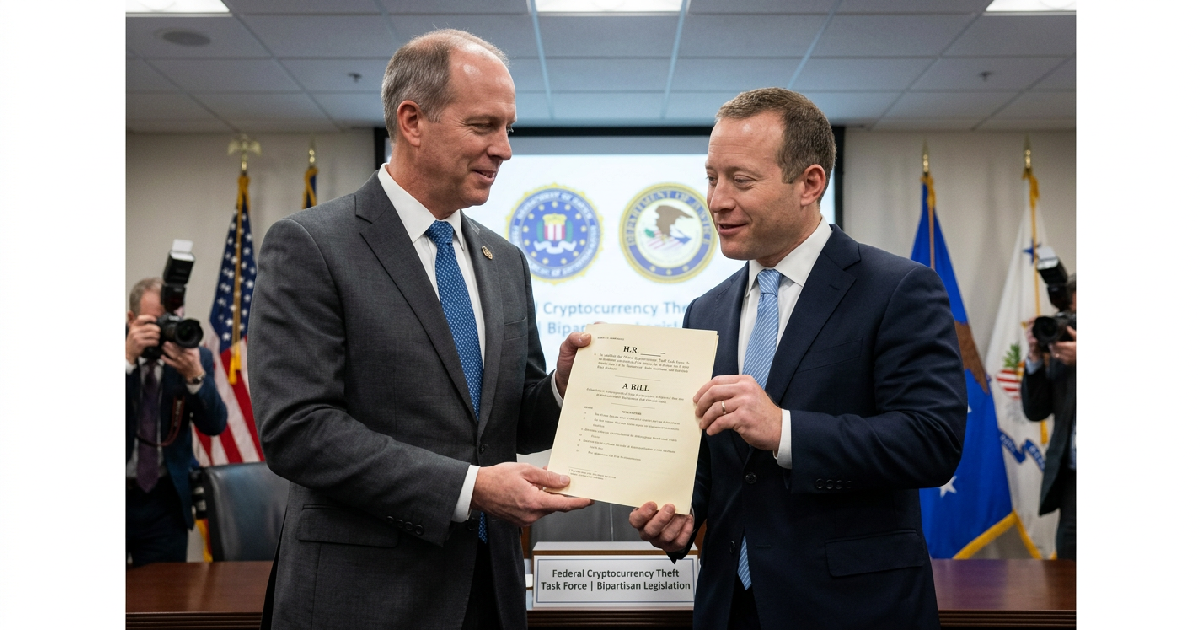

Representative Lance Gooden and Representative Josh Gottheimer have introduced a bipartisan bill in the U.S. House of Representatives to establish the Federal Cryptocurrency Theft Task Force. This newly proposed multi-agency group would operate under the leadership of the U.S. Attorney General to coordinate investigations into digital asset theft.
The legislation enlists the cooperation of major federal bodies, including the Federal Bureau of Investigation (FBI) and the Department of Justice (DOJ).
The bill addresses a growing crisis of criminal activity that reportedly resulted in $11 billion in thefts and scams over the past year. By creating the Federal Cryptocurrency Theft Task Force, lawmakers aim to provide a unified federal response to crimes that have historically been met with inconsistent enforcement.
Beyond the DOJ and FBI, the task force would involve the Department of Homeland Security (DHS) and the Treasury Department to form a central point for prevention and investigation.
While the exact date of the bill’s introduction was not specified in initial reports, its bipartisan nature highlights a rare consensus in Washington regarding consumer protection. The initiative reflects broader concerns about how Bitcoin supply on exchanges remains a primary target for complex criminal networks and state-backed hackers.
Supporters of the bill argue that the current fragmented system leaves victims with no single, reliable channel to seek help when their assets are stolen.
Consolidating federal law enforcement against digital fraud
The proposed legislation seeks to bridge the gap between national agencies and local law enforcement by housing the coordinating body within the Justice Department. Under this framework, participation would be on a voluntary basis, allowing federal investigators to assist local authorities while respecting jurisdictional control.
This structure is intended to solve the “missing link” for victims who often face a maze of different agencies after a hack.
According to the bill text and associated statements, the following individuals and agencies are confirmed as the core participants or sponsors of this effort:
- Sponsor: Representative Lance Gooden (Republican, House Judiciary Committee)
- Sponsor: Representative Josh Gottheimer (Democrat, House Financial Services Committee)
- Task Force Lead: U.S. Attorney General
- Participating Agency: Department of Justice (DOJ)
- Participating Agency: Federal Bureau of Investigation (FBI)
- Participating Agency: Department of Homeland Security (DHS)
- Participating Agency: Treasury Department
The initiative arrives at a time when lawmakers are under pressure to demonstrate that the U.S. can safely manage the integration of digital assets.
While previous specialized units like the National Cryptocurrency Enforcement Team were disbanded under the administration of President Donald Trump due to concerns over “regulation by enforcement,” this new bill prioritizes a permanent statutory response to theft. Ensuring security is vital for market stability, even as com/bitcoin-price-77000-market-confidence-geopolitics-2026-analysis/”>Bitcoin price stabilizes near $77,000 and draws further institutional interest.
Targeting $11 billion in annual losses from scams
The task force’s mandate would explicitly cover a variety of illicit activities, including “pig butchering” scams run by organized crime groups and high-level hacks. Proponents note that the lack of a coordinated strategy has previously allowed these criminal networks to thrive.
By establishing a “single federal point of contact,” the bill aims to streamline the process of tracing stolen funds and pursuing recovery for individual investors.
The Treasury Department has already experimented with similar models, such as the Scam Center Strike Force led by the U.S. Attorney for the District of Columbia. That specific group reportedly seized more than $700 million in cryptocurrency from scams often backed by Chinese organized crime groups through intermediaries in Southeast Asia.
This bill would essentially formalize and expand that model across the entire federal spectrum, rather than leaving it as a series of isolated strike forces.
Dannis Porter, CEO of the Satoshi Action Fund, noted that the bill provides a unified federal response that has been missing for years. By centralizing resources, the task force theoretically ensures that law enforcement possesses the training and tools necessary to investigate complex on-chain activity.
This move toward professionalized investigative infrastructure is seen as a way to strengthen trust in the ecosystem as U.S. Treasury leadership and other regulators debate the long-term role of digital currencies.
Future of the Federal Cryptocurrency Theft Task Force
The road to implementation remains uncertain as the bill enters a busy congressional session. To become law, the legislation must either find a path through a formal House committee markup or be attached to a larger, must-move legislative package. Its success depends on whether the bipartisan momentum from the Judiciary and Financial Services committees can be sustained through the legislative gauntlet.
Industry groups like the Digital Chamber have already emphasized that better training for law enforcement is critical for tracking bad actors. They argue that proactive crime-fighting can rehabilitate the sector’s image among political opponents who cite criminal abuse as proof that digital assets are inherently risky.
If passed, the bill would mark the first significant, permanent inter-agency framework dedicated specifically to the recovery of stolen cryptocurrency.
For now, the effort remains a proposal, but the inclusion of heavyweight agencies like the DHS and Treasury suggests the government is beginning to view crypto theft as a systemic threat akin to organized crime. The outcome of this legislative push will likely set the tone for federal crypto policy for the remainder of 2026.
Law enforcement and consumer advocates alike are watching to see if Washington can finally align its resources to combat digital asset fraud at scale.