
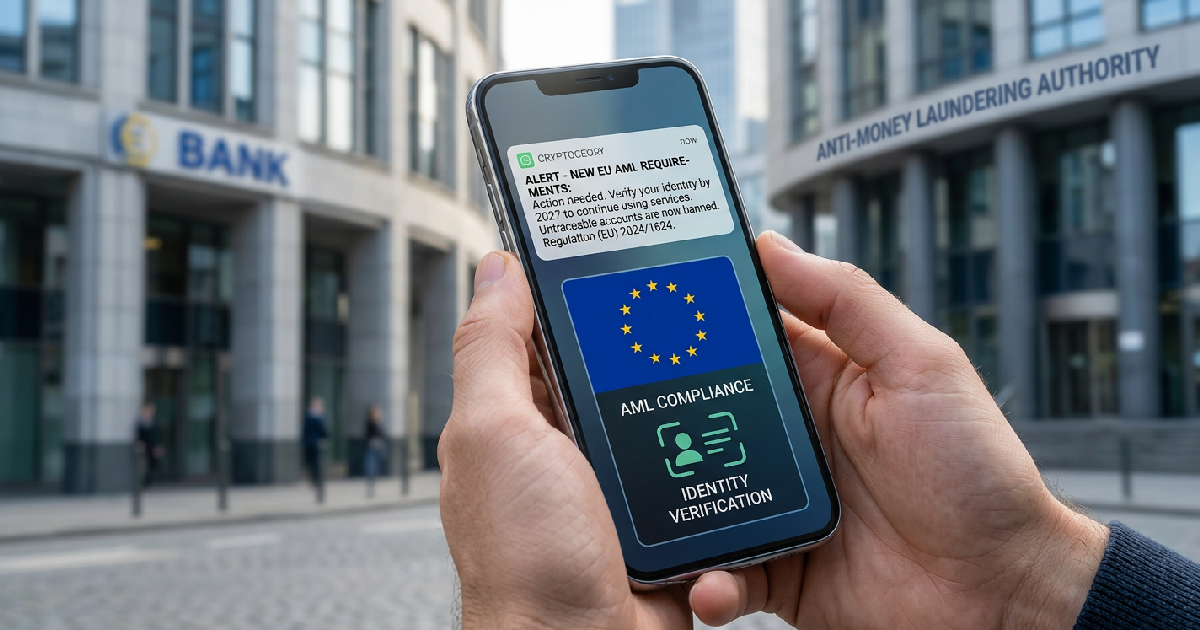

The European Union has officially confirmed a sweeping new legislative package that will ban anonymous crypto accounts and services, while also outlawing the use of privacy coins by regulated firms.
Regulation (EU) 2024/1624 is set to take full effect on July 10, 2027, marking a pivotal shift in how digital assets are managed across the bloc. These laws, which target crypto-asset service providers (CASPs) such as exchanges and custodians, are designed to curb illicit capital flows and the financing of terrorism.
Under the new rules, the era of pseudonymous transacting on regulated platforms is nearing its end. Service providers will be prohibited from maintaining accounts for users that utilize anonymity-enhancing cryptocurrencies.
Stricter identity checks and transaction limits
While individuals are still permitted to own privacy coins privately, they will be unable to trade, custody, or convert them through any regulated exchange in the EU. French Minister for the Economy, Finance and Industrial and Digital Sovereignty, Bruno Le Maire, emphasized that the quickly evolving sector faced an “urgent need” for such unified regulation.
The enforcement timeline has led to significant speculation regarding the European Central Bank (ECB) and its plans for a digital euro. The 2027 deadline coincides with the formal testing phase of the digital euro, leading some analysts to suggest the move is intended to reduce competition for the central bank’s digital currency.
This shift occurs as investors reassess market resistance and regulatory barriers that could reshape the hierarchy of available digital assets in Europe.
The new framework introduces rigorous Know Your Customer (KYC) requirements. CASPs must now perform full customer due diligence for any occasional transaction exceeding €1,000. For transfers involving self-hosted wallets, the rules are more specific: when a transaction of €1,000 or more involves a regulated intermediary, the CASP must apply risk mitigation measures.
This includes identifying the owner of the exchange wallet receiving funds from an offline storage device.
These rules build upon the “Travel Rule” (Regulation (EU) 2023/1113), which has been enforceable since December 30, 2024. That regulation already requires providers to collect and share identity information for every crypto transfer, regardless of the size.
The 2027 laws go a step further by banning specific assets entirely, including Monero (XMR), Dash (DASH), and Zcash (ZEC), though Zcash may remain viable if users utilize its non-private public transfer mode.
In addition to crypto-specific rules, the EU is capping commercial cash payments at €10,000 for goods and services across all member states. Traders and other entities must also verify customer identities for any cash transaction of €3,000 or more.
This broader crackdown on anonymity aligns with the implementation of earlier frameworks, such as the Markets in Crypto-Assets (MiCA) regulation, which saw its final provisions for CASP licensing and conduct enter into force on December 30, 2024.
New oversight from the AMLA in Frankfurt
Enforcement of these new standards will fall under the jurisdiction of the newly established Anti-Money Laundering Authority (AMLA), based in Frankfurt, Germany. The agency is expected to become fully operational in 2024 and plans to directly supervise up to 40 crypto-asset service providers by 2027. To ensure consistent oversight, the AMLA will have at least one supervised entity located in each member state.
The scope of the new AML laws also extends well beyond the financial sector. Professional football clubs and luxury goods dealers are now classified as “obligated entities,” requiring them to follow the same reporting and due diligence standards as banks. Given these tightening constraints, some major industry players are already pivoting.
Tether (USDT) has reportedly indicated a lack of interest in the EU market, allowing rivals like Circle’s EURC stablecoin to gain prominence.
As the market adjusts, many large exchanges are still waiting for official operating licenses. Bobby Ong, CEO of Coingecko, suggested that major firms like Binance may consider acquiring existing licensed exchanges to ensure compliance before the full weight of the laws is felt.
This corporate maneuvering highlights the high stakes for businesses trying to maintain a presence while navigating key support levels and regulatory hurdles in the European market.
Implications for self-hosted wallets and private use
It is important to note that the EU has not banned the private ownership of crypto or the use of self-hosted wallets for direct transfers. Peer-to-peer transactions between private individuals remain outside the scope of mandatory identification requirements. However, the moment a user interacts with a regulated business—whether to buy, sell, or trade—the new identity and verification rules will apply immediately.
The 2027 rules also strengthen transparency by requiring all legal entities in the bloc to register beneficial ownership information. This is part of a multi-year effort to harmonize AML directives across Europe, moving on from the standards established by the 5th and 6th Anti-Money Laundering Directives.
For crypto users, this means the choice will likely be between remaining in a restricted private ecosystem or operating within a highly supervised, de-anonymized financial system.
While the goal is to eliminate money laundering, the strictness of the checks for self-hosted wallets could drive some capital toward other regions. As institutional interest in digital assets continues to grow through regulated products like ETFs, the EU is betting that a transparent, supervised environment will ultimately foster greater trust and long-term stability for the continent’s digital economy.