
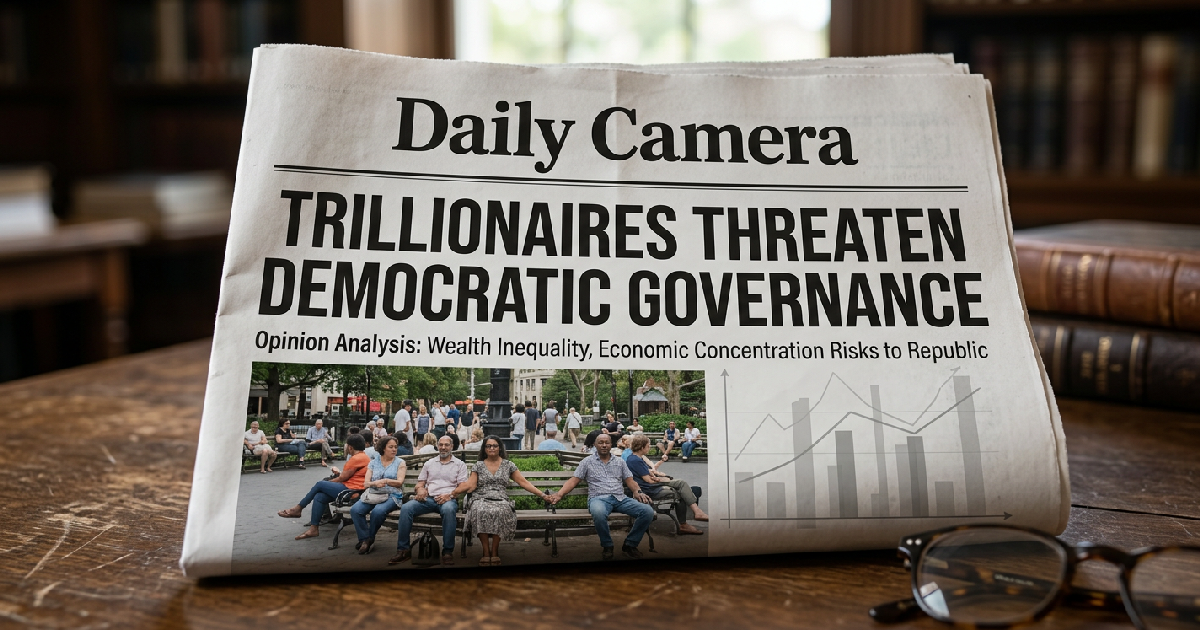

The rise of the world’s first trillionaires poses a fundamental threat to the stability of modern republics, as extreme wealth concentration begins to bypass traditional democratic checks and balances.
According to a recent analysis published by the Daily Camera, the staggering disparity between the ultra-wealthy and the general public is no longer just a matter of economics, but a direct challenge to the survival of representative governance and the Rule of Law.
Wealth concentration threatens the foundations of democratic republics
Historians and economists have long warned that republics are fragile ecosystems requiring a level of social cohesion that cannot withstand the pressure of “super-citizens” who possess more resources than entire nations.
As the wealth of a handful of individuals approaches the trillion-dollar mark, their ability to influence policy, legal structures, and public discourse expands beyond the reach of any single voter or even a collective bloc of citizens.
This imbalance creates a dynamic where the state begins to serve the interests of an elite few rather than the broader electorate.
The fundamental promise of a republic is that every citizen holds a shared stake in the law and that no individual is above it. However, the emergence of trillionaire wealth effectively creates a “private sovereignty” where individuals can afford to ignore national borders and regulatory frameworks.
Key details
When a single person controls assets equivalent to a significant portion of the global GDP, they are no longer merely participants in an economy; they become the architects of it, often at the expense of the middle and lower classes.
Concentrated capital allows for the funding of massive lobbying efforts that can stall environmental regulations, labor protections, and anti-monopoly legislation. This influence is often invisible to the average citizen, manifesting as “dark money” in political campaigns or the funding of think tanks that shape the intellectual landscape to favor the ultra-rich.
The erosion of trust in public institutions is an inevitable byproduct of this perception—and reality—that the system is rigged to favor those at the absolute top of the pyramid.
While the focus is often on individual net worth, the systemic risk involves the movement of capital across digital borders. For instance, macro warning signs emerge when institutional wealth moves so rapidly that it destabilizes traditional fiat currencies.
This volatility often forces governments to choose between protecting the savings of their citizens and placating the massive entities that hold their debt or control their technological infrastructure.
Historical precedents for the collapse of elite-heavy systems
History is littered with examples of republics that struggled to survive when the wealth gap became insurmountable. From the late Roman Republic to the Gilded Age in the United States, periods of extreme accumulation have historically led to civil unrest, populism, and eventually, the rise of authoritarianism.
When the public feels that the legislative process has been bought, they often turn to strongman leaders who promise to “break the system,” even if those leaders are themselves part of the elite class.
The distinction between the current era and the past is the sheer scale and speed of modern wealth generation. Technological monopolies and the automation of labor allow for the extraction of value at a rate that would have been unimaginable to the oil and steel barons of the 19th century.
Today, a trillionaire’s influence is not limited to a single industry or city; it is global, digital, and often decentralized, making it nearly impossible for a single republic to regulate effectively without international cooperation.
Key details
The rise of decentralized finance has provided new avenues for the ultra-wealthy to shield their assets from the traditional reach of the state. While crypto-assets were originally marketed as a tool for financial inclusion, they have frequently been co-opted by large players to move capital without the friction of taxation or public oversight.
Even as bitcoin exchange supply maintains multi-year lows, the underlying trend shows that the largest holders—the “whales”—retain the power to move markets at will.
This concentration of digital power mirrors the concentration of physical resources. It allows the ultra-wealthy to operate in a parallel financial system that is largely immune to the monetary policies designed to stabilize the lives of average workers.
If a republic cannot track or tax the wealth within its borders, it loses its ability to provide the basic services—infrastructure, education, and defense—that justify its existence to the citizenry.
Why extreme wealth concentration leads to toxic political environments
A “toxic mix” occurs when the interests of the trillionaire class diverge completely from the interests of the republic. This is most visible in the debate over climate change and social safety nets.
A trillionaire might have the means to build private bunkers or fund space colonization as an escape from global crises, whereas the average citizen must rely on the state to manage collective threats. This leads to a fundamental “de-coupling” of the elite from the society they inhabit.
Furthermore, the media landscape is increasingly owned or influenced by billionaires, who can use their platforms to fracture public opinion. By steering the national conversation toward divisive cultural issues, they can distract from the economic policies that benefit their own bottom lines.
Key details
This strategy prevents the formation of a unified coalition that might demand higher taxes on capital gains or a more robust enforcement of antitrust laws.
In some jurisdictions, there is a push to integrate these new financial realities into the legal code. For example, Russia lawmakers push to legalize p2p crypto trade as a way to circumvent international sanctions.
While this may help a state survive in the short term, it often further empowers the oligarchs who control the peer-to-peer networks, deepening the divide between the politically connected elite and the rest of the population.
Future outlook for maintaining democratic stability
If republics are to survive the age of the trillionaire, systemic reforms are likely required. This could include more aggressive global tax treaties to prevent wealth from being moved to tax havens, or the implementation of strict term limits and campaign finance restrictions that actually hold weight.
Without these interventions, the natural trajectory of capitalism toward consolidation suggests that we will see more individuals wielding more power than the governments that are supposed to govern them.
The “toxic mix” referenced by the Daily Camera serves as a warning for the coming decade. As wealth continues to pool at the top, the pressure on democratic structures will only increase.
Whether these institutions can adapt to manage the influence of the ultra-rich, or whether they will eventually buckle under the weight of an era defined by modern-day feudalism, remains the defining political question of the 21st century.
The outcome will determine whether the “republic” remains a meaningful term or becomes a mere facade for an unchecked global plutocracy.