
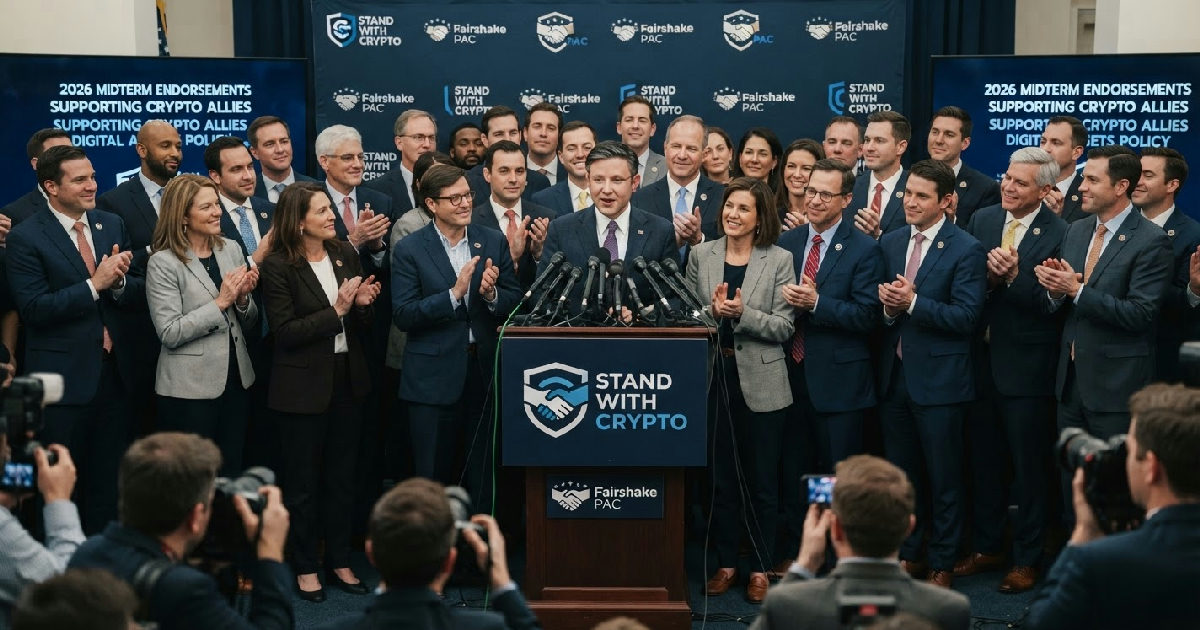

The crypto industry’s political organizing arm is ramping up its efforts ahead of the November midterm elections. On August 24, 2026, Stand With Crypto, the grassroots advocacy organization initially backed by Coinbase, announced its endorsement of 32 incumbent members of the U.S. House of Representatives, signaling a coordinated push to solidify its influence in Washington.
The bipartisan list includes influential figures who have been pivotal in shaping digital asset policy. This move represents a maturing strategy, combining voter mobilization with the financial firepower of industry-backed super PACs, as the future of crypto regulation hangs in the balance. The goal is clear: to build a durable and effective crypto voting bloc that politicians can no longer afford to ignore.
Supporting a crypto political group
Stand With Crypto’s endorsements span both sides of the aisle, underscoring a calculated approach to building broad support for the industry. The list features prominent Republican leaders, including House Majority Whip Tom Emmer and House Agriculture Committee Chairman Glenn “GT” Thompson. Also included is Bryan Steil, the Republican chair of the digital assets subcommittee within the powerful House Financial Services Committee.
But the group is also hedging its bets in case the political tide shifts. Key Democrats have also received endorsements, most notably Jim Costa, a high-ranking member on the Agriculture Committee who could be a contender for the chairmanship if Democrats retake the House. This demonstrates a pragmatic focus on supporting allies who hold sway over relevant committees, regardless of party affiliation.
The endorsements extend to lawmakers who have actively authored or sponsored key crypto legislation. Nevada Democrat Steven Horsford, who introduced the bipartisan Digital Asset Protection, Accountability, Regulation, Innovation, Taxation, and Yields (PARITY) Act this year, is on the list.
So are Michigan Republican Bill Huizenga and Ohio Republican Warren Davidson, both of whom have sponsored pro-crypto bills. New York Democrat Ritchie Torres, a vocal advocate for the industry, also secured the group’s backing.
All 32 of the endorsed lawmakers share a crucial commonality: they voted in favor of the CLARITY Act, the crypto industry’s foremost policy priority. The bill aims to establish a federal regulatory framework for digital asset markets and provide legal clarity for crypto companies.
Mobilizing the crypto voter base
Unlike traditional political action committees, Stand With Crypto’s strategy hinges on grassroots organizing rather than large-scale campaign spending. The group, which claims a membership of over three million U.S. advocates, aims to prove that a dedicated “crypto voter” base can be a decisive factor in tight electoral contests.
The endorsements are designed to direct this voting bloc toward candidates who have demonstrated support for the industry.
“The midterms come at a key inflection point for crypto policy in Washington, D.C.,” said Mason Lynaugh, Executive Director of Stand With Crypto, in a statement. “As candidates from both parties are trying to reach voters outside of more traditional constituencies, they overlook crypto voters at their own peril.”
This approach marks an evolution in the industry’s political playbook. According to Lynaugh, the 2024 election cycle was about proving the existence of the crypto voter. Now, in 2026, the focus has shifted to demonstrating their organizing capacity. “I think we can be the difference maker in some of these [closely contested races],” he added.
The group has even targeted competitive districts, endorsing figures like Arizona Republican Juan Ciscomani and Pennsylvania Republican Brian Fitzpatrick. Such efforts are crucial for advocates seeking a clear federal regulatory framework.
The group’s “Voter Hub” platform rates politicians on their crypto-friendliness, providing a clear guide for its members. While Stand With Crypto isn’t directly funding these campaigns, its endorsement often aligns with financial support from the industry’s heavily funded super PACs, creating a powerful one-two punch of voter mobilization and financial backing.
Fairshake PAC’s financial influence
While Stand With Crypto focuses on organizing, a network of super PACs led by Fairshake is providing the financial muscle. Funded primarily by major industry players like Coinbase and Ripple Labs, the crypto industry has funneled nearly $200 million into the 2026 midterm election cycle.
As of March 13, 2026, Fairshake alone held over $193 million in cash, making it one of the most formidable super PACs in the nation.
This financial war chest is already being deployed. Fairshake holds $122 million on hand for the run-up to November, and its spending in the primaries has already paid for supporting advertisements for 49 winning candidates. These crypto funds are a significant factor in the electoral landscape as the industry seeks to gain more influence.
This strategy was battle-tested during the 2024 elections. Fairshake and its affiliates spent roughly $130 million, intervening in 68 congressional races. They achieved an 82% success rate, with 23 of the 28 candidates they supported in the general election winning their races. A notable victory included spending $12 million in Ohio to help crypto-friendly Republican Bernie Moreno defeat incumbent Sherrod Brown, a vocal crypto critic.
Other crypto-aligned PACs are also emerging. Fellowship PAC, chaired by Jesse Spiro, Tether’s head of government affairs, began endorsing candidates for the 2026 U.S. midterm elections. It claims to hold over $100 million in funding from undisclosed backers with ties to the crypto industry.