
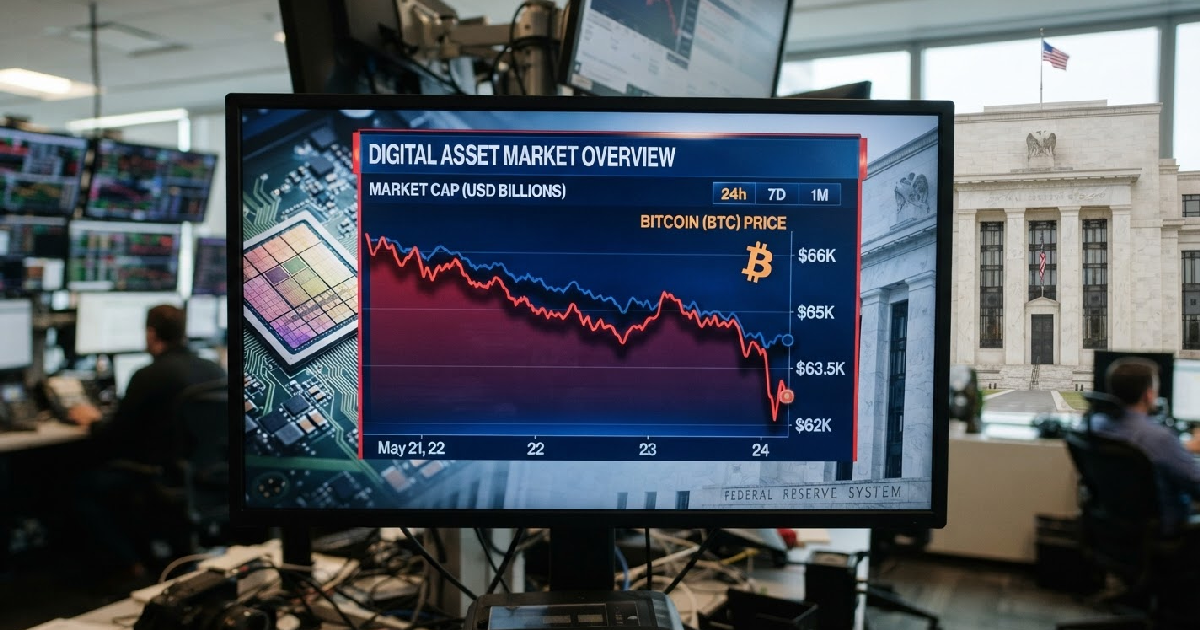

The cryptocurrency market shed nearly $24 billion in overall market capitalization on July 28, 2026, as Bitcoin (BTC) dipped below $64,000. This sharp decline reflects a broader retreat from risk assets, triggered by a global semiconductor sector sell-off and persistent outflows from US spot Bitcoin Exchange-Traded Funds (ETFs).
Investors also showed increased caution ahead of the Federal Reserve’s policy meeting this week, adding to the negative sentiment that had already seen crypto markets showing signs of weakness.
Global tech jitters rattle digital assets
The immediate catalyst for the market’s slump was a significant sell-off in Asian technology stocks, which quickly spread to other risk assets, including cryptocurrencies. Bitcoin, a bellwether for the digital asset space, traded near $63,130 at press time, marking a nearly 1% drop over the past day. It briefly fell below $63,000 after reaching an intraday high above $63,700.
Other major cryptocurrencies followed suit. Ethereum (ETH) saw a decline of almost 1% to approximately $1,883, while XRP and Solana (SOL) experienced drops of 1.30% and 1.77% respectively. Hyperliquid (HYPE) recorded one of the session’s steepest losses among prominent digital assets, falling more than 3%.
China’s semiconductor breakthrough sparks rout
The tech sell-off originated from reports that a state-backed Chinese manufacturer had begun producing domestic deep-ultraviolet (DUV) lithography machines. Investors interpreted this development as a significant challenge to established global semiconductor equipment makers, particularly amid ongoing geopolitical tensions.
South Korea’s Kospi index plunged by 10.8%, marking its largest single-day decline since 2020. This broad market impact saw industry giants like Samsung Electronics fall by 13.4%, and SK Hynix lose 14.7%.
Shanghai Aishengna Electronic Technology Group, a state-owned company, is reportedly behind this push, aiming to produce around five DUV machines in 2026 and roughly 20 in 2027. These machines are slated for delivery to major Chinese chipmakers such as Semiconductor Manufacturing International Corp (SMIC), Hua Hong Semiconductor, and ChangXin Memory Technologies (CXMT).
While DUV technology is a generation behind the cutting-edge Extreme Ultraviolet (EUV) lithography exclusively produced by Dutch firm ASML, its domestic production signals China’s strategic move towards semiconductor self-sufficiency. This initiative is largely driven by US export restrictions that have blocked China’s access to advanced EUV systems.
ASML, the dominant supplier of lithography systems, saw its shares drop over 8% following the news. The market reaction underscores the profound impact of supply chain nationalism and technological independence on global markets, even in areas like crypto which lack direct exposure to chip manufacturing.
Spot Bitcoin ETFs see sustained outflows
Even before the semiconductor rout, demand for cryptocurrencies had already shown signs of cooling. US spot Bitcoin ETFs, approved in January 2024, have become a crucial gauge of institutional and retail interest.
These products recorded three consecutive trading sessions of net outflows, effectively ending a seven-day inflow streak that had previously underpinned Bitcoin’s rally. These withdrawals removed an important source of spot demand, making it harder for Bitcoin to maintain its price levels above $64,000.
Data from SoSo Value revealed net withdrawals of $225.1 million on July 23, followed by $240.1 million on July 24. Another $11.6 million left the products on July 27, bringing the total outflows across these three sessions to a substantial $476.8 million.
This sustained period of net selling from the ETFs highlights a shift in investor sentiment, suggesting that the enthusiasm seen earlier in the year may be waning. It indicates that the institutional liquidity channels, once a significant bullish factor, are now contributing to selling pressure.
Federal Reserve meeting looms, adding caution
Compounding the market jitters, investors are also exercising caution ahead of the Federal Reserve’s policy decision scheduled for July 29. Though markets largely anticipate interest rates to remain unchanged, traders are closely monitoring the central bank’s forward guidance.
Any clues regarding the timing of future policy moves or shifts in economic outlook could significantly influence market behavior. This uncertainty has prompted many investors to de-risk, reducing their exposure to volatile assets, including the broader cryptocurrency market.
The broader implications of such macroeconomic events cannot be overstated for the crypto sector. As digital assets become increasingly integrated into the global financial system, they are more susceptible to the same forces that impact traditional markets, from interest rate expectations to geopolitical trade tensions.
Crypto market capitalization contracts, key levels tested
The cumulative effect of these pressures led to a substantial reduction in the overall crypto market’s value. TradingView data shows that the total crypto market capitalization, excluding stablecoins, fell by $23.37 billion on July 28.
This brought the market’s total value down to approximately $1.86 trillion at press time. The decline underscores that the recovery observed in July had stalled just below the $1.95 trillion mark, where buyers repeatedly failed to push the rally further.
Analysts are now closely watching the $1.85 trillion level as the nearest support for the market. A decisive break below this point could expose further downside, potentially testing $1.80 trillion, and possibly even the June and July lows near $1.75 trillion.
Conversely, for the market to regain momentum, it would first need to reclaim the $1.90 trillion level. After that, it would face a more significant challenge in breaking through the stronger resistance zone situated between $1.94 trillion and $1.96 trillion, which represents a crucial psychological and technical barrier.
The Relative Strength Index (RSI) for the total crypto market capitalization, a momentum indicator, dropped to 44.44. While this signals a strengthening of bearish momentum, it hasn’t yet entered oversold territory, suggesting there might be room for further declines if selling pressure persists.
This immediate contraction in market cap signals a re-evaluation of risk across the board, demonstrating that crypto’s resilience isn’t isolated from external macroeconomic or geopolitical shocks. For investors, it means a renewed focus on fundamental analysis and risk management in a turbulent global environment.