
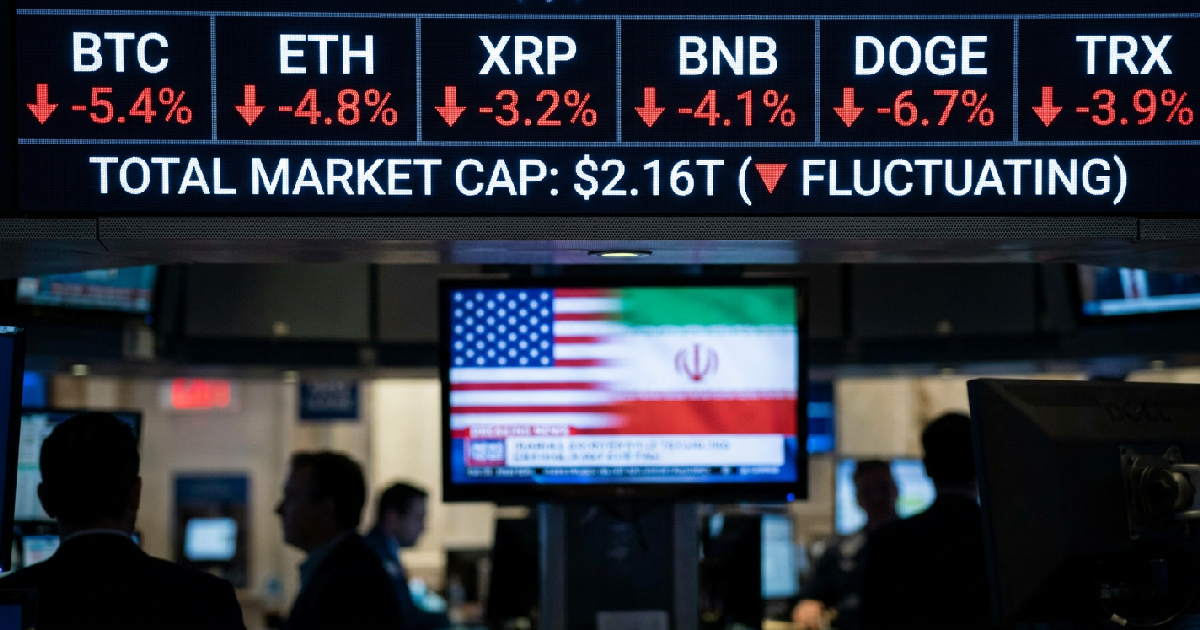

The cryptocurrency market is experiencing a significant downturn today, July 13, 2026, with its total market capitalization dropping 1.43% in the last 24 hours to $2.16 trillion. This retreat comes amid escalating geopolitical tensions between the United States and Iran, coupled with robust demand for artificial intelligence (AI) technologies diverting investor capital.
Bitcoin (BTC) leads the slide, trading around $62,750, a 1.55% decrease, pushing it below the $63,000 mark. Bitcoin’s price analysis often highlights such rejections at key resistance levels. Major altcoins like XRP, Ethereum, BNB, Dogecoin, and TRON are also down, reflecting a broader risk-off sentiment gripping global financial markets.
Escalating US-Iran conflict triggers market retreat
Renewed military clashes between the U.S. and Iran near the Strait of Hormuz have sent shockwaves through global markets, triggering significant risk-off selling. The U.S. launched its fourth round of strikes this week, increasing fears of a broader regional conflict and potential disruptions to global oil supplies.
According to a tweet from The Hormuz Letter, Iran’s IRGC claimed to have fully destroyed fuel tanks and Patriot air defense systems at the US Ali Al-Salem Air Base in Kuwait. They also reported hitting an FPS strategic radar system at the Ahmed Al-Jaber Air Base. This geopolitical instability encourages investors to pull funds from volatile assets like cryptocurrencies and global equities.
The impact wasn’t confined to crypto; Asian stock markets alone saw over $950 billion wiped out following the US-Iran strikes. South Korea’s KOSPI plunged 9.2%, losing approximately $377 billion. Japan’s Nikkei fell 2.7%, while China’s Shanghai Composite and Taiwan’s market saw significant declines of 2.3% and 3.1% respectively. India’s NIFTY slipped by 0.3%.
Macroeconomic headwinds from inflation and the Fed
Beyond the immediate geopolitical concerns, broader macroeconomic factors continue to exert downward pressure on the crypto market. Persistent higher-for-longer interest rate expectations and stubborn inflation concerns contribute to a cautious global investment climate. These conditions push investors away from riskier assets.
The Federal Reserve’s June meeting minutes, released on July 8, 2026, highlighted these anxieties. While all officials supported holding rates steady, some expressed a preference for a rate hike, indicating a hawkish bias within the central bank. Most Fed policymakers warned that inflation stemming from surging AI demand, ongoing Middle East tensions, and new tariffs could necessitate further monetary tightening.
Such a prospect discourages investment in speculative assets like cryptocurrencies. Capital costs rise and economic growth forecasts dim in this environment. S.
is expected to release new inflation numbers later this week, which could significantly impact market direction.
AI trade drains capital from crypto
A significant capital rotation is also underway, with money seemingly flowing out of the crypto space and into the booming artificial intelligence and silicon trade. Chipmakers are experiencing an unprecedented surge, attracting substantial investment.
Nvidia, Micron, Broadcom, and Applied Materials are collectively projected to generate a record $430 billion in combined free cash flow over the next 12 months. This figure represents more than triple what they earned just two years ago, underscoring the immense financial power of the AI sector. This massive influx into AI-related firms means fewer dollars are chasing risk assets like cryptocurrencies. The trend spotlights a shift in investment priorities towards sectors with clearer, immediate growth prospects.
Crypto liquidations and altcoin performance
The internal mechanics of the crypto market also played a role in today’s price depreciation. Over the past 24 hours, approximately $266.8 million in total liquidations occurred, with a significant majority—around $198.9 million—coming from leveraged long positions. This suggests many bullish bets were caught off guard by the sudden market shifts. It led to forced selling. Macro warnings often accompany such significant liquidation events, indicating broad market sensitivity.
Furthermore, profit-taking in altcoins that may have become overextended is contributing to the overall pullback. Uncertainty surrounding crypto regulations and upcoming key events, such as potential spot ETF decisions, adds another layer of volatility for investors. com/xrp-speculative-activity-resistance-analysis-2026″>XRP has seen increased speculative activity recently, testing major resistance levels.
For example, Lighter (LIT) fell about 6% on July 9, 2026, even while holding a 51% monthly gain. Its recent activity included 86 transactions above $100,000, signaling its biggest whale activity in six months. This highlights how even coins with strong monthly performance can see pullbacks.
Market outlook and key support levels
The immediate outlook for the cryptocurrency market remains precarious as these diverse pressures converge. The total crypto market capitalization stood around $2.16 trillion today, a slight decrease from $2.16 trillion on July 8, 2026, and a drop from $2.11 trillion on July 9, 2026. Bitcoin’s trading volume shot up 21% in the last day, indicating heightened activity during the decline.
13 trillion. Should this support break, analysts warn that further declines are probable. 382 Fibonacci shallow pullback level.
72 trillion on May 10, 2026, and has been in a falling channel since then. Bitcoin has lost more than half its value since its October 2025 peak. This current market reflects previous downturns, with sentiment weakening due to inflation, ETF uncertainty, and global factors.