
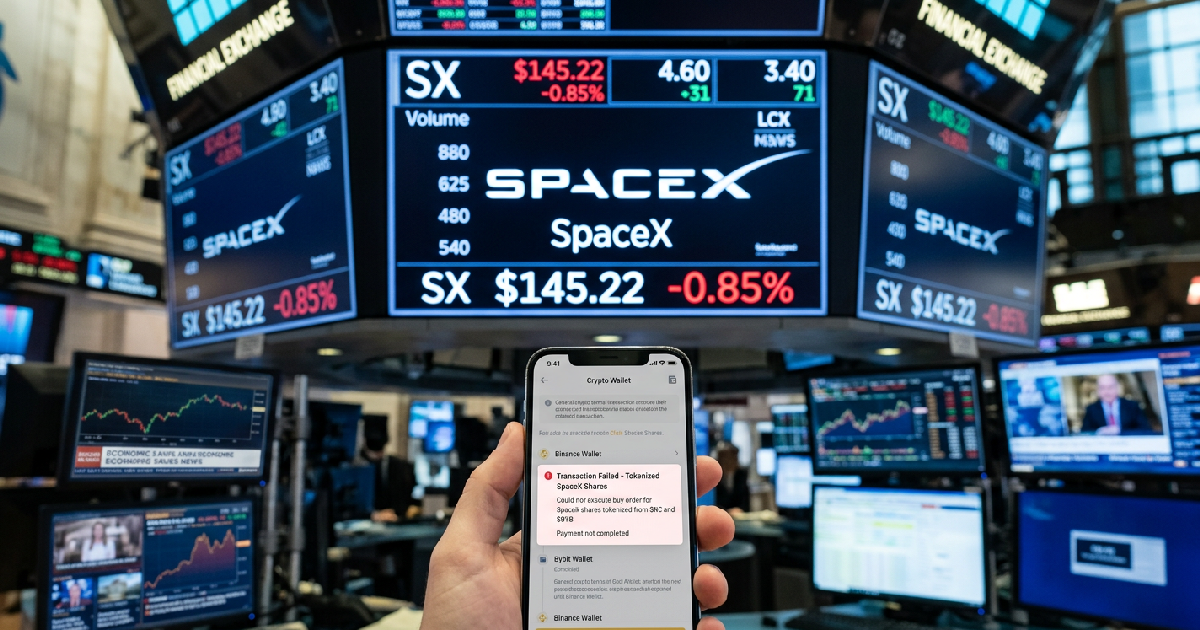

Crypto traders failed to secure approximately $1 billion in tokenized SpaceX shares during the company’s June 12 public debut, as multiple digital asset platforms were forced to cancel offerings due to a lack of underlying assets.
While the aerospace giant made its highly anticipated market entry, Binance Wallet, Bybit, MEXC, and Bitget Wallet scrapped their tokenization campaigns, leaving retail participants with price-tracking derivatives instead of legal ownership.
The company listed at $150 per share on Friday, June 12, 2026, reaching a peak of $176.52 before ending its first session at $160.95. While traditional institutional investors traded nearly 500 million shares, the crypto-native “tokenized share” movement hit a significant roadblock.
Providers such as xStocks, a platform owned by Kraken through Payward, reportedly failed to secure enough underlying shares to fulfill orders across several major exchanges.
This collapse highlights a growing friction between decentralized finance aspirations and the complex logistics of private equity. Bybit’s “IPO Express” and related campaigns from Bitget Wallet were officially canceled on the day of the listing. Most affected users received refunds, but they were shut out of the direct gains enjoyed by those holding actual equity.
The failure comes even as Apple Inc. satellite connectivity advances continue to drive retail interest in the broader space and communications sector.
Derivative markets provide price discovery ahead of opening bell
While ownership proved elusive, crypto platforms provided an early venue for price discovery that preceded the traditional market open. Hyperliquid and Binance derivative markets remained active, allowing global traders to speculate on the listing price through perpetual futures. These “perps” have gained popularity among international traders and are slowly moving into regulated U.S. markets through platforms like Kalshi.
On the Hyperliquid exchange, SpaceX futures were trading near $180 just before the official market debut. As the shares began trading at $150, these futures corrected downward to approximately $153. This narrow spread suggested that crypto markets, despite lacking the underlying equity, effectively defined a relevant price range for the stock’s eventual discovery.
High activity in these markets mirrors recent trends where Binance Chain token open interest has seen sharp spikes during major market events.
Volume on these decentralized platforms was substantial. Hyperliquid alone recorded more than 7 million trades on Friday, valued at over $1.2 billion. These contracts offered exposure to the price action of the Elon Musk-led company but granted no voting rights or legal claims on the firm.
This pivot to derivatives occurred as traditional exchange operators, including Nasdaq (NDAQ) and Cboe Global Markets (CBOE), face increasing competition from continuous derivative products.
Ron Baron expands stake as retail traders face cancellations
The contrast between retail crypto enthusiasts and institutional titans was best illustrated by billionaire Ron Baron, chairman and CEO of Baron Capital. While crypto platforms were refunding users for failed tokens, Baron Capital invested an additional $1 billion into the listing. This move increased the firm’s total position in the rocket company to approximately $25 billion.
Mr. Baron told CNBC on Monday that his firm participated in the debut to protect its ownership from dilution. He emphasized a long-term investment philosophy over the short-term trading patterns seen in the crypto space. “I’m an investor in a business. I’m not buying and selling or trading,” Ron Baron remarked, noting he expects the venture to eventually generate “hundreds of billions of dollars.”
As of March 31, the company represented roughly 33% of the $10.4 billion Baron Partners Fund and 25.5% of the Baron Asset Fund. For Baron Capital, the public listing was another step in a relationship that began in 2017 when the firm was valued at under $22 billion.
For the crypto world, however, the day served as a reminder that even as Bitcoin supply on exchanges reaches historic lows, bridging the gap to high-demand private equity remains difficult.
Uncertain future for on-chain equity tokenization
The mass cancellation of “pre-IPO” tokens by Binance Wallet, Bybit, and others suggests the infrastructure for tokenized equity is not yet mature. While some platforms like Kraken and Backpack Securities managed partial or successful alternative offerings, the failure of major aggregators to deliver underscores a lack of reliable liquidity paths for private shares.
Regulatory bodies like the Commodity Futures Trading Commission (CFTC) are beginning to authorize more crypto-centric products, such as bitcoin perps on Kalshi. However, the physical delivery of shares in a multi-trillion dollar company remains a hurdle. For now, the “tokenization of everything” remains a work in progress, with retail traders largely restricted to the sidelines of the most exclusive equity deals.