
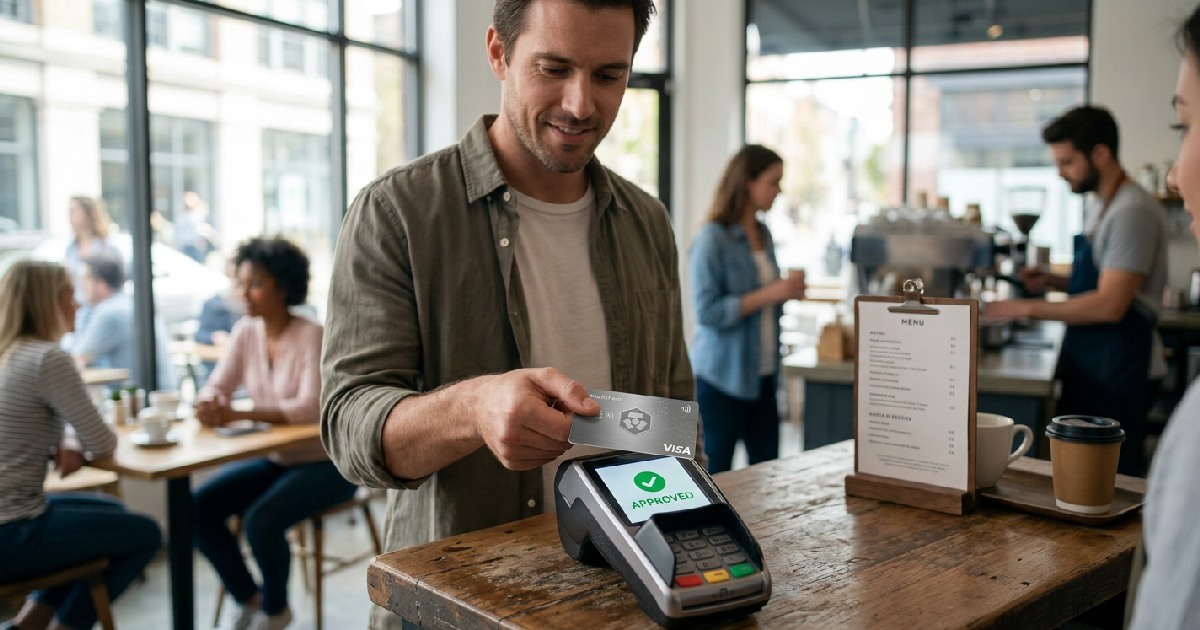

Total crypto card spending has climbed to a record $7.8 billion as of May 28, 2026, marking a 230% increase since the same period last year. Data from Paymentscan reveals that this surge is primarily fueled by the growing utility of stablecoins, which have transitioned from speculative assets into functional daily payment tools. Visa (V) has emerged as the clear market leader, securing approximately 90% of all on-chain crypto card transaction volume.
The shift in consumer behavior is reflected in the rapid performance of specific payment ecosystems. Jupiter Global, a blockchain-integrated system that assists Visa in handling blockchain activities, saw its card spending volume jump 648% over the past two months. This trend indicates that the reduced bitcoin exchange supply may be driving users toward self-custody wallets that allow for seamless retail spending through linked debit and credit cards.
Stablecoins such as USDT and USDC now represent the backbone of this ecosystem. According to Paymentscan, USDT alone dominates 62.5% of the settlement volume. This liquidity allows users to maintain balances in digital dollars and spend them at traditional merchants without needing to manually interact with legacy banks. Analysts at The Kobeissi Letter recently noted that these cards represent the strongest real-world use case for stablecoins to date.
Visa secures massive lead in crypto card market share
Visa’s dominance in the sector follows a period of rapid capture. In late 2023, the payment giant’s share of on-chain volume rose from near-zero to approximately 85-90%. By 2025 and into early 2026, this lead expanded further, with Visa accounting for roughly 95-97% of all tracked crypto card spending. This surge has come at the expense of Mastercard, which saw its share of the market decrease to approximately 3-5% during the same timeframe.
A key factor in this growth is Visa’s partnership with Bridge, a stablecoin infrastructure company owned by the private fintech firm Stripe. The two firms are working to bring stablecoin-linked cards to more than 100 countries by the end of 2026. The program is currently live in 18 markets, including several Latin American nations where currency instability has driven demand for dollar-linked payment options. The initial rollout includes:
- Argentina
- Colombia
- Ecuador
- Mexico
- Peru
- Chile
Future expansions are targeted for Europe, Africa, Asia-Pacific, and the Middle East. These cards allow users to spend balances directly from self-custody wallets like MetaMask and Phantom. By utilizing Visa’s network of 175 million merchant locations, the system provides a bridges between decentralized finance and global commerce.
On-chain settlement replaces traditional fiat conversion
The technical infrastructure supporting these cards is evolving to reduce friction. A recent arrangement between Bridge and Lead Bank enables card transactions to settle directly on-chain in stablecoins. This is a departure from earlier versions of the technology, which required converting digital assets into local fiat currency at the point of sale before the merchant could be paid. As Tether has become a critical funding source for these programs, direct settlement minimizes processing delays and fees.
Consumer data from various regions shows that crypto cards are being used for essential daily needs rather than luxury purchases. When OKX launched its stablecoin card in Europe in early 2026, the company reported that 26% of transactions were for groceries, while 18% occurred at restaurants. Another 13% of volume was attributed to online shopping, suggesting that digital assets are successfully competing with traditional revolving credit for mainstream retail use.
While TRON, BNB Chain, and Solana provide the underlying liquidity for many of these transactions, the focus remains on ease of use. The ability to pay for a coffee or a utility bill with a stablecoin balance, without the volatility associated with assets like Bitcoin, has made these cards an attractive alternative to traditional international payment accounts.
Central banks respond with Project Agorá testing
The rise of private stablecoin card networks has prompted a formal response from the global financial establishment. Seven major central banks and 40 financial firms, including HSBC and MUFG Bank, are currently testing Project Agorá. Led by the Bank for International Settlements (BIS), this initiative explores how to tokenize commercial bank deposits to improve the speed and cost of cross-border settlements.
Project Agorá utilizes distributed ledger technology to enable “atomic settlement.” Early synthetic tests, which did not involve real money, successfully moved tokenized deposits across currencies on a shared ledger. The project aims to modernize the aging correspondent banking system, which remains slow and expensive compared to modern stablecoin rails. The participating central banks currently include:
- Federal Reserve Bank of New York
- Bank of Japan
- Bank of France
- Bank of England
- Bank of Korea
- Bank of Mexico
- Swiss National Bank
As central banks attempt to reclaim market share in the cross-border payment space, private sector actors like Visa and Bridge are continuing their rapid expansion. The record $7.8 billion in spending suggests that for many consumers, the choice between traditional banking and on-chain payments has already been made based on speed and global accessibility.